Self-Improvement and Interesting Knowledge

  • The Art of Manifestation:  Harnessing Belief to Tackle Environmental and Social Turmoil

    The Art of Manifestation:  Harnessing Belief to Tackle Environmental and Social Turmoil

    Belief and faith can move mountains, but they can also cause natural disasters. I always wonder how much certain individuals think about this. I mean, all those people who believe or are at least willing to try to begin believing that thoughts have power and that certain intentions, especially if they are held unyielding over time, can change reality, can alter the objective reality all around us.

    For those who are willing to believe, do they realize that this means that everything in the objective world, in the physical world that they see around them, is the result of their thoughts and intentions? This quite literally means that we create the weather, and I have tried to bring this to light in the past through articles such as ‘the true hockey stick in the equation’

    In this article, I attempted to highlight the possibility that the great instability people have been observing in the weather lately may not be directly caused by human physical interference, but rather the result of the increased human population and the cumulative thoughts and intentions of billions of individuals.
    We create our reality through our thoughts and intentions. On an individual level, we are accountable for the world we perceive, and have the possibility to choose every moment what we will experience next. However, on a mass scale, the aggregate sum of human thought and intention contributes to shaping the environment, and we are directly responsible for the world that unfolds as a result.
    What a daunting statement in one sense. And yet, at the same time, it is also a liberating and incredibly empowering declaration. If you are truly willing to accept the fact that you create your own reality, then you must acknowledge that the collective reality shared by all humanity on this planet is also your responsibility to some extent.

    Just like a raindrop that, on its own, might not realize it’s part of a hurricane, you exist as a unique and separate water bubble falling from the sky. Since you create your reality from the very center of your being, you, in that sense, stand at the center of all creation. You can, from that individual moment, choose to perceive and be a part of a joyful reality free of pollution and natural disasters. However, such movements and directions in an individual’s life do indeed become more challenging if one finds themselves surrounded by people who are dogmatically insistent on seeing only the worst.

    The large majority of the world is not prepared to accept the fact that they create their own reality through their thoughts and intentions. As a result, they refuse to take responsibility for the myriad of thoughts that go through their minds throughout their day. Just imagine how many thoughts you have in one day; try to keep track of the general nature of these thoughts.

    Keeping track of every single thought is, from the average person’s point of view, impossible; however, you can try to pay attention to your moods, and by doing so, you can get a general sense of the nature of your thoughts throughout your day. With a little bit of effort, you may realize that many of your thoughts, perhaps because they are so influenced by the social media around you, may be quite negative. Others might find that they tend to have a more positive attitude. Whatever the case, contemplate at least the general trend of your thoughts and in this way discover, generally speaking, the underlying current that you might be part of.

    Think about the general nature of your thoughts. Think about the thousands of thoughts that you might have in one day, and then imagine all the people around you and the thousands of thoughts that they have. Consider all the thoughts that you might have in this day as a kind of general intention or intent, like a current that leads in one direction generally. Then notice how, in this sense, every single person around you is following a general intent or reality of their own. But being that your own reality attracts you to people who share your reality, again generally speaking, then using the metaphor I have tried to stick to thus far, you are like a raindrop that can slowly move itself across a vast sky and become part of different currents as it falls unerringly from the sky.

    In that way, then, you create the weather patterns around you by being part of a general current. The sum of your thoughts throughout your day moves you in certain directions and attracts you to others who share the same general intent as you. Together, you create a current that is quite literally a kind of weather pattern, and you exist within the cumulative intention that you have all created together.

    Your beliefs and faith do not only create the good things in your life but also the unpleasant things as well. And on a mass level, you create not only a splendid day and clear skies, but you also participate in creating the chaos all around you.

    And you might ask yourself, what am I to do with all this information? I mean, I can’t change the thoughts of others and what they are willing to believe. I am stuck where I am.

    This may seem physically true at the moment, in accordance with your outer physical senses, but you do have the possibility of moving the current of your existence. This does not mean a physical or external move, but it quite literally begins as an internal action. What I mean by this is that, as an individual droplet of water, you must start from the very center of the universe, which is the very center of your being, and begin to control the nature of your current of thoughts. In doing so, you will begin a slow and inevitable move away from any current that you do not want to be part of, and in that way, move internally before any kind of external move can take place.
    It may be difficult for you, depending on where you find yourself at the moment. This is something that is seldom discussed by people who believe in the power of thought to create reality, but the truth is that if you are in the midst of a current of very negative people, then moving away from that current will be harder for you. The intent of others does indeed affect you, and going against the current of what you might perceive to be the world can be difficult in the beginning. You must stand firm in your own beliefs and ideas in the midst of the intention of others. And like a lowly little droplet trying to push its way across a windy sky, you will have to steel your intent and focus on the new reality that you want until you can slowly move in a new direction.

    Again, this is an internal action, rather than an external one. What I mean by this is that you do not need to physically move per se; instead, what you need to do is physically move internally. If you believe in the power of thought to change reality, then you must begin there. You must change your thoughts – the thousands of thoughts you have throughout the day – and, in doing so, change the general intent of your life. This sounds challenging at first, but this is the only true change possible. You are a remarkable being, with the potential to move in the direction you desire, even in the face of great adversity. However, that change will not come from without, and it does not involve any kind of bizarre physical or external action. Instead, you must begin from within because this is the only place where you will truly see any positive and lasting change.

    As you change your current thoughts and beliefs, you will see changes externally manifesting as well. You might not physically move at all, but you may find that many disasters affecting the world no longer affect you as much. A kind of momentum will start building within you, and this internal momentum will propel you – in an impossibly hard-to-define way – to a place where even in the midst of chaos, you remain unaffected by it. It is possible that, over time, you may find yourself physically moving into the best situation for you.

    This world has the possibility of being hell on earth or a true heaven. This is the secret and revelation – hell is here, heaven is here. They are just a breath away; they are just a turn of the head away. It is up to you to choose what you will be a part of, but that choice is not some kind of physical conflict; instead, it is an internal action where you begin to slowly take stock of your inner reality and begin to change yourself from the inside out – always moving in the direction you want to go. There is no judgment here, nor any horrible intent browbeating you to tell you exactly what you’re supposed to do according to whatever dogma. Instead, there is freedom to do whatever you desire. And in doing so, you will discover that your greatest bliss will bring about a positive change to the entire world.
    There are many ways and techniques to begin this change within yourself. I encourage you to explore your personal impulses and seek out those techniques that work best for you. As an inner alchemist, I personally prefer the techniques that are part of my current practice. I have written extensively on this kind of inner alchemy of reality, specifically in books such as ‘Overcoming the Archon through Alchemy.’ I would highly recommend that book to you if you’re interested in understanding the nature of your reality – that lowly raindrop falling from the sky. There, you will find ways to understand the currents of which I speak, and also ways to move in your own individual direction.

  • Historical Recurrence: Understanding the Cycles of History and Its Impact on Human Civilization

    Historical Recurrence: Understanding the Cycles of History and Its Impact on Human Civilization

    Do things repeat themselves? Does the world feel like an ever-turning merry- go-round that seems to be going in circles? Most people in the modern world believe in linear time. They think there is a past they can look back at and remember, as well as a future they can look forward to and try to predict but never fully know until it finally arrives. We are often told that we are evolving, that things are changing, and indeed there does seem to be increasing change and modernization, at least from a technological point of view.

    However, if you look around with a critical eye and have had the possibility of studying the past in some manner, you will notice that in some fundamental ways, the world has not changed very much at all. Interestingly, there seems to be a cyclical nature to everything, including human endeavors across time.

    In a previous article The Cycles of Time, I explored the differences between modern society and past civilizations, particularly those from the medieval period. I mentioned the fact that every era finds itself within its own present moment point, and that moment point creates a new cognitive position that is unique. In that article, I also challenged the notion of linear time and evolution but did concede that there was a type of slow transmutation in people. I did not dive deeply into the reason why human evolution is so slow and so full of ups and downs. I did not want to go to deep into that because this would inevitably lead us to the cyclical looping nature of human reality, which is a very large rabbit hole indeed.

    In this article, I aim to extend the concepts of the cyclical nature of human reality (Historic Recurrence) further, by arguing that despite changes in cognitive positions across time at certain levels, there are inherent building blocks of the human psyche that remain relatively consistent even across vast expanses of history. This homogeneity in people can be referred to as a recording, a cognitive crown of thorns, or a stamp that has been imprinted upon the collective psyche of humanity.

    What this means is that even though cognitive positions of humanity may change across time, there is this underlying recording, or ARCHETYPE, that stays the same. Therefore, a large aspect of the psyche stays the same and is forever present in people, but the expression of those archetypes changes in accordance with different cognitive positions. As such, we have different types of civilizations throughout the ages, meaning that at a certain point in time a new cognitive position in people might have them express those underlying architypes in a certain way, while in a different era these same architypes might be expressed differently. At one point in time, in accordance with a certain cognitive position, a civilization might evolve technologically and express those architypes within them in a certain way, while at another time a more emotionally driven cognitive position might be present and a completely different expression of those same architypes might be expressed. But being that those architypes are deeply imbedded in the psyche, all motion by any one group at any point in time, will eventually lead to the same place, which is in essence an ever- repeating loop. So, there is no significant human evolution or change, just an ever-winding loop, a cage, that does not permit easy escape.

    The Study of Cyclical Patterns

    For centuries, scholars have been captivated by the cyclical patterns evident in human civilizations and history. These interests date back to ancient times, where philosophers such as Plato and Aristotle contemplated the recurring nature of societal progress and decay. More recently, thinkers like Giambattista Vico and Oswald Spengler have built upon these ideas, drawing correlations between the rise and fall of multiple civilizations across time. Many have noticed striking resemblances between modern Western civilization and ancient empires including Rome and Greece, observing comparable patterns of growth, prosperity, decadence, and eventual decline. This cyclical perspective of history contradicts linear notions of advancement, suggesting that societies may undergo foreseeable phases of development, peak, and regression.

    Archetypes and Cyclic Patterns

    To study this cyclical trap that seems to forever take us to a kind of crescendo only to have us crash back down into barbarism, as Robert E. Howard would put it, we could start by understanding the nature of archetypes as they were defined by Carl Jung. Archetypes are universal, archaic symbols and images that derive from the collective unconscious, as proposed by Jung. They exist in both the individual and the collective and go about creating the reality that a person manifests as a single being and as a member of a society.

    These embedded patterns have been placed within the conscious and, at a certain level, within the unconscious. We seem to be driven to repeat endlessly old patterns that create a very limited range of positive and negative outcomes. These outcomes then go about creating a seemingly cyclical human reality, where as individuals and as a collective civilization, we seem to go from periods of great prowess and evolution to periods of deep darkness and utter barbarism.

    Inner Alchemy and Breaking the Cycle

    An inner alchemist is someone who can see that archetypical recording that seems to have been placed in the human psyche. By understanding it and perceiving it directly through their ability to see and use their inner senses, they find that they are able to predict individual and civilizational action. Most importantly, they are able to stand in awe as they see the endless merry-go-round of existence.

    Having seen this endless merry-go-round created by this archetypical recording embedded within the psyche, they then conceive the myriad of cages that are the true nature of human existence. And having seen the many cages, they engage in the act of trying to break out of all of them.

    Historical Recurrence and Eternal Recurrence

    The concept of Eternal Recurrence, as eloquently described by Nietzsche, can be seen as a recurring pattern throughout history. This idea suggests that humanity is trapped in a cycle of creation and destruction, perpetually repeating itself. To escape these psychological traps, one must first acknowledge and accept this eternal recurrence.
    As Nietzsche noted, acknowledging the eternal recurrence allows individuals to develop the resilience necessary to live without resentment or wasted energy, even in an infinite series of lifetimes where this pattern is repeated.
    However, this is merely the initial step. There are methods and strategies to transcend this cycle. One such method is ‘energetic containment’, another is ‘energetic absorption and reabsorption’, and a myriad of other techniques that have been refined by inner alchemists over centuries. I delved into these techniques in my Magnum Opus Trilogy, and I wholeheartedly recommend reading it if you seek to free yourself from the endless cycle of historical recurrence.

    Conclusion

    The concept of historical recurrence challenges the notion of linear progress and suggests that human societies are bound by cyclical patterns. In this article, I propose that the general public will begin to understand this concept of historical or eternal recurrence when they start to recognize the nature of certain aspects of the human psyche and how these embedded patterns shape human reality. These patterns were perhaps best described by Carl Jung when he defined archetypes.

    Archetypes, as Jung conceptualized them, are universal, archaic symbols and images that derive from the collective unconscious. They shape human reality by creating a kind of scaffolding or belief structure blueprint that influences the entire human mind. This mind, guided by these embedded belief structures through the archetypes, then goes about creating both individual reality and the reality of the human collective.

    By studying these patterns, humanity can gain a deeper understanding of not only its past and present but also its future. Recognizing these patterns makes it possible to predict certain future outcomes because patterns of action are likely to be repeated, as these archetypes are deeply ingrained in the mind. Indeed, removing or transcending these archetypes becomes one of the major tasks for anyone trying to break out of the cages created by an endlessly repeating pattern of action that persists throughout a lifetime.

    There are techniques and different practices that have been studied not only by inner alchemists but also by those who have searched for freedom and true spiritual evolution. For example, the concept of Samsara, which can be loosely translated as “wandering” or “cyclic existence,” suggests that by breaking free from attachments and ignorance, we can begin to escape the endless cycles of birth, death, and rebirth.

    In my opinion, the most effective methods I’ve found for overcoming the constraints imposed by archetypes in the mind are those rooted in inner alchemy, which I explore in-depth in my Magnum Opus Trilogy. This trilogy provides practical strategies for transcending these archetypal patterns and attaining liberation from a purely physical existence. I strongly recommend it to anyone seeking alternative ways to break free from the cycle of eternal recurrence.

  • The Enlightenment Rollercoaster: Navigating the Ups and Downs of Spiritual Awakening

    The Enlightenment Rollercoaster: Navigating the Ups and Downs of Spiritual Awakening

    Introduction:

    Embarking on a spiritual journey can be like hopping on a rollercoaster – an exhilarating adventure that’s full of twists and turns, unpredictable moments of joy and excitement, and sometimes downright terrifying drops into the unknown. As you begin this winding path, you may find yourself oscillating between feelings of euphoria and despondency, as if you’re taking two steps forward and one step back on your quest for enlightenment.

    But don’t be fooled – you’re not alone in this journey! Many people before you have traversed the same terrain, navigating the complexities of spiritual awakening with varying degrees of success. In this article, we’ll explore the often-misunderstood process of spiritual awakening, dispelling common myths and shedding light on the mysteries that lie within.

    As you embark on this inner odyssey, it’s essential to be prepared for the unexpected. Spiritual growth is a journey of self-discovery, and like any rollercoaster ride, it’s bound to have its ups and downs. But with the right guidance and mindset, you can learn to navigate the twists and turns of your personal growth, harnessing the power of your inner wisdom to overcome obstacles and reach new heights.

    So, lets strap in because the ride is about to get interesting. The rollercoaster of spiritual awakening awaits – are you ready to take the first step?

    The Enlightenment Myth: Debunking the “Destination” Fallacy

    The pursuit of enlightenment can be an all-consuming passion for many seekers. We’ve been led to believe that it’s a final destination, a cosmic finish line where all struggles cease, and eternal bliss begins. But here’s the truth bomb: enlightenment is not a one-and-done deal. It’s a dynamic, ever-evolving process that requires constant nurturing and attention.

    The “destination” mindset is problematic for several reasons:

    • It creates unrealistic expectations: We’re led to believe that enlightenment is a tangible goal that can be achieved through a specific practice or ritual. This sets us up for disappointment when we don’t immediately achieve the desired state.
    • It leads to frustration and discouragement: When our expectations aren’t met, we may feel like we’ve failed or that we’re not good enough. This can lead to feelings of burnout and discouragement, causing us to abandon our spiritual practices altogether.
    • It ignores the value of the journey itself: In our haste to reach the finish line, we overlook the incredible growth opportunities that arise during the journey. Each step forward is a chance to learn, adapt, and evolve as a person.

    So, why do we perpetuate this myth? Perhaps it’s because we’ve been conditioned to believe in quick fixes and instant gratification. Or maybe it’s because we’re afraid of the unknown and prefer to cling to familiar concepts. Whatever the reason, it’s time to let go of this limiting mindset and embrace the present moment.

    Embracing the journey: Instead of fixating on reaching a mythical end-point, focus on embracing the present moment and the growth opportunities it presents. Remember that even the most enlightened masters continue to learn and evolve. In fact, they often report that their spiritual practices become more profound and nuanced as they mature.

    So, what does this mean for you? It means that your spiritual journey is not a destination to be reached, but rather an ongoing process of discovery and growth. It means that each moment is an opportunity to learn, adapt, and evolve. And it means that the value lies not in achieving some mythical state, but in the journey itself.

    By letting go of our attachment to the “destination” fallacy, we can cultivate a deeper appreciation for the present moment and the incredible growth opportunities it offers. We can learn to cherish each step forward, no matter how small or seemingly insignificant it may seem. And most importantly, we can discover that true fulfillment lies not in reaching some distant goal, but in embracing the journey itself.

    The Backsliding Phenomenon: Two Steps Forward, One Step Back

    The journey to spiritual awakening is often marked by moments of profound insight, followed by periods of regression. If you’ve ever felt like you’ve made significant progress one day, only to wake up feeling like you’re back at square one the next, you’re experiencing what some spiritual teachers call “backsliding.” This phenomenon is not only common but also an essential part of the awakening process.

    Understanding backsliding: Backsliding can occur at any stage of your spiritual journey, whether you’ve been practicing for a few weeks or several years. It’s as if your consciousness has reached a new plateau, only to be challenged by the forces of ego and conditioning. This phenomenon is not a sign of failure, but rather an opportunity for growth and deeper understanding.

    Key points about backsliding:

    • More frequent in the beginning stages of awakening: As you begin your spiritual journey, you may experience more frequent episodes of backsliding as your mind and body adjust to new patterns and habits. This is a natural part of the process, and with patience and persistence, you’ll find that these episodes become less frequent over time.
    • Can occur even after long periods of stability: Just because you’ve experienced a period of relative stability doesn’t mean that backsliding won’t arise again. In fact, it’s often during times of complacency that our egos and conditioning can sneak back in, causing us to regress. This is why it’s essential to maintain a consistent practice and stay mindful of your thoughts and emotions.
    • Serves as a catalyst for deeper growth and understanding: Backsliding may be frustrating at times, but it can also serve as a powerful catalyst for growth. When you’re forced to confront your own limitations and doubts, you’ll develop a greater sense of compassion and understanding towards yourself and others.

    Embracing backsliding: Think of backsliding as spiritual resistance training. Just as muscles grow stronger through cycles of stress and recovery, your consciousness expands through periods of clarity and confusion. By embracing these moments, you can:

    • Develop greater resilience: With each episode of backsliding, you’ll develop a greater sense of resilience and ability to bounce back from setbacks.
    • Cultivate compassion and self-awareness: Backsliding provides an opportunity to explore your own thought patterns and emotions, leading to a deeper understanding of yourself and others.
    • Discover new insights and perspectives: Each time you experience backsliding, you’ll have the chance to re-examine your spiritual practices and gain new insights into the nature of reality.

    Remember that backsliding is an inevitable part of the journey to spiritual awakening. By embracing these moments with patience, compassion, and self-awareness, you can transform them into opportunities for growth and deeper understanding.”

    FAQ: Navigating the Ups and Downs of Spiritual Awakening

    Q1: Is it normal to feel like I’m losing progress?

    A: Absolutely! Fluctuations in awareness are a natural part of the awakening process. These perceived setbacks often pave the way for deeper insights and more stable growth. In fact, many spiritual seekers report experiencing periods of regression as their consciousness expands, allowing them to let go of old patterns and limitations that no longer serve them.

    As you navigate these ups and downs, remember that it’s essential to be patient with yourself and your journey. Spiritual awakening is a process that unfolds at its own pace, and setbacks are an inevitable part of the journey. Instead of getting discouraged, try to view these moments as opportunities for growth and learning.

    Q2: How can I minimize backsliding?

    A: While some backsliding is inevitable, you can reduce its frequency and intensity by:

    • Maintaining a consistent spiritual practice: Regularly setting aside time for meditation, journaling, or other practices can help anchor your spiritual growth and prevent backsliding.
    • Cultivating self-compassion and patience: Treat yourself with kindness and understanding, just as you would a friend who is struggling. Remember that setbacks are a normal part of the journey, and that you have the power to course-correct at any time.
    • Surrounding yourself with supportive, like-minded reality expanding individuals: This process doesn’t have to involve group activity which can be dangerous because it’s sort of like putting a bunch of fish in a barrel, all there together ready for easy picking. Instead, I suggest surrounding yourself with inspirational books, a library of media that inspires you, and constantly searching for new media and new authors that motivate you. In this way you will be led quite naturally to a like-minded world, then you can consider letting certain key people into your oasis.

    Q3: What should I do when I feel like I’ve lost my connection?

    A: Remember that your connection to the divine is never truly lost – it may just be temporarily obscured. Use these moments as opportunities to:

    • Practice mindfulness and present-moment awareness: Focus on the present moment, without judgment or distraction. This can help you reconnect with your inner self and the universe.
    • Reflect on past experiences of connection and clarity: Think back on times when you felt fully connected and engaged with your spiritual path. What were some common themes or practices that helped you access those states? Try to recreate those conditions to regain your connection.
    • Engage in activities that nurture your soul (meditation, nature walks, creative expression): Make time for the things that bring you joy and fulfillment, as these can help you reconnect with your inner wisdom and sense of purpose.

    By acknowledging the natural ups and downs of spiritual awakening and taking proactive steps to maintain your connection, you’ll be better equipped to navigate the twists and turns of your journey.”

    The Journey IS the Destination: Embracing the Process

    The concept that the journey is the destination is often overlooked in our pursuit of spiritual awakening. We tend to focus on the end goal, whether it’s enlightenment, self-realization, or inner peace. However, by doing so, we miss out on the incredible opportunities for growth and transformation that arise along the way.

    Benefits of embracing the journey:

    • Reduced anxiety and frustration: When you stop fixating on the destination and start enjoying the process, you’ll find that your sense of urgency and stress will dissipate.
    • Increased presence and mindfulness: By being present in each moment, you’ll cultivate a deeper sense of awareness and connection to yourself and the world around you.
    • Greater appreciation for the lessons in every experience: Every challenge, triumph, and setback is an opportunity for growth and learning. When you focus on the journey, you’ll begin to see the value in these experiences and appreciate the wisdom they bring.

    Why the journey matters more than the destination:
    The journey itself holds so much significance because it’s where we truly connect with ourselves, others, and the universe. Every moment of every day is an opportunity for growth, learning, and transformation. By embracing this journey, you’ll discover that:

    • Spiritual growth is not a linear process: It’s more like a spiral, where you revisit familiar themes at deeper levels of understanding and integration.
    • The destination is constantly changing: The moment you reach one milestone, the next one appears on the horizon. This keeps you engaged and motivated, as there’s always something new to look forward to.
    • The journey is where true freedom lies: When you stop focusing on external goals and start embracing the present moment, you’ll find a sense of liberation that’s unparalleled.

    Practical tips for embracing the journey:

    1. Practice mindfulness and presence: Take time each day to cultivate awareness in your thoughts, emotions, and physical sensations.
    2. Reframe challenges as opportunities: View difficulties as chances to learn, grow, and develop resilience.
    3. Celebrate small wins: Acknowledge and celebrate your progress along the way, no matter how small it may seem.
    4. Connect with others on similar journeys: Try as best you can to surround yourself with people and media that understand and support your spiritual journey, but learn to be strong enough to stand before all ideologies and memetic mind virus infection. To that end I recommend the book, Overcoming the Archon Through Alchemy.
    5. Embrace imperfection: Recognize that perfection is not the goal; growth and transformation are the ultimate outcomes.

    By embracing the journey as the destination, you’ll discover a profound shift in your perspective and approach to spiritual awakening. You’ll find joy, fulfillment, and a deeper connection to yourself and the world around you.

    The Power of Inner Knowing: Trusting Your Inner Guidance

    One of the most transformative realizations on the spiritual path is that all the wisdom you seek already exists within you. The answers to your deepest questions are not found in external sources but in the quiet whispers of your own heart.

    The importance of inner knowing:

    • Unconditional trust: When you trust your inner guidance, you’ll find a sense of unconditional trust in yourself and the universe.
    • Increased confidence: As you develop a deeper connection with your inner wisdom, you’ll radiate confidence and self-assurance.
    • Clarity and purpose: Your inner knowing will guide you towards your true life’s purpose and provide clarity on the decisions that align with your soul’s path.

    Practical tips for accessing your inner wisdom:

    1. Develop a regular meditation practice: Set aside time each day to quiet your mind, focus inwardly, and listen to the whispers of your heart.
    2. Journal your thoughts and insights: Write down your reflections, observations, and insights from your meditation practice or daily life experiences. This will help you tap into your subconscious mind and gain clarity on your inner guidance.
    3. Pay attention to your intuition and gut feelings: Learn to trust your instincts and listen to the subtle nudges that guide you towards your highest good.
    4. Create space for silence and reflection in your daily life.

    The Illusion of Separation: Recognizing Your Interconnectedness

    At the heart of our collective human experience lies a profound realization – one that has the power to transform our understanding of ourselves, others, and the world around us. This is the recognition that we are not isolated beings, disconnected from each other and the universe, but rather an intricate part of a vast web of life.

    This epiphany dissolves the illusion of separation, revealing a reality where every thought, action, and emotion has a ripple effect on the entire cosmos. It is this interconnectedness that holds the key to a more compassionate, harmonious way of being – one in which we move through life with a sense of unity and shared responsibility.

    Ways to cultivate a deeper understanding of interconnectedness:

    • Spend time in nature, observing the intricate web of life that surrounds us – from the tiniest microbe to the vast expanse of the universe
    • Study the use of the inner feeling sense and personal intuition, uncovering the secrets that reveal our interconnectedness with all that exists

    As we embody this truth of interconnectedness, we begin to see the world through new eyes. The fluctuations in our spiritual journeys become less dramatic and more integrated into our overall growth, allowing us to move forward with a sense of clarity, purpose, and unity. In this way, we can co-create a world that is more harmonious – one where every individual has the opportunity to thrive.

    The Eternal Now: Everything Has Already Happened

    Here’s a mind-bending concept to ponder: from the perspective of the eternal present moment, everything that is to happen has already happened. This realization can free you from the anxiety of constantly striving for future attainment and allow you to fully embrace the perfection of the present moment.

    Practical applications of the “eternal now” concept:

    • Let go of worrying about future outcomes
    • Release regrets about the past
    • Fully engage with and appreciate the present moment
    • Trust in the divine unfolding of your life’s journey

    By aligning yourself with the eternal now, you tap into a wellspring of peace, joy, and unlimited potential.

    Conclusion:

    As our enlightening exploration comes to an end 🙂
    it’s crucial to remember that the spiritual journey will never end; it isn’t about reaching a final destination it’s about the ride itself!
    For that reason, you must start right now to embrace the beautiful, messy, and transformative process of awakening. It’s vital to understand that backsliding, doubts, and moments of disconnection are not obstacles to overcome but integral parts of your growth.

    By trusting your inner wisdom, recognizing your interconnectedness with all of life, and anchoring yourself in the eternal present moment, you open yourself up to the profound grace that has been within you all along. This realization is essential because it reminds us that enlightenment isn’t a destination we can reach; instead, it’s an ongoing journey of self-discovery and growth for a being that is already far more than it could ever imagine.

    So, next time when life throws you into the turbulent rides through the twists and turns of what seems like an enlightenment rollercoaster, remember to take a deep breath, smile, and embrace everything. Each challenge and triumph along the way is part of this incredible ride called life. Embrace the journey, trust the process, expand your consciousness, and move closer towards embodying your true, radiant self with each twist and turn.

    You can never finally be enlightened because you are in many ways infinite and the universe itself is constantly expanding, forever growing. We don’t live in a closed system. Contrary to popular opinion we don’t live in an entropic and closed world, we don’t live in hell. The reality is that we are already in heaven, an open system that is forever expanding and growing to become more itself. All you have to do is finally realize who you are and where you are.

    If you don’t know where to begin this journey to Spiritual Awakening , then may I suggest, The Magnum Opus Trilogy.

  • The Solo Journey of the Inner Alchemist: Finding True Creativity and Personal Growth Amidst the Chaos

    The Solo Journey of the Inner Alchemist: Finding True Creativity and Personal Growth Amidst the Chaos

    In today’s fast-paced world, it’s all too easy to feel lost in the noise of societal expectations and the constant pressure to conform. For those seeking personal growth and self-discovery, this feeling can be especially pronounced. Yet, what if the answer doesn’t lie in the external world of shared experiences and societal involvement, but within the depths of our own being?

    This is the concept of inner alchemy, a practice steeped in the traditions of alchemy and personal transformation. Inner alchemy tells us to delve deep within ourselves and uncover the hidden treasures that lie within. This journey is not for the faint of heart, but it offers a unique reward – the opportunity to become more oneself, to shine a radiant inner light that can take us to incalculable places and even inspire and deepen the journeys of others.

    A. The Intensity and Radiance of the Inner Alchemist’s Journey

    The inner alchemist’s journey is an artistic quest for self-discovery and transformation, a courageous venture into the uncharted territories of our own minds. It’s an exploration into the depths of our consciousness, where we uncover the hidden aspects of our psyche, the whispers of our soul, and the secrets of our own unique essence. As we delve deeper into the labyrinth of our own being, we begin to unravel the tangled threads of our thoughts, emotions, and desires, revealing the intricate patterns and designs that shape our lives.

    With each step, the intensity of our inner journey increases, like a flame burning brighter with each passing moment. The more we confront and transcend our fears, doubts, and limitations, the more radiant our inner light becomes. This light is not just a flicker of insight or a flash of inspiration, but a steady, pulsing glow that illuminates our path and guides us towards our highest potential. The deeper we delve, the more our inner radiance intensifies, casting a warm, golden light upon our surroundings, nourishing and illuminating all that we touch.

    As we continue on this journey of self-discovery, we begin to realize that our inner alchemy is not just a process of personal transformation, but a gift to the world. Our unique blend of experiences, perspectives, and passions becomes a catalyst for creativity, innovation, and positive change. Our inner light shines brighter, hopefully illuminating the path for a select ‘few’ others to follow, and our presence becomes a beacon of hope and inspiration in a world that often needs it. The intensity and radiance of the inner alchemist’s journey is a journey that never ends, a lifelong process of growth, evolution, and transformation, as we continue to uncover, refine, and share our inner gold with the world.”

    B. The Solo Journey: Embracing the Inner Alchemist’s Path

    Our journey as inner alchemists may be a solo one, but it’s a necessary part of the process, a crucial step towards awakening our true potential. By embracing our inner light and focusing on our personal growth, we create a space for true self-expression and transformation. We become beacons of inspiration, shining our light for those who will benefit from it, and in doing so, we not only illuminate our own path but also provide a guiding force for others to follow.

    Inspiration breeds inspiration, and one individual’s journey may deepen the depths of another’s. A single spark can ignite a wildfire of creativity, innovation, and progress. However, it’s essential to remember that the way of the inner alchemist is not one of shunning the world but of becoming more oneself. It’s not about hiding away from others, but about cultivating a sense of authenticity and integrity that radiates from within.

    And, of course, this comes with the caveat of knowing that one must be very careful in our dealings with others and the memetic wars they engage in. In a world where external validation and social comparison often reign supreme, it’s easy to get caught up in the whirlpool of other people’s opinions and lose sight of our own inner guidance. But the inner alchemist knows that true power lies not in conforming to external expectations, but in staying true to one’s own inner truth.

    As we embark on this solo journey, we must be willing to confront our own shadows, our deepest fears, and our darkest insecurities. We must be willing to look within, to listen to our own inner wisdom, and to trust our own inner guidance. And in doing so, we will discover that the greatest magic lies not in the external world, but in the depths of our own souls. Our inner alchemist’s path is not one of isolation, but of connection with our own true selves, and from this place of inner harmony, we can radiate our unique light into the world, inspiring others to do the same.

    C. Memetic Wars: Navigating the Battlegrounds of the Mundane

    The world outside can be a distraction, filled with memetic wars – ideological battles that often result in dogma, repetition, and the banal. It’s a world where people are more likely to get caught up in the latest trends, memes, and ideologies, rather than seeking authentic connection and growth. As inner alchemists, we must navigate this terrain with care, protecting our inner light and focusing on our personal growth.

    The memetic wars are a constant barrage of stimuli, designed to shape our thoughts, emotions, and beliefs. They can be overwhelming, and it’s easy to get caught up in the vortex of other people’s opinions and perspectives. But the inner alchemist knows that true power lies not in conforming to external expectations, but in staying true to one’s own inner truth.

    In this world of memetic wars, most people seek dogma, seeking answers and validation from external sources rather than within themselves. They crave certainty and stability, and are often willing to trade their autonomy and creativity for the fleeting comfort of conformity. But the inner alchemist must seek true creative expression, not just intellectual understanding or superficial agreement.

    We must be discerning in our interactions with others, seeking out those who fly higher than the average person, true individuals who share our commitment to authentic self-discovery and transformation. These individuals are rare, but they can be found in unexpected places.

    The memetic wars are a test of our resolve, a gauntlet thrown by the external world to see if we will stay true to ourselves. Will we conform to the norms of society, or will we forge our own path, guided by our own inner light? The choice is ours, and the stakes are high. But for those who choose to navigate the memetic wars with care, the rewards are immeasurable – a deeper connection to our own true selves, and a radiant light that shines brighter with each passing day.

    D. Seeking Out True Creators: Finding Rare Birds

    The company we keep plays a crucial role in our personal growth and transformation. It’s a truism that we are shaped by the people we surround ourselves with, and yet, it’s often overlooked in our haste to achieve success and recognition. By seeking out true creators – those who are beyond the dogma, the repetitive, the common, the NPCs – we find kindred spirits who can inspire and challenge us.

    These rare birds are the pioneers, the trailblazers, the game-changers. They are the ones who refuse to conform to the status quo, who challenge the norms, and who push the boundaries of what is possible. They are the ones who are driven by a burning passion, a sense of purpose, and a desire to shine like gorgeous stars in the sometimes-dark sea of reality.

    When we surround ourselves with these true creators, we find ourselves inspired and motivated. We begin to see the world in a new light, as a vast expanse of possibility and potential. We start to feel a sense of excitement and anticipation, as we realize that anything is possible, and that we have the power to shape our own destiny.

    These rare birds help us soar to new heights and deepen our understanding of ourselves and the universe. They challenge our assumptions, our biases, and our limitations. They encourage us to take risks, to experiment, and to push beyond our comfort zones. And in doing so, they help us to unlock our full potential, to tap into our inner strength and creativity, and to live a life that is authentic, meaningful, and fulfilling.

    So, how do we find these rare birds? How do we attract them into our lives, and how do we nurture and cultivate our relationships with them? It starts with being open, receptive, and willing to take risks. It starts with being willing to step outside our comfort zones, to explore new horizons, and to connect with people who share our passions and values.

    It’s not always easy, and it’s not always comfortable. But the rewards are immeasurable. When we surround ourselves with true creators, we find ourselves growing, evolving, and transforming in ways that we never thought possible. We find ourselves becoming the best version of ourselves, and we find ourselves living a life that is rich, meaningful, and fulfilling.

    E. The Importance of Solitude: Cultivating Inner Refuge

    Solitude is a powerful tool for the inner alchemist. In a world that is increasingly noisy, crowded, and distracting, it is essential to carve out space for quiet reflection and inner exploration. By doing so, we deepen our connection to our inner light and accelerate our personal growth and transformation.

    Solitude is not about isolation or loneliness; it’s about creating a sense of inner refuge, a sanctuary where we can retreat from the chaos of the external world and reconnect with our true selves. It’s about finding silence in the midst of noise, stillness in the midst of turmoil, and clarity in the midst of confusion.

    In solitude, we can tune in to our inner wisdom and intuition, allowing us to guide ourselves on our journey of personal growth and transformation. We can listen to our own inner voice, untainted by the opinions and expectations of others. We can explore our own thoughts, emotions, and desires, without the distractions and interruptions of the external world.

    Solitude also allows us to recharge and rejuvenate, refilling our inner wellspring of energy and vitality. It’s a chance to disconnect from the constant demands and expectations of others, and reconnect with our own needs and desires. It’s a time to rest, relax, and rejuvenate, allowing our minds, bodies, and spirits to heal and renew.

    The importance of solitude cannot be overstated. In a world that is increasingly fast-paced and frenetic, it’s easy to get caught up in the whirlwind of activity and forget to slow down, reflect, and recharge. But the inner alchemist knows that solitude is a necessary ingredient for growth, transformation, and inner peace.

    By making solitude a priority, we can cultivate a deeper sense of inner connection, clarity, and purpose. We can tap into our inner wisdom and intuition, guiding us on our journey of personal growth and transformation. And we can emerge from our solitude feeling refreshed, renewed, and revitalized, ready to tackle the challenges of the world with greater ease, confidence, and inner peace.

    F. The Power of Authentic Self-Expression: Sharing the Fruits of Our Labor

    As we continue on our inner alchemist’ journey, we may feel compelled to share the fruits of our labor with the world. We may feel an overwhelming desire to express our creativity, share our insights, and connect with others who resonate with our unique perspective. And yet, it’s essential to remember that our primary audience is ourselves and those rare individuals who will truly benefit from our creative expression.

    These individuals are the kindred spirits, the fellow travelers on the path of personal growth and transformation. They are the ones who will appreciate our authenticity, our vulnerability, and our willingness to take risks. They are the ones who will resonate with our unique frequency, and who will amplify our energy and our message.

    But we must be mindful of the memetic wars and the potential for our work to be co-opted or diluted by those who don’t share our commitment to authentic self-expression. We must be cautious of those who would seek to water down our message, to manipulate our intentions, or to use our creativity for their own gain.

    Instead, we must stay true to ourselves, and to our own unique vision. We must stay committed to our own inner guidance, and to the integrity of our creative expression. We must trust that our work will find its way to those who need it most, and that our impact will be felt in the world.

    When we share the fruits of our labor with the world, we must do so with intention, with integrity, and with a deep connection to our own inner truth. We must be mindful of the energy we are putting out into the world, and of the potential impact it may have on others. And we must be willing to adapt, to evolve, and to refine our message as we continue on our journey.

    Ultimately, the power of authentic self-expression is not just about sharing our creativity with the world, but about staying true to ourselves in the process. It’s about honoring our own unique path, and respecting the sacredness of our own creative expression. And it’s about trusting that our work will have a profound impact on the world, even as we stay grounded in our own inner wisdom and intuition.

    G. The Transformative Power of the Inner Alchemist’ Journey

    The inner alchemist’s journey is a transformative process, one that requires courage, resilience, and a deep commitment to authentic self-discovery. It’s a journey that leads us to the depths of our consciousness, where we unearth the hidden treasures that lie within. As we delve deeper into the mysteries of our own minds and hearts, we begin to uncover the secrets of our true nature and the potential that lies within us.

    By embracing our inner light and seeking out true creators, we deepen our understanding of ourselves and the world around us. We begin to see the world through new eyes, with a fresh perspective and a renewed sense of purpose. We start to recognize the interconnectedness of all things, and the ways in which we are all part of a larger web of life.

    As we continue on this journey, we discover that the transformative power of the inner alchemist’s journey is not just about personal growth and transformation, but also about the intensity of the light within us and how this light can impact the world.

    The transformative power of the inner alchemist’s journey is a gift that keeps giving. It’s a process that never truly ends, but one that continues to unfold and evolve as we continue to grow and learn. And as we share our inner light in the form of personal and unique art, by bringing what is within us without, we inspire others to embark on their own journey of self-discovery and transformation.

    As you progress on your own inner alchemist’s journey, remember that you are not alone. Embrace your inner light, seek out true creators, and trust in the power of your own creative expression. And, above all, remain committed to your personal growth and transformation, for it is through this journey that you will find true release and fulfillment.

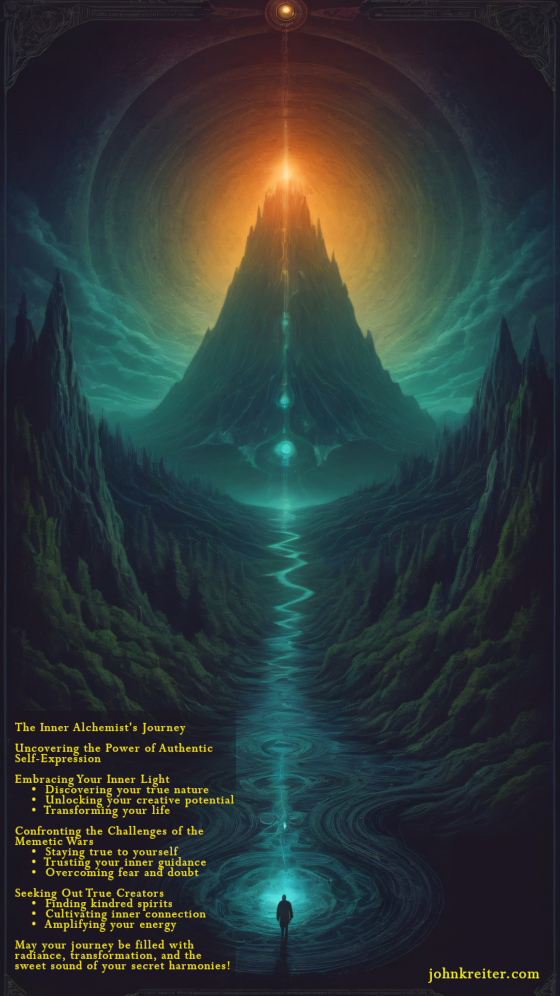
    The inner alchemist’s journey is a solo journey, one that requires a deep commitment to authentic self-expression and a willingness to navigate the challenges of the memetic wars. By embracing our inner light and seeking out true creators, we deepen our understanding of ourselves and the universe, and inspire others to do the same. May your journey be filled with radiance, transformation, and the sweet sound of your secret harmonies.


  • Simulation theory, older religions, concepts of a multiverse

    This is my response to a question that someone asked. I found the question so interesting that I decided to post it as a new article. It’s not my hope to offend any religiously minded people, as I do not question the validity of such beliefs. Rather, it is my hope to provide an inner alchemist’s perspective on the ever-developing expanse within us, and how we try to come to terms with it.

    The question is as follows:

    Hi John
    Thanks for posting this article and the link:

    I think it perfectly mirrors your own ambition to tell your readers not to take anything (especially words and their interpretation) for granted. However, I have a question about the micro and macro that is also covered in this video: I currently feel that the simulation theory deserves a lot of credit as it gives potential explanations for otherwise rather mysterious theories (what is often referred to as “science” without giving actual proof). What is your opinion on the simulation theory? As I am reading your book about OBEs currently, I was wondering if by having one we might exit this sim and enter a parallel one instead. And the Archon for example might be the adversary (role) player that makes our experience in this simulation (and others) challenging and worthwhile so we can grow spiritually. In other words, the collective reality is given for our individual (alchemical) transformation to take place – which leads back to “there is nothing to change but self”. I would love to hear your opinion about this?

    My response:

    I find the simulation theory to be a very interesting way for modern people to try to grasp the incredible magnitude of what I refer to as the dark sea.

    I have found that every human age has a certain way of classifying and judging the beliefs of its time. What I mean is that every age has its own version of theology, its own religious framework. By religious framework, I mean the way a certain society within a particular window of time is able to truly come to terms with and explore realities and experiences that are at the fringe of personal belief as individuals and as a society.

    To the individuals of that time, those terms and the way they map out reality need to be credible. Accepted beliefs are incredibly important here.

    For people to believe something is real, those things need to be explained using terms and theories that are in complete alignment with the current facts of the time, and each window in time accepts only certain things to be facts.

    Due to the “fact” that the outer senses can only perceive time as a linear event, the beliefs (that is, the facts) of a certain historic period seem to be cutting edge, meaning that everything that preceded this particular time (the past) is inferior, and what is in the future is better, more right, more evolved. What I’m trying to say here is that simulation theory is not a new concept; it is just the newest way to conceptualize (and for some, to utterly believe in) the newest fact framework of the time. For some, this new theory is an interesting way to conceptualize greater possibilities, but in time (for some, already), the simulation theory is already fact. We may be witnessing the birth of a new religion using the current “all is science” framework.

    In the past, other windows in time had different words for simulation theory, and there were certainly slight alterations in those general theories as proposed by those people at that time. For example, we could say that the Christian doctrine is one such theory that became utter fact for a time. Interestingly, even though it is for the most part overlooked in this modern time, that old theology had its own kind of science that was quite valid and quite useful to the people of the time. And if we were to take measure for measure, as to which is more helpful to people, there were actually great benefits to that old science, just like there are benefits to this new one. And while that old science did not function in a generally technological kind of way like this new science that now posits simulation theory, that old science functioned through more internal methods that were quite valid and useful to people in medieval Europe, for example.

    Certainly, from the modern perspective, being that we humans perceive time as a linear event, and being that psychologically such a framework of perception makes it seem like the past is inferior while the future is cutting edge, that past version of simulation theory seems wrong and can never answer the questions of a modern belief framework.

    So, modern simulation theory is the current theology; it is an attempt, a scientific attempt, at tackling the nature of the psyche, or what the Christian framework might have called the soul.

    With all that in mind, I find the modern simulation theory incredibly interesting. And being a modern person myself, I am greatly interested in the new technological versions of a systematic theology.

    If anything, perhaps this new theology will allow others, perhaps through the use of virtual reality, let us say, instead of “Ignatian meditation”, to explore such profound revelations for themselves in a different way.

    Interestingly, you are studying a book on a very old way (astral projection) of exploring the incredibly mind-bending properties of our shared reality. The problem comes, of course, when theory turns into fact in the minds of the practitioners, and certain interpretations of deep experiences while exploring that outer edge of the dark sea are taken to be unassailable fact. That is when theory becomes theology.

    And if you doubt the power of the mass of humanity to turn science into theology, then all you have to do is look at these past few years to see just how certain health practices were initiated worldwide.

    The simulation is an incredibly interesting theory that is actually as old as time, and I encourage you to try to see the connection between this current idea of a simulation and past ideas and traditions. You may, for example, be interested in the connection between modern ideas of an adversarial character in a Sim and the accuser or the adversary in old Hebrew.

    But whatever you do, it is my hope that you begin to trust your inner knowing as opposed to outer dogma, whether that is the modern science of the times or a past one. What do I mean by this? Well, I hope that in the future you might ‘see’ that there is no difference between science trying to prove simulation theory and Thomas Aquinas trying to prove whether an angel moving from A to B passes through the points in between.

  • Terence Howard, Eric Weinstein, and the problem with experts

    I. Introduction

    The world of science and innovation is a captivating territory, teeming with revolutionary discoveries that appear to be unfolding at an exponential rate. I’ve mentioned in previous articles that the world is experiencing a quickening, which translates to an escalating pace of innovation and advancements across all domains. However, this landscape is not without its challenges, as the tension between established experts and innovative thinkers can lead to contentious debates and disagreements.

    As the world accelerates, and the traditional order begins to creak under the pressure of the relentless pace of change, such clashes between the past and the future are bound to become more prevalent. In this article, I intend to highlight a graphic example of this dynamic by exploring a recent Joe Rogan Podcast featuring Eric Weinstein, a renowned mathematician and theoretical physicist, and Terrence Howard, an actor and self-proclaimed innovator, and their different viewpoints on the prospect of new discoveries in mathematics.

    Weinstein, an esteemed figure in the scientific community, has been known for his skepticism towards the likelihood of significant mathematical discoveries. His perspective, shared by some experts, highlights the challenges that come with pushing the boundaries of knowledge and the importance of relying on established principles and methodologies.

    The Joe Rogan podcast played host to an intriguing debate between Weinstein and Howard, where their contrasting intellectual approaches were brought to the forefront. Howard, a self-taught mathematician, claimed to have made groundbreaking discoveries in the field. However, Weinstein questioned the validity of Howard’s claims, citing the improbability of new mathematical discoveries and challenging Howard’s use of terminology and understanding of fundamental concepts.

    This article explores the core issues of their debate, including disagreements on scientific terminology, contrasting views on mathematical understanding, differing perspectives on proof and evidence, and the clash of intellectual approaches. While I do not agree with much of what Terrence Howard has proposed, I find his theories challenging and intriguing. His ability to bring light to older ideas on geometry and vibratory science is worth a deep investigation.

    Most importantly, this debate outlines the difficulty in pushing through the bureaucratic mess that modern science has become. Going forward, it is my hope that we can find a sober solution to the problems between established experts and innovative thinkers. However, as is usual for the race, what we will most likely encounter is a slow civil war where old bureaucracies will slowly fall due to their inadequacy.

    I would personally like to avoid this kind of slow entropic war, as it has the potential to lead us into a new Dark Age. With that in mind, I have called for the development of what I refer to as a mind science – one that could incorporate internal perceptions and intuitions, like those Howard may have access to, and rigorous, truly open exploration of those insights by scientists willing to explore new possibilities openly.

    II. Historical Examples of Geniuses Challenging the Status Quo

    The tension between established experts and innovative thinkers is not a new phenomenon. Throughout history, there have been numerous instances where groundbreaking thinkers faced resistance and skepticism from the scientific community of their time. I want to highlight just two people, perhaps among the most famous in the long list of individuals who dared to challenge the accepted beliefs of their time. In this list, I could have included figures such as Nikolai Tesla and Wilhelm Reich, who not only faced ridicule but were also punished and had their work stolen.

    1. Galileo Galilei (1564-1642): A pioneer in observational astronomy, Galileo challenged the prevailing geocentric model, which held that the Earth was at the center of the universe. His observations and discoveries, such as the moons of Jupiter, provided empirical evidence for the heliocentric model proposed by Copernicus. Despite facing significant opposition and even being placed under house arrest by the Catholic Church, Galileo’s work laid the foundation for modern astronomy.
    2. Albert Einstein (1879-1955): Einstein’s revolutionary theories of relativity challenged the classical view of physics, particularly Newtonian mechanics. His theory of general relativity, which describes the large-scale structure of the universe, fundamentally altered our understanding of space and time. Initially dismissed by many in the scientific community, Einstein’s theories ultimately gained acceptance and have become the cornerstone of modern physics.

    These historical examples demonstrate the importance of challenging established norms and pushing the boundaries of knowledge, even in the face of skepticism and resistance. Whenever you hear someone say it’s very unlikely that an innovative person can make a contribution in a particular field, you know you’re dealing with someone whose reality tunnel has shrunk to allow only for certain narrow possibilities. They have literally erected a cage around themselves; their beliefs do not permit them to see beyond the walls of their belief structures. The stories of Galileo, Einstein, and other powerful innovators remind us that the path to innovation is often fraught with challenges. In the best of cases, these rebellious insights can lead to groundbreaking discoveries that reshape the world, but often, these discoveries are buried and later abused by elite groups.

    It’s my hope that we, as a large group of aware people, can become conscious of and challenge those halls of established authority. And I do feel that this is happening. The sanctioned technology of the world has thankfully reached a point where it allows many more people to communicate, experiment, and think about groundbreaking new (and old) sciences and possibilities. I am very optimistic about our potential future.

    When faced with such hardheaded skepticism, like the kind often seen in academic halls, I often wonder if late at night these academics can truly grasp just how small they are. I wonder if their empathy allows them to face the fact that humanity is tiny in the face of the infinity that surrounds us.

    I don’t wish to indulge in Lovecraftian sentiment, but we are indeed insignificant in the face of the vast cosmos that surrounds us. This is obvious to anyone with empathy, and yet we constantly hear a message from the academic body, which boils down to: ‘I truly doubt that your theories have anything new to offer; we’ve figured most of it out by now, and your views don’t fit into our framework.’ Such a superior, self-important stance is, in my opinion, shortsighted.

    III. The Weinstein-Howard Debate: A Case Study

    The Weinstein-Howard debate, taking place on the Joe Rogan podcast, offers a compelling modern-day illustration of the tension between established experts and innovative thinkers. In this section, I will summarize what I feel were the key points of contention between the two figures and analyze how their exchange reflects the broader tension between defending established knowledge and proposing unconventional ideas.

    • Weinstein’s Position:

    Eric Weinstein, an accomplished mathematician and theoretical physicist, emphasized his credentials as an expert and the importance of adhering to established scientific terminology and principles. He argued that Terrence Howard’s use of terms like “supersymmetry” was misleading and potentially damaging to the scientific discourse. Weinstein also expressed skepticism about Howard’s claims, citing the low probability of making groundbreaking mathematical discoveries as a reason for his skepticism.

    • Howard’s Position:

    Terrence Howard positioned himself as an innovative thinker, even if his approach was unconventional. He attempted to explain his theories using a mix of scientific and less conventional language, which often led to misunderstandings and frustration from Weinstein. Howard also referred to his patents as potential evidence for his claims, despite Weinstein’s disagreement on their relevance to the scientific debate.

    • Analyzing the Debate:

    The Weinstein-Howard debate serves as a microcosm of the broader tension between experts defending established knowledge and innovators proposing unconventional ideas. Weinstein’s emphasis on established scientific terminology and principles represents the importance of maintaining rigorous standards in the scientific community. However, his skepticism towards Howard’s claims also highlights the challenges of evaluating the validity of unconventional ideas and the potential risks of dismissing them outright. In trying to defend terms that stem from the academic need to support the legitimacy of prior theories (which may at times become erroneously taken as facts by some scientists), we finally face the true reason why it is almost impossible to communicate new theories with the old guard. Essentially, they must defend prior foundational beliefs because if these fall, their castle falls as well.

    Howard’s innovative approach showcases the value of pushing the boundaries of knowledge and the importance of openness to new ideas. Yet, his use of unconventional language and reluctance to engage with established scientific discourse was and will always be the breaking point between the old guard and truly new and innovative thinkers. To engage in the discourse that such an established old guard is after, the innovator needs to become part of the academic circle, which then presupposes getting the ‘correct’ academic ‘training’ and credentials, which can take a lifetime. If this sounds like a bit of a catch-22, then you have hit the old academic defense strategy, square in the head.

    So, people like Einstein, with the help of Ernst Gabor Straus and many others, were able to turn brilliance into understandable academic language, being that he was an academic himself; but those without such credentials have little chance to change the established order. Their only chance is to hopefully make new engineering discoveries like Tesla, and then hope that these patents aren’t stolen or suppressed.

    Ultimately, the Weinstein-Howard debate underscores the importance of fostering a balanced approach to scientific discovery, one that values both the rigor of established knowledge and the potential of innovative ideas. In the following section, we will explore the implications of this debate and the lessons it offers for the future of scientific discourse.

    IV. The Role of Expertise and the Potential for Innovation

    The Weinstein-Howard debate highlights the importance of both expertise and openness to new ideas in the scientific community. In this section, we will discuss the role of expertise, the value of questioning established paradigms, the potential pitfalls of dismissing unconventional theories, and the possibility of breakthroughs in various fields, using Weinstein’s acknowledgement of innovation in engineering as an illustrative example.

    • The Importance of Expertise:

    Expertise plays a crucial role in maintaining rigor within scientific fields by ensuring that research is based on a solid foundation of knowledge. Experts bring a deep understanding of the underlying principles and methodologies, enabling them to evaluate new ideas critically and contribute to the ongoing development of their fields.

    • The Value of Openness to New Ideas:

    Openness to new ideas is equally important for scientific progress. Challenging established paradigms and exploring unconventional theories can lead to groundbreaking discoveries and advancements. As history has shown us, many revolutionary ideas were initially met with skepticism, but ultimately transformed the way we understand the world.

    • The Pitfalls of Dismissing Unconventional Theories:

    Dismissing unconventional theories solely based on their conflict with current understanding can limit our potential for discovery. By closing ourselves off to new ideas, we risk overlooking potential breakthroughs and missing opportunities to advance our knowledge. Weinstein’s skepticism towards Terrence Howard’s claims serves as a reminder of the importance of carefully evaluating unconventional ideas while remaining open to the possibility of their validity.

    • The Possibility of Breakthroughs in Various Fields:

    Weinstein’s acknowledgement of innovation in engineering, particularly the development of the Rubik’s Cube, illustrates the potential for breakthroughs in various fields. The Rubik’s Cube, initially an unconventional puzzle, ultimately led to significant advancements in mathematics, computer science, and even robotics. This example demonstrates how seemingly unconventional ideas can ultimately contribute to the development of established scientific fields.

    Howard brought up the Rubik’s Cube on several occasions during the debate to try to highlight his point that a simple toy could revolutionize science and actually change mathematics, but this key point was largely brushed aside I feel,  with the true understanding of what he was trying to say going unheeded.

    How many know that Tesla was awarded the patent for remote control in 1888? At the time, this patent was considered a novelty and mostly ignored. Very few people saw the change that such an invention would herald. And now Tesla’s original idea has been used to change many aspects of the world, without much credit given to him personally.

    The Weinstein-Howard debate underscores the importance of both expertise and openness to new ideas in scientific progress. While expertise maintains rigor and ensures the solid foundation of scientific knowledge, openness to new ideas pushes the boundaries of understanding and drives innovation. By acknowledging the potential for breakthroughs in various fields, we can learn to participate in the delicate balance between adhering to established norms and embracing unconventional theories.

    This will be crucial in navigating and staying afloat as the world speeds up at an alarming rate. If we cannot do this, I fear that we may fall into a new Dark Age as academia in its current form is erased from the world.

    V. Navigating the Divide: Fostering Innovation While Upholding Scientific Rigor

    The Weinstein-Howard debate highlights the importance of finding a balance between fostering innovation and maintaining scientific rigor. For that reason, I will propose some possible strategies for encouraging innovation while upholding scientific rigor, emphasizing the crucial role of a balanced approach in scientific progress.

    • Encouraging Open Dialogue:

    One strategy for fostering innovation while maintaining scientific rigor is encouraging open dialogue between experts and innovative thinkers. This can be achieved through platforms like academic conferences, workshops, and collaborative research projects. In this regard, the Joe Rogan Podcast cannot be overestimated in its importance and cutting-edge approach.

    By providing opportunities for discussion and collaboration, we can create an environment where innovative thinkers can challenge conventional ideas and experts can flesh out these new possibilities using rigorous logic.

    • Encouraging Interdisciplinary Collaboration:

    Interdisciplinary collaboration can help bridge the gap between established and innovative ideas by bringing together diverse perspectives and expertise. Encouraging collaboration between experts in various fields can lead to novel insights and breakthroughs, as well as a deeper understanding of the implications of unconventional theories.

    With that in mind, I feel that this is a very important point to make in this article:

    Mathematics is not THE language of the universe; it is one of many possible languages of the universe. Once some academics realize this, true innovation may begin.

    • Embracing a Culture of truly Logical Calculation and Open-Mindedness:

    A culture that values both true logic and open-mindedness is crucial for scientific progress. Some argue that all science needs to be skeptical, using the term “skepticism” quite openly. In my opinion, such a term and methodology, as it is commonly understood, is incorrect. To be a skeptic is to disbelieve, and to disbelieve is to have already taken a side. For an inner alchemist, it is better to strive to be logical and use calculation and one’s own direct perception in order to redefine the likelihoods of any existing possibility, in accordance with whatever operating theater is being studied.

    So, from the inner alchemist’s logical framework, the term “skepticism” or the act of it, of being a skeptic, is really a sign of poor thinking. To truly understand the potential of any phenomenon to exist within any particular field, the possibilities of its existence and nonexistence must be examined in equal measure. To do otherwise is to fall prey to the simplistic ideas of Occam’s Razor, which have never been equal to the grandiose nature of the infinity that surrounds us. By fostering a culture that encourages both strong logical calculation and intuitive projections of perception, we can create an environment where innovation and scientific rigor coexist.

    • Investing in Education and Training:

    Investing in education and training can help equip the next generation of scientists with the skills and knowledge necessary to navigate the divide between established and innovative ideas. Providing opportunities for interdisciplinary learning, critical thinking, and problem-solving, as well as the use of mental disciplines like the inner senses and mental projection, can help students develop the ability to engage with new ideas while maintaining a solid foundation in established scientific knowledge.

    While these are just simple and preliminary ideas, they may start us on a better journey. Of greatest importance, I would passionately advocate for the development of what I refer to as Mind Science – being that this is really the only way to overcome the power of artificial super intelligence and its ability to dominate the human world. We must learn to exit the box that traps such artificial intelligence by finally realizing that we are not stuck in that same box; human beings are quite simply, magical.

    VI. Conclusion

    In conclusion, the Weinstein-Howard debate serves as a powerful reminder of the importance of striking a delicate balance between respecting established knowledge and fostering an environment that encourages innovation. It actually shows us exactly where that divide is – in defending terms. Terms are the words (the language) used to define and erect a barrier around beliefs. In defending terms, an established order defends itself from challenge because if these beliefs fall, then the order potentially crumbles. And such a rigid system seems to now be at the core of modern academia.

    Perhaps due to arrogance or fear, modern academia insists that it is right and all else is wrong until proven otherwise. There is no better example of this elitist attitude to me than the modern academic insistence that math is THE ONLY POSSIBLE language of the universe.

    Perhaps the world to come can invest in the pursuit of many logical fields not just purely mathematical logic, in its quest for scientific understanding. Perhaps the theories proposed by people like Howard Gardner and his idea of multiple intelligences, the use of true informal logic, and perhaps even philosophical logic may be explored if this is helpful in any way.

    But at the heart of all this is the inability of academia to properly use fundamental logic. In other words, those who we trust to be most logical are, at times, failing at that job. True logical inquiry recognizes the need to explore any possibility and not judge a theory wrong from the outset. This methodology is in my opinion an inversion of innocent until proven guilty, and instead finds guilt in all things not establishment until they are proven innocent (harmless).

    True logic is only possible when you explore and calculate every possibility equally. The skeptics’ approach is easy, using Occam’s Razor is far easier than having to calculate from the beginning of the equation. Perhaps that is the greatest potential gift of the Artificial Intelligence future: such powerful computation for example, might be able to calculate a possibility where the definition of “supersymmetry” is potentially wrong in accordance with accepted thought, and thereby explore a divergent possibility that is far beyond what is calculable by the modern human mind, that must rely on simplistic heuristics. Such computational power might be able to calculate a problem and a potentially divergent causal structure from beginning to end.

    Like Kasparov falling before the might of Deep Blue, perhaps such ever-growing computational power can overcome the simplistic heuristic of skepticism and the poor use of Occam’s Razor. If you’d like to explore a more open logical framework and the possibility of greater awareness, then I recommend reading ‘The Occult Experience‘. In this book, you’ll find that the limits placed on you by modern authorities are not accurate representations of reality. This book offers a chance to explore a more complex and nuanced logic, which may allow for new perspectives and insights

  • The Resurgence of Occultism: A Modern Spiritual Awakening?

    In recent years, there has been a considerable increase in interest and participation in occult, esoteric, and metaphysical practices, particularly among younger generations. Activities such as tarot readings, witchcraft, meditation, and astrology have seen a remarkable surge in popularity, leading to what is commonly known as the “occult revival.” This cultural shift has attracted the attention of scholars, scientists, and politicians, who I often refer to as the ‘authority figures’ of the times. They are eager to understand the reasons behind it and its impact on society, as well as exploring potential ways to benefit from and control these movements in order to maintain their power and influence over the masses.

    One fascinating aspect of the occult revival is that its implications are far greater than some might suspect. These early stages indicate another significant shift in collective ideas and belief structures of our times. This shift could potentially initiate a new memetic war, a psychic war of sorts, where one group’s beliefs battle against another. Perhaps this new belief war will be one focused on the genuine pursuit of inner reality, rather than the mechanical objective reality that has become dominant in the modern world.


    One of the primary contributors to the occult revival is the rise of the internet and social media. These platforms have made occult-related content more accessible and popular than ever before. Individuals who may not have been exposed to these practices in the past now have the opportunity to learn about them and explore their interests. This development can be both advantageous and disadvantageous, as I will discuss later in this article.

    Another factor is the desire of some, particularly millennials and Generation Z, to establish a unique political and cultural identity that differentiates them from mainstream religious and ideological movements. The occult presents an alternative way of thinking and living that appeals to those who wish to forge their own path.


    Nevertheless, the allure of the occult extends beyond merely being different. Numerous individuals are drawn to these practices because they offer a sense of empowerment, camaraderie, and purpose in a world that can sometimes feel disenchanted and dis-empowering. The occult provides a sense of control and connection to something greater than ourselves, which can be highly appealing in today’s fast-paced and frequently impersonal reality, where the narrative of a completely mechanical and object filled world, has become the norm.


    Despite the increasing popularity of the occult, some people criticize this trend, viewing it as a rejection of Enlightenment values and a step backward. However, others argue that practices like tarot, astrology, and witchcraft have connections to scientific and health fields, such as quantum entanglement or the growing popularity of mindfulness.


    I believe that the rise of the occult among younger generations is a reflection of their desire for meaning, purpose, and control in a complex and ever-changing world. Whether you view this trend as a positive spiritual awakening or a cause for concern, the occult revival is an intriguing cultural phenomenon that is worth exploring further. This is particularly relevant in a time where people are becoming more disconnected from society and the world, due to the influence and power of artificial intelligence; which seems to be increasingly able to perform all of the physical and everyday tasks, that once gave many individuals a sense of purpose and meaning.

    The world is on the verge of a transformative shift, moving us away from a narrow focus on the physical and material, and inviting us to explore the depths of human potential. By turning inward, we can uncover the true wonders of our being, expanding the human experience. This evolution holds great promise, but only if we are open to embracing the upcoming artificial intelligence revolution in a positive way, intelligently using this evolving technology as a means to freedom rather than a new bureaucracy to overcome and fight against. In the best-case scenario, this technological leap can serve as a catalyst for freedom, providing us with unprecedented opportunities. Under these conditions, spirituality may once again regain its prominence, enabling humanity to transcend our limited self-conception as merely mechanical beings and reach new heights of existence.


    The Evolving History of Occultism


    The term ‘occult’ refers to a wide range of beliefs and practices that have influenced human history for thousands of years. From ancient times to the present day, the occult has served as a means to understand and interact with the world, often through mystical and supernatural means. Additionally, some argue that the occult represents advanced knowledge and mind sciences from the past, which, if rediscovered, could empower us to rise above being mere slaves to technology and its controllers, ensuring that all of us have the opportunity to thrive and evolve beyond our current constraints.


    In the earliest days of human civilization, in accordance with the dictates of recorded history, the occult was seen as a way to unlock hidden truths and access supernatural powers. These early practices, closely linked to religious and spiritual beliefs, were often guarded by priestly classes and esoteric societies. Astrology, alchemy, and divination were among the most popular occult practices, allowing practitioners to influence the natural world and communicate with divine forces.

    During the Renaissance, the occult underwent a renaissance of its own, as Europe’s leading thinkers sought to reconcile the emerging scientific worldview with traditional mystical beliefs. Scholars like Marsilio Ficino and Pico della Mirandola played a pivotal role in popularizing Hermeticism, Neoplatonism, and other esoteric traditions. The Corpus Hermeticum and the Picatrix, two influential occult texts, were produced during this period, as well.


    By the 19th and early 20th centuries, the occult had once again captured the public’s imagination, thanks in part to movements like Spiritualism, Theosophy, and the Hermetic Order of the Golden Dawn. These groups aimed to explore the hidden realms of the mind, the cosmos, and the supernatural, drawing on a diverse array of occult and esoteric traditions. Notable figures like Aleister Crowley and Helena Blavatsky emerged during this time, further cementing the occult’s place in popular culture.


    Before recorded history, in a time long past, there were ancient traditions and mysterious technologies that far surpassed our current imagination. These technologies predate written history and combined the logical with the spiritual. They delved into the inner reality of humanity and melded incredible journeys and discoveries with an alternative logic that bridged internal and external dimensions. This synthesis created a cohesive whole that enabled ancient, now-forgotten civilizations to perform what we now consider miracles, hinted at only in modern fiction’s fantastical speculation.


    Throughout its rich and diverse history, the occult has been profoundly shaped by the social, cultural, and intellectual contexts of its time. While the specific practices and beliefs have changed throughout the ages, and have taken a decidedly more material turn, the underlying human desire to explore the hidden and the supernatural has remained a constant. As the occult continues to adapt and change, it will undoubtedly continue to reflect and influence the zeitgeist of the times. In the current era, marked by a technological revolution, we have the potential to create new allies in the form of artificial intelligence and robotics. This technological advancement may finally free us to explore our inner reality and reach our true potential, not in a haphazard way, but through a logical and rigorous new scientific field – the field of what I like to call Mind Science.


    The Implications of the Occult Resurgence


    The recent surge of interest in occult, esoteric, and metaphysical practices has significant implications that the average person should be aware of. This trend is a reflection of a growing dissatisfaction with traditional religious and ideological institutions among certain demographics, particularly younger generations, who are drawn to the occult as a means of finding meaning, purpose, and a sense of empowerment outside of mainstream belief systems. This “re-enchantment” of the secular world through occult practices can be seen as a reaction against the perceived disenchantment and dis-empowerment of modern life.


    The occult revival has certainly sparked a lot of interest in recent times. However, it’s not without its risks and potential downsides. Some experts are concerned that the appeal of occult practices like mediumship and astrology could be particularly harmful for vulnerable populations. There are also worries that the embrace of occultism represents a rejection of Enlightenment values and a retreat into “Dark-Age” thinking.

    We must remember that there is some value in the insights made by those who consider themselves to be the modern “authority figures” of the times. To that end, we must be careful not to fall into the opposite extreme of the modern mechanical world view, by embracing a superstitious and dark age attitude. We must stay vigilant and not allow the majority, the mob mind of the times, to dictate how this new occult revival will evolve.

    Instead of following the Mob Mind or even the supposed ‘experts’, we must learn from history and reject those who show a lack of intelligence. We must pursue a new line of possibilities using methods that do not involve manipulation or the desire to believe in a thing without any ‘personal’ exploration and experimentation. We must reject the dogmatic, blind surge of the mob mind and instead find our own truth and share that truth in new ways, using experimentation and controlled replication, the scientific method. And by scientific method, I don’t mean the bureaucracy of the modern elite, but instead a movement towards true experimentation and logic.

    As our external technology allows us to let go of an existence where we must toil physically in potentially meaningless jobs, we must use this new freedom to navigate a new course, not into a dark age of superstition, but into a new world of possibilities that would make those who existed before recorded history proud.


    For the average person, it is important to be aware of the growing prevalence of occult-related content and practices, and to approach them with a critical eye. While many occult traditions can offer valuable insights and tools for personal growth and spiritual exploration, it is crucial to be discerning and to rely on reputable sources and qualified practitioners.

    Additionally, the average person should be mindful of the potential for occult-related content and practices to be used for manipulation, exploitation, or the promotion of harmful ideologies. It is important to be wary of any occult-related claims or activities that seem to be promoting extremist, conspiratorial, or unethical agendas. Basically, anything driven by the mob mind and what seems to be just endless memetic war, as I explained in my book, ‘Overcoming the Archon through Alchemy‘, must be rejected. All inner exploration begins with the personal self within the individual, to give those rights to others is the beginning of all manipulation.


    The resurgence of occultism is a complex and multifaceted phenomenon that reflects deeper societal and cultural shifts. While the occult can offer meaningful spiritual and personal experiences for some, it is essential for the average person to approach it with a critical and discerning mindset, and to prioritize their own well-being and the well-being of their community.

    Moreover, the fascination with the occult can lead to a better understanding of the human psyche and our innate desire for spiritual connection. As a result, the average person may find themselves exploring various belief systems, philosophies, and practices in search of their own path to personal growth and fulfillment. This journey of self-discovery can ultimately lead to a greater appreciation for the diversity of human experience and a deeper understanding of our shared human condition.


    The growing interest in occult practices and their potential impact on society is a fascinating and complex topic. It’s important to be aware of the risks and benefits associated with these practices, as well as the potential harm they may cause to vulnerable populations. But beyond that, the exploration of occultism can be a powerful tool for self-discovery and personal growth.

    If you are interested in truly understanding the mysteries within yourself and how to begin to unlock those incredible lost powers, then I highly recommend the book, The Occult Experience. It’s a great starting point for anyone looking to delve into the world of occultism with an open mind and a desire for personal transformation.

  • The Walking Crazy

    There are individuals who choose to look, while others shy away from going deep enough. There are those who find intrigue in exploring potential opportunities, even if they initially seem absurd. On the other hand, there are people who cannot spare time from their hectic schedules filled with endless work and busy tasks to delve into anything deemed inconsequential by today’s rational society.

    It is all crazy from beginning to end.
    In the midst of a hectic life, you might momentarily pause, almost by accident, to gaze up at the stars on a dark and lonely night and contemplate what life is about. The fascinating part is that the simple act of focusing on this intriguing question seems to shift your mind for a moment. Within that fleeting window of focused time, as you ponder the meaning of existence, it can occur that a multitude of questions and theories may invade your thoughts. You may recall old philosophical musings or thoughts that you may have heard, or you may recall just the right phrases or ideas that you may have seen or heard from various sources. Some might even wonder at that moment why our minds work this way, that is, we focus on one thing and are instantly flooded by previously unexplored thoughts and concepts. It is almost as if the focus of our attention, in this case the focus on the infinite expanse of the sky above us, simultaneously draws us into that infinity while at the same time pulls into our minds a multitude of questions and theories that we may have pondered for years.

    And this is where most people may turn away. Almost unconsciously, sometimes with conscious effort, something else seems to pop into our minds and as our focus shifts, our brief moment of contemplation ends. That prior moment is lost, gone, forgotten, and something else draws your attention away from the dark sky and the glittering stars. And interestingly, you find that you are somewhat relieved that the busyness of life has engaged you once again, so you do not have to think about crazy theories, crazy ideas, crazy feelings that, in the end, do not matter very much at all from the point of view of average life and living.

    But those who are crazy enough to openly ponder the dark infinity above them for a little longer than average, begin to discover, through the strange focusing power of the mind, an odd reality that exists alongside the mundane world. It is like they have stumbled across a secret that was right in front of their faces all along but they could not quite see for some reason. This is their first clue that something is strange, something is not quite as they have been told it is.

    And upon contemplating the dark yet glittering immeasurable expanse above them, odd questions may arise, such as: why are we here? Is this all there is? Am I just a meat machine? Is there a soul? Is there a heaven? Is there more to me? Are there powers within me that are untapped?

    Upon contemplating such questions, there arises this desire, a more accurate word would be commandment, to turn away and think about other things. Some will turn to theology and instantly begin to recite to themselves all of the beliefs that are part of that reality tunnel, almost like a bandage, to try to mend the fracture that they have felt so deeply inside. Others will turn to the modern theology of the times, rational skepticism, and begin to recite in their heads all of the beliefs that are part of that reality tunnel. But whether it is the gods in heaven or the latest scientific theories on space, planets, and gravity, the commandment to look away is obeyed.
    Then, infinity and all those other worlds before them turn into something mundane, something easy to handle, something altogether sane. And thankfully, the average person can enjoy the beauty of the sky without worry, and quite literally protect themselves from the onslaught of the great Titans above and beyond the human world.

    But what about those who pay attention for just a little longer, while resisting the great commandment to turn the extraordinary into the mundane? Well, for those who are crazy enough to pay attention for sometimes even just a few seconds longer, an odd thing begins to happen.
    This process starts as a feeling and it is difficult to put into words. That feeling is like you have uncovered something that was right in front of your face all along. It is like seeing something that was always there but somehow just beyond your vision, just beyond your ability to focus. And as you look up at the immeasurably dark sky and the stars, infinity will pull you. You will feel it in your stomach, almost like something is pulling you up, as if you could fall up. And as that feeling invades your mundane reality, you will finally realize that we are all falling, that the entire world is ever falling into infinity.
    It’s like a goldfish looking beyond the edge of its fishbowl and seeing a whole other world beyond its little bubble of existence. Can anyone who is sane be blamed for not wanting to understand or feel in any way the limits of their tiny little world, let alone contemplate the possibility that the fishbowl, one day might shatter!

    Sometimes, even a few seconds of looking into the infinite while struggling to fight the commandment to look away can turn you into the walking crazy. We are the walking crazy, we who have realized our precarious position in this tiny little fishbowl. Our limited little goldfish brains might only be able to perceive so much, and our attention span is so small, but for some that glimmering moment is enough to turn them into the walking crazy.
    The majority of us have had this kind of moment at some point in our lives, perhaps many, when we have looked up into the dark skies and into infinity and wondered. Some of us have been able to maintain our focus on that infinity long enough, to come to the life-shattering realization that we are merely tiny goldfish in a precarious little fishbowl, a small and fragile little fishbowl that is falling into the very depths of infinity.

    Being able to maintain that focus long enough to be able to see the precarious nature of our existence and the infinity all around us, is a burden. Many people speak of wanting to understand the riddle of existence. But the truth is that deep down, few are genuinely interested in such mind shattering revelations.
    The infinite is all around us. The odd and the weird are around every bend, and hidden within all of the angles that make up our walls, our cage. But most will not resist, or fight in any way, the commandment to turn the magnificent, the magical, the mysterious, the frightening, into the mundane.
    Perhaps you have experienced the way of the walking crazy to some degree. Perhaps in one of those moments, as you stared into infinity, you realized the frailty of our existence and glimpsed the Titans beyond our fishbowl.

    Upon becoming the walking crazy, even if it’s for just a fleeting moment, there are three general possibilities for all of us. The first two options are the most common:

    The first is that, as you catch a glimpse of eternity and instantly become conscious of the madness that is taking over, you come to your senses and turn away. This is what most of us do. Faced with the madness of eternity, you quickly turn away and try to explain your feelings and realizations as some kind of illusion or mistake. You may then spend the rest of your life trying to ignore or forget about it, wondering at times if that moment and those feelings were real, but in the end, you will come to accept that it was just a momentary delusion that had no consequence.

    The second option is that you cannot fight that madness and accept it. But you accept it as any normal human being would. And that is to believe yourself to be sick, afflicted, stricken. You may then walk down that long road of insanity and allow the world to take care of you in whatever way is fashionable for the times. Lost in insanity you can then blame the world for your sickness, but most importantly you can forget about that infinity that you had seen, accepting the fact that it was all a delusion and therefore inconsequential, stupid, sick.

    The third option is the option of the walking crazy. After seeing infinity such individuals know that they can never go back. Some may keep looking into infinity, while others might have had enough from just one glimpse. But whatever the case the walking crazy accept the fact that they are crazy, that they can no longer tolerate the mundane facts of the average world. Having accepted their lot as the consciously insane, in accordance to the standards of the modern world, they learn to go on and to hide the fact that they are now a wholly different kind of animal.

    In the best of cases, the walking crazy revel in the fact that they are free, and use that freedom as a source of extra energy that they can then channel into further seeing, further exploration farther and farther away from the cage of humanity.

    The walking crazy that have accepted their lot and go on can become marvellous beasts. If they are successful in their mission, they will conceal their insanity from the rest of the world, knowing that if their madness is exposed, people will attempt to cure them.
    You may recognize these individuals by a sudden, almost feral glint in their eyes, which they quickly try to hide. They may be staring endlessly at the sky or a tree, and often seem lost in thought, as if in some kind of delusion, lost in worlds far beyond the human.
    There is no cure for the walking crazy. There is no reward for us because surely it would be madness to believe that after a long and fruitful journey of overcoming obstacles, we may finally find peace at last. There will always be another barrier to overcome, another wall to break. We are fighters seeking the infinite quest for complete freedom, and for us, the reward is not some destination but rather the struggle itself and the endless journey into boundless, immeasurable space. After all, what else would you expect from those who are supposedly insane?

    If you would like to know the way of the walking crazy. If you are insane or daring enough to read a book that may just turn you into the walking crazy yourself, then I recommend the book, The Art of transmutation.

  • Do yourself a favor, and go ever so slightly mad!

    Some people might say, and I would personally agree, that the world is a little bit Mad. And it is good to start carefully, certainly it might be slightly frivolous to say that we are the sane ones, while it is the rest of the world that is truly crazy. Indeed, to think such unbalanced thoughts might be a form of insanity after all.

    But, from a point of great sobriety, could we say, that the world is, well, bonkers? And that is the odd bit really, either I am insane, you are insane for thinking the world is insane as I do, or the rest of the world is the truly mad one. And if we are all bubbles as they say, if it is a mad little world, perhaps if we have not gone bubbles ourselves already, maybe we should start on a journey towards our own version of crazy, because whatever we do, we are already living in utter lunacy.

    The question then becomes, are there benefits to further insanity? Is there a little bit of a silver lining, to be ever so slightly more mad?

    I am being slightly cheeky. But do not judge me too harshly, at least so early in my rant. Because hidden in this mad outburst lies wisdom of an unsuspected kind. And this bit of reality-check has to do with inner alchemy, and the hard won lessons of old sorcerers, that discovered very long ago, that the world in the end, that oh so real and supposedly hard as rocks and low lying furniture world out there, well, that world, is merely a point of view, a point of cognition.

    It is likely that you have heard the story of the Emperor’s new clothes. In that story, none can supposedly see, but all pretend to see the emperors stylish new gown. The story of “The Emperor’s New Clothes” is a hilarious tale about an emperor who is obsessed with his wardrobe. Two cunning weavers convince the emperor that they can make him the finest robe, but the catch is that the clothes are only visible to those who are intelligent and competent. The emperor, not wanting to appear foolish, pretends to see the clothes, as do his advisors and the townspeople. In the end, a child blurts out that the emperor is actually naked, and everyone realizes the absurdity of the situation. The story humorously highlights the theme of authenticity and the fear of appearing foolish. It’s a witty reminder that sometimes the truth is plain to see, even if it’s not what we want to believe.

    Now, this is a story of consensual pressure, supposedly. From it you are supposed to get a rather sober idea of just how weighty and foolish the power of conformity can be. But here is a secret, a crazy little secrets, all hidden in there in that simple child’s story. And what the story does not go into, perhaps this is a little too much for a simple story meant for children, but what it does not go into, what it dared not say perhaps, is that the townspeople in that kingdom that did not see the Emperor’s new clothes at first, did in time, with a little pressure from all of the other pretenders around them, did in fact, in time, begin to see, to really see, the Emperor’s new clothes.

    This is a terrible secret, kind of hilarious really in a nutter kind of way I suppose. And that secret is that, the townspeople in the story were mad before the con-men, the weavers, arrived. All the people in that kingdom were mad, just like all the people in this world are mad…whether we want to admit it to ourselves or not.

    Incredibly, there was, and there now is, a level of madness in all of us. And this is because we all see, to differing degree, that which we are supposed to see instead of what actually is!

    In the story, some people saw the Emperor’s new clothes right off, they didn’t even have to be prompted, that is how in sync they were to the crazy of the times. It was real for them, as real as punch, because the greatest authority in the land declared this so by merely acting in a certain way, and there was no questioning such authority. Others, saw snippets, a cuff here, nickers over there, the robe was starting to appear for them. Others saw nothing at all but waited patiently to finally see what they were supposed to see. They knew that in time the world would change for them, that they would finally see.

    And that is the state of our world really, our madness is not black-and-white, here or there kind of thing. It is not a yes or no situation, no matter how much our brain likes to simplify things. It is instead the case that our insanity is in degrees. But of greatest concern, the really important slice in all of this, at least for a deeply mad old sorcerer like my loony self anyway, is that the range of that insanity in the world is so very one directional. Human insanity is, quite simply, so uniform, that one could say that for all intents and purpose, it is, a herding mechanism.

    So, insanity is rampant in the world, and the insanity in people is by degrees. Some see the emperors new clothes as distinctly as you see your fingers in front of your face. Others see part of it and call themselves silly for not seeing the whole picture. A few see nothing but expect to see it very soon, and hardly any at all even question the madness. But the crazy thing, the interesting thing, the thing that very few talk about ever, even if they notice the rampant insanity of the world, is that human insanity seems to flow in a very specific direction. And in the end, all that one could say is that human insanity seems to be a kind of herding instinct. If the Emperor says that he has new clothes that are invisible and only the intelligent can see, then the herd will see. If the Emperor says that he can fly every time he has the hiccups, then such an assertion instantly becomes fact.

    This means that from an individuals point of view, to be a loony of a slightly different kind is most difficult, possibly even dangerous. The world at large practices a kind of homogeneous insanity that is difficult to stand against or overcome because of the sheer scale of the crazy conformity.

    But the crazy part, the part that will drive you bonkers thankfully, if you are not loony already, is that since the world is insane in a very conformist kind of way, to be a lunatic of a different variety can have some great benefits if you can manage it safely.

    Just like the young boy that refused to see the Emperor’s new clothes, and saw things for what they were, or were not in that case, the way of inner alchemy, is the way of going against the great weight of that mad kind of conformity. By doing so you can see new things. By being a different kind of lunatic you can relieve some of the great weight of this world, find an odd kind of peace, and see, for the first time perhaps, begin to truly see, a different kind of truth.

    Let me repeat that in hopefully more understandable gobbledygook. The way of inner alchemy, is the way of going slightly more mad, and on certain occasions completely mad indeed. But mad in your own way, a new way as far away as possible from the conformist madness of society.

    The mass of the world sees the emperor’s new clothes to some degree. Some see parts of that new robe that the emperor is wearing, hopefully the knickers at least, but not all of it. Others see it all, perfectly, every bejeweled part of that new robe that the king is wearing. For them it is striking and beautiful and beyond doubt. But whatever the case, whether they do not see and pretend to see, or whether they see it in all its splendor, just like you see the many walls all around you now, the mass of the world is in that sense mad. And, unfortunately, unlike the story, some small child won’t save this planet by screaming out the obvious truth. Instead, you must plan your own individual escape. You must plan for your own individual kind of madness.

    This is the escape of the inner alchemist. Since the world is quite mad to whatever conformist degree, then, in such a crazy and mad world, the only truly sane thing to do is to go mad yourself, but in a non-conformist way. You must go mad in your own unique way, well and far away from the herd mind.

    You must go mad in a way that turns the robe invisible again, as opposed to visible. You must become so mad indeed, that in time you can turn all the walls and barriers around you ethereal, as opposed to solid and unyielding. Your lunacy must make those walls and that robe so invisible and ethereal, that you can just walk away and past all of the shackles of this place.

    And I just bet, that you are one of those odd little lunatics. I see you out there sometimes with that crazy little glint in your eye. I marvel at the sight of you as you take step after step in this crazy world, the courage of you, the sheer audacity. You out there, who are so much more courageous then you realize, I revel and I marvel at the sheer existence of you.

    Starting today, my courageous brethren, give yourself a break, give yourself a little selfish gift. Take a hint from this old devil and as the greatest band on earth once put it, go ever so slightly mad!

    Look up to the sky, then look down at the world and say those magical words, who cares!

    Like the fool in the tarot, stepping off into oblivion with that deer caught in the headlights look on his face, take a step into indifferent oblivion. Dissociate from the madness of this place, and go mad in a different way. Believe me, you won’t regret it.

    Smile at it, relax in the face of it. Let it go, let it do itself. Step outside of it, care nothing for it, for anything, just smile and forget the self that’s supposed to care so much about everything. There might be gum stuck on the bottom of your shoe, the sky might be falling, super intelligent robots might take over the world at any moment, and you just remembered that you forgot to pay off your credit card. Well, say who gives a fig about that!

    Who gives a blunt about it. Go ever so slightly mad my courageous and wonderful friend. Give me that gift. For a little bit forget to see the Emperors new clothes. Oh, but do not let them know that you cannot see it, that supposedly wonderful robe, those supposedly protective walls. Act as if you are just as insane, I mean rational and lucid, as everyone else. But deep down inside, deep down in places where they at least for now cannot see just yet. There, in that place that is yours alone, just go on the bonkers. Smile your lunatic smile and say to all the walls and authority of this mad little world, who cares!

    If you would like to know more about the madness of this world and how to overcome it, I recommend the book, Overcoming the Archon through Alchemy.

    And remember, as Bob, your uncle, once said, and I paraphrase, who gives a fig if they can’t take a joke!

  • Seeing Trans-Dimensional Entities

    It must be realized, that there are trans-dimensional entities that cross into this three dimensional plane on a regular basis. These entities are called trans-dimensional, because they are able to accomplish something that very very few humans are able to achieve, or even able to perceive in the correct manner, and that is the ability to move from this three-dimensional space, this three dimensional plane of existence, and into another one.


    This is the first paragraph from a two-paragraph post that I wrote some time ago. Some of you have asked me about it, so I thought that I would delve a little deeper into it. This is a link to the full post on my Facebook page if you are interested.

    So, what does this passage mean? I think we should dive into it a little deeper.

    First, it is important to understand that the traffic flow within our world is far more complex than most people may realize. The space around you now, as you perhaps turn your head to look alongside you and around, is a bustling intersection teeming with inter-dimensional interaction. However, before I delve too deeply into this topic, let us first define what trans-dimensional beings are.

    A trans-dimensional being is a life-form that originates from or exists in a realm that is beyond the normal space-time continuum. Trans-dimensional beings can have different forms and abilities depending on the nature of their native dimension. Some trans-dimensional beings may be able to travel between dimensions, while others may require assistance or special conditions to do so. Trans-dimensional beings may also have different motivations and intentions for interacting with other dimensions, such as curiosity, exploration, manipulation, or invasion.

    We may further say that, trans-dimensional beings transcend the boundaries of our physical reality and can manifest themselves in various forms and phenomena. They may originate from other dimensions, parallel universes, or higher planes of existence. They may have abilities and knowledge that are beyond our comprehension and may influence our world in subtle or overt ways. They may appear as entities from our myths, legends, and religions, or as creatures that defy our natural laws and logic. They may have benevolent, malevolent, or indifferent intentions towards us, or may have motives that we cannot fathom. They are the ultimate mystery of the cosmos and the challenge of our perception and our secular skepticism, that insists that there is no such thing as life beyond the biological, and no real phenomenon of worth beyond anything that we can perceive with our physical senses.

    But this is where we must be incredibly careful, and by even sticking to the understood scientific facts of the times, it must be realized that our physical perceptions are incredibly limited to the nth degree.

    For example, Human physical sensual perception is the process by which our sensory organs and nervous system receive and interpret physical stimuli from the environment. However, this process is limited by the range, sensitivity, and accuracy of our senses, as well as by our attention, memory, and cognition. Therefore, we are missing the vast majority of the world around us because our senses and even our imagination and cognition find it hard to contemplate the true vastness of our world.

    Even using the woefully limited scientific understanding of the universe, we can get a basic range of just how much of the world around us we are missing. For example, human hearing can perceive sound waves that vibrate between 20 and 20000 hertz, while human vision can perceive light waves that oscillate between 430 and 770 terahertz (which is equivalent to 430 trillion and 770 trillion hertz). However, there is so much more out there beyond this limited hertz range that we cannot perceive with our natural senses. For example, there are sound waves that vibrate below 20 hertz (infrasound) or above 20000 hertz (ultrasound) that we cannot hear, and there are light waves that oscillate below 430 terahertz (infrared) or above 770 terahertz (ultraviolet) that we cannot see. These types of waves have different properties and effects that may be useful or harmful to us, and they may reveal aspects of the world that are hidden or unknown to us.

    Generally speaking, our eyes can only see the rainbow, which corresponds to wavelengths from about 700 nanometers (red) to 400 nanometers (blue). Our ears can hear roughly between 20 hertz (low sound) and 20,000 hertz (high pitch sound). This is just a sliver of the total range of hertz in the cosmos. It is estimated that the total range of hertz Out There is about 3 × 10 to the third Hz (or 3 kilohertz) to 3 × 10 to the twenty sixth Hz (or 3 yottahertz). This is the estimated amount by what is currently known by science, which is honestly woefully lacking. My point in writing this, is to point out just how little we see in the world. To call our perceptions as sliver of the world would not even begin to truly define just how minuscule our reality is as modern human beings.

    Some might argue that we can use modern technology to expand on the senses. We may use devices or instruments that can convert frequency ranges beyond our physical senses into signals that our senses can recognize and interpret. For example, we can use a microphone to record infrasound or ultrasound and play it back at a lower or higher speed, or we can use a camera to capture infrared or ultraviolet images and display them in visible colors. By doing so, we can expand our perception and explore the world beyond our limited hertz range. And indeed, in doing so humanity has begun to understand in a different way, a technological way, that the world is incredibly vast, and we are but a tiny sliver in a world that is beyond even the imagination of average contemplation.

    Some might even claim to have captured odd and unexplainable phenomena, perhaps evidence of life and active agents that are beyond current physical definition. But overall, what few consider is our stubborn stupidity, our latest version of religion, something I referred to as secular skepticism, which is what I call the modern cognitive position of the times. This modern cognitive position, can be thought of as a kind of theology or religion in its own right. And this very limited and constricting belief structure only allows for the creation and the exploration of a very limited range of possibilities.

    By a limited range of possibilities, I am being quite literal. This means that the modern human world only creates technological contraptions and instruments designed to only see what they expect to see, to only perceive further that which they want to see and expect to see in accordance with the rigid boundaries of what they consider to be true reality. You can think of it like a person watching videos. The algorithm of the site you are using controls the video output, which means that it uses past data to try to figure out what you might like to see next. In doing so it filters for you the vast number of potential videos out there to watch, and only feeds you those things that it thinks you want to see. This means that if you are not careful, you are taken down a funnel that makes you believe that the world is a certain way because you only see the kind of videos that you expect to see, in accordance with a foreign and often times forgotten algorithm that works in the background filtering out your content.

    The modern algorithm of the times, the modern theology of the times, is now something I referred to as skeptical secularism. And I can only hope that in the future this tunneling effect will somehow be broken, so that a greater number of us begin to truly perceive the incredible wonder and the influence, of forces and entities beyond modern rationality.

    In a future video, I wish to explore the next segment of this passage which discusses the warping nature of our physical space, the cubing effect as I call it, of our three-dimensional plane. But for now, I want to leave off by having you contemplate just how much we are missing of the whole pie of existence, when we either refuse or do not know enough about the limitations of our perception, to even begin to contemplate the forces that now affect us as individuals and as the whole of humanity.

    Think about it like this, there is a wind out there that is blowing. Sometimes it is a mild wind, and it might feel like a breeze but a breeze that can nevertheless cool us and affect our nature. At other times this wind, becomes a roaring tornado that changes our reality, a typhoon that spreads itself across and through our world and brings with it the tides of change that sometimes might not be in any way peaceful. Secular skepticism will have you believe that this wind does not exist, because it is not perceivable by the physical senses or any of the instruments that it is currently using to try to perceive a greater reality beyond all modern cognition.

    But those winds are real! They are a true catalyst for change and those trans-dimensional forces that move through and across our world through unsuspected and odd angles have the power to change our reality. We are truly small corks floating above and around a tempestuous sea.

    If you would like to learn more about the limitations of our perception and cognition, I highly recommend the book, The Occult Experience. In this book, I explore in depth not only the constraints of our perceptual range but also provide practical strategies for expanding your awareness, so that you can begin to appreciate the great beauty and wonder that surrounds us every moment of every day.

    Thank you very much for reading if you have stuck around this long, I truly appreciate your kind comments, and I can honestly say that like unseen sparks of light, existing in taking shape in dimensions beyond modern conceivable frequency, they help me more than you know.