Self-Improvement and Interesting Knowledge

  • If I Was 17 Again…Advice to my younger self to thrive in these challenging times

    The world is a fascinating place, and it seems to be changing faster and faster every day. Technology is advancing at such an incredible pace that it often feels impossible for any one person to fully grasp what is possible now; or what will be possible in the near future. With so many innovations emerging, every aspect of life can feel unpredictable and overwhelming.

    The social sphere is so different now, changing as quickly as everything else. Is there a place for magic in this modern world, for inner alchemy?

    As a thought experiment, I might ask myself: What would I do if I were starting over at this particular moment in time? What if I were seventeen years old again, stepping into this rapidly evolving world with a fresh slate? What advice would I give to that younger version of myself, who is about to embark on life’s journey from that point yet again?

    First and foremost, I would tell myself to learn to trust my instincts; to pay close attention to that quiet, often elusive inner voice, the subtle pull that can sometimes feel confusing or contradictory. Even when my feelings appear to be mere emotional noise or fleeting whims, I would remind myself that these impulses frequently carry profound wisdom rooted in deeper parts of who I am. It is crucial to cultivate a relationship of trust with myself, to listen carefully and honor that inner guidance without rushing to dismiss it. After all, in a world that constantly dazzles with new technologies and scientific advancements (presented as infallible truths) there is often an unspoken assumption that what exists beyond our inward experience holds greater authority.

    This narrative can make the inner life feel outdated, unreliable, or even primitive. Yet, it is precisely this inner realm, rich with nuance and complexity, that deserves our unwavering attention and respect amid the clamoring ‘supposed unwavering certainty’ of the external technological world.

    The Imperative of Detachment AND Embrace

    Drawing from many of my writings, whether articles or books, I often advocate for a form of emotional containment; a deliberate detachment from the world. This is the foremost advice I would offer my younger self. Being able to take a step back and observe the world, as I see it, from a place of sober detachment is perhaps the most important skill one can cultivate.

    What does this detachment entail? It means developing some degree of control over my emotions, practicing what I call energetic containment. Too often, we unconsciously spill energy creating emotional responses, and from those emotions, we construct our entire perception of reality. This sobriety, this ability to contain and redirect energy inward, is incredibly precious. It grants clarity; a chance to see things as they actually are, rather than through the fog of emotional manipulation.

    The world bombards us with dogmas and supposed truths, usually endorsed by some self-proclaimed experts or relentless media narratives. These voices rarely encourage us to trust our own inner feelings or instincts. Instead, they instruct that truth is found externally, by following others. Often, those “experts” are little more than loudspeakers for fear, control, or bias.

    Therefore, my first daily task would be to cultivate detachment; to set aside time each day to sit quietly, comfortably, and perceive my world from an outsider’s viewpoint. I would imagine looking down from above, seeing myself like a Sim character within a panorama that includes family, friends, media, and society at large.

    From this third-person vantage point, I would carefully observe the fabric of my relationships and environment. Through this lens, I would practice logical thinking and study causality: how one event leads to another, and how myriad forces interrelate to shape my experience. This broader picture would help me understand not just what is happening, but why it happens.

    Beyond logical analysis, I would continue to engage with my instincts; those intuitive feelings or whims that arise from below the surface of conscious thought. When I felt a certain way observing a situation from my detached perspective, I would ask myself, why do I feel this way? Over time, this questioning would deepen my understanding of intuition: its nature, its reliability, and how best to apply it in my life.

    This cultivated detachment is essential; now, and always. Without it, I risk losing myself in a world of illusion and manipulation, merely playing the role of an NPC (a non-player character) in the videogame of life. That, above all, would be the greatest tragedy.

    The second crucial thing I would advise my seventeen-year-old self is to fully embrace life; not just passively accept it, but actively engage with the way I receive and create what I desire. Throughout my experience and writings, I have often described life as a vast sea of vibration; a dark, energetic sea that responds to the focus of our attention.

    This idea, which can be referred to as the law of vibration, shares similarities with some modern interpretations. While I am cautious about much of the contemporary enthusiasm surrounding it, I acknowledge its valuable core insight: the vibrations we emit through our thoughts, feelings, and intentions attract similar vibrations from the universe.

    In today’s popular culture, there is a notable tendency to pursue what is supposed joy in accordance to the narrative of the times, above all else, and to regard any other emotion as suspect, negative, or even wrong. To that, I would tell my younger self: yes, pursue joy; but do so with wisdom, hopefully realizing in time that many of the things people call negative, even negative emotions, are valid and can teach you a great deal about yourself. The key to embracing life fully is mastering the focus of your attention.

    Mastering attention is perhaps the most vital skill I could pass on. It means deliberately directing your mental energy toward what you want more of in your life, and equally importantly, choosing to ignore what you don’t want. This practice often contradicts the prevailing dogma of our times, which bombards us relentlessly with fear and negativity, frequently condemning joy as frivolous or sinfully indulgent.

    Forget all that noise. Forget the NPC mindset that tells you to absorb every distressing detail or subscribe to every fearful narrative. Instead, focus on what makes you feel alive; whatever that may be. Trust your innate goodness and lean into what you love.

    Focus your attention single-mindedly on those passions, interests, or pursuits that bring you joy. Simultaneously, turn your back on what you do not enjoy, even when ignoring it is a challenge. In doing so, you begin to reshape your life; paying back the world, little by little, through the energy of your attention. Think of your attention as currency, and only give it to what you truly love.

    Ignore the barrage of media and voices that push agendas you don’t align with. Do not patronize negativity or cynicism, that sometimes under the guise of doing the right thing, tells you that being the better person means you must give everything that you have to those that are not worthy of it. Be a supporter only of people and things that truly resonate with you.

    When it comes to those things you genuinely love, invest your precious energy generously—because that is what you want to do. Learn to give your energy away like a miser who has found something worth spending on, and reserve yourself completely from the rest.

    By following this principle, you can achieve something many deem impossible: creating your life from the inside out. You manifest what you desire by focusing attention on it, and you deliberately forget or release that which you neither want nor ever signed up for.

    Embracing the Paradox: The Path to Flourishing in a Rapidly Changing World

    In the accelerating swirl of change ahead, the boundary between your subjective experience and objective reality will blur. Truth will no longer be found simply by looking outward to external authorities or prevailing narratives. Instead, you must seek and discover your truths from within.

    The first essential practice is disciplined detachment; an approach that combines seemingly opposing qualities. Like a Vulcan, you must apply logic and dispassion to analyze complex issues, understand causality, and step back from emotional turmoil and the noise of the world. This logical detachment clarifies how the external “game” works, allowing you to see patterns and influences without becoming overwhelmed.

    At the same time, you must embrace the Betazoid side of yourself; developing a deep, intuitive connection with your inner feelings, senses, and psychic impressions. This empathetic attunement helps you interpret what your inner world is telling you about reality beyond pure logic, honoring the subtle wisdom that emotions and instincts offer.

    By combining these two modes [Vulcan logic with Betazoid intuition] you cultivate a powerful, integrated form of detachment. This balanced perspective enables you to move across and understand both the external world’s complexities and your internal truths.

    The second practice is mastering your focus of attention—not limited solely to the inner world but extended outward to the world at large. Consciously choose to direct your attention toward what genuinely brings you joy and fulfillment. Whether it is a hobby, a type of work, a philosophy, or an inner state, focus your energy on what truly resonates with you.

    Most importantly, learn to discern between your authentic self and the persona shaped by external forces and relentless media influence. This clarity allows you to invest your attention meaningfully, building a life aligned not with imposed dogmas but with your core being.

    Though the world may try to reduce you to a reactive “meat machine,” hold firm in your belief in your innate and almost magical ability to create your reality through focused attention. Guard this precious energy wisely, spending it only on the life and experiences you truly desire.

    This paradoxical integration [logical, dispassionate observation combined with compassionate, intuitive insight] and the deliberate focus of your attention are your keys not just to survive but to thrive in the unstoppable tide of change. In mastering this balance, you unlock the power to craft a meaningful, joyful, and authentic life, no matter what transformations lie ahead.

    I would tell myself, “be a lunatic! Hang out with other lunatics and explore the seldom walked path. In a world where we are headed, it is the dedicated and highly focused artist that will prevail!”

    ADDENDUM:

    If I could sit down and talk to my 17-year-old self (especially living now, in this time where artificial intelligence is changing everything) I would share a message that’s a little surprising: To thrive in the coming years, you will need to be more human than ever before. These are not ordinary times. Old rules about careers and success no longer apply. The predictable paths (what you might have once thought of as safe office jobs or administrative work) are swiftly transforming or vanishing entirely, replaced by AI systems that can process data and handle routine tasks faster and more efficiently than any person.

    Over the next five years, expect to see a major decline in jobs like entry-level accounting, bookkeeping, data entry, paralegal work, standard customer support, and even some aspects of project management: tasks that mostly require processing information, making routine decisions, and following set rules.

    These roles are among the first to be absorbed by AI, which can do such work perfectly, around the clock, at a fraction of the human cost. Jobs that rely heavily on human creativity, empathy, judgment, critical thinking, leadership, and adaptability: like design, education, research, mental health services, skilled trades that require complex problem solving, and entrepreneurship, are likely to remain more stable and valuable. Teaching, counseling, inventing, and leading teams: these will still need the spark only people can provide.

    But if you want to thrive, go beyond this and become cutting edge. Become an artist, bring into the world that which artificial intelligence can’t, which is true creativity from the void itself, and to do that you need to be not just a mere artist or inventor, the typical designer that you see everywhere that combines already existing things in sometimes clever ways. No, you must become a sorcerer that dives deeply into the void where artificial intelligence can’t go, and from there you must bring forth the unimaginable!

    Even blue-collar jobs, once considered safer from automation, are beginning to shift. In the next five years, expect to see major changes in warehouse logistics, transportation (especially trucking and delivery), basic manufacturing, and even retail checkout and cleaning services, as robotics and AI combine for more cost-effective solutions. While jobs in construction, electrical work, and other skilled trades may hold steady a bit longer because they demand both technical skill and adaptability, eventually, these too will evolve as technology advances.

    My advice to my younger self is this: Rather than fearing this change, embrace it. Make it your mission to learn about AI; understand what it does, how it thinks (so to speak), and how you can work alongside it rather than compete with it. The greatest opportunities come not from simply using these new tools, but from imagining new ways to use them, connecting unlikely ideas, and becoming the sort of person who brings their unique individuality to every challenge.

    Don’t just learn to code or follow the trends. Instead, dive into the creative, the original, the personal. Become more self-aware. Keep developing your curiosity, your empathy, your problem-solving abilities, and your ability to collaborate with others. The real demand will be for people who show up as themselves and offer the world something it has never seen before.

    In many ways, I see this era as the beginning of a cyberpunk future: strange, dynamic, sometimes chaotic, always full of adventure and unexpected possibilities. There is an excitement in building a life where the only constant is change, and the only limit is your imagination. Embrace that reality. Follow what you love, explore boldly, and remember: whatever you want, you can learn to do. The world is waiting for minds and hearts that dare to be fully themselves.

    Be more yourself! Ever more, always more, here and now yourself. As one lunatic once said, “every man and every woman is a star.” Understand this phrase in the deepest level that you can, this is another critical point.

  • Exploring the ‘Dark Sea’: Unveiling Inner Alchemy and the Infinite Realms Beyond Physical Awareness

    Inner Alchemy and the Infinite Realms Beyond Physical Awareness

    In my journey through perception and consciousness, I often refer to what I call the ‘dark sea’—sometimes described as the ‘energetic sea’ or ‘sea of energy.’ These evocative terms have naturally sparked curiosity. What do they truly signify? Where do these expressions come from? Why do I choose such fluid, metaphorical language to describe dimensions of experience that most may never directly encounter?

    Before diving deeper, it is crucial to address an important principle I emphasize throughout my work: the nature of dogma and its impact on awareness. The terms we use, no matter how poetic or powerful, are themselves a form of dogma. They come with external definitions and rigid rules that attempt to prescribe what is “correct” or “true” based on second-hand information. In my exploration, I stress that dogma arising from external sources is unreliable. It confines and limits awareness by constructing boundaries that do not truly exist. The map is not the territory!. A term or concept is merely a flat, simplified representation of a vast, multidimensional reality that can only be fully understood through direct, lived experience.

    From this perspective, the ‘dark sea’ and related terms serve as flexible, interpretive guides. They are tools to help navigate the mysterious flow of inner alchemy, the infinite expanse of awareness, and the subtle sorcery of transformation beyond the physical body. These terms invite us to look past conventional perception and engage with profound realities where infinity reveals itself and consciousness expands.

    Join me as I unpack the origins and meanings behind these terms. Together, we will explore how they assist in entering deeper states of awareness that transcend the material world and open gateways to the unknown.

    The term “dark sea” may be familiar to many through the writings of Carlos Castaneda. I have adopted this evocative phrase because it best describes what I perceive through my inner senses during my explorations beyond ordinary awareness. While its origins vary across traditions, including mystical writings, the term resonates deeply with my direct experiences of an infinite, enveloping reality beyond physical perception.

    I use “dark sea” not merely as a label but as a metaphor that encapsulates the profound infinity I sense surrounding us. When I rely on my inner feeling senses (a way of seeing beyond the physical) the experience is vast, boundless, and mysterious. The dark sea perfectly captures the sense of depth, unknown dimensions, and infinite energy that I perceive in this expanded state of awareness.

    The imagery of a dark sea is not unique to my work. For example, Hinduism references the dark sea as symbolizing vast, encircling waters that represent the unknown or infinite realms. This symbolism evokes the boundaries that separate ordinary perception from deeper realities. Such parallels show the universality of this metaphor across different paths seeking to describe the infinite and mysterious aspects of existence.

    To introduce these profound concepts, I must rely on a kind of map, which is a way to guide the mind toward understanding experiences that go beyond words. The dark sea serves as this map, a tool to evoke inspiration and point toward the ineffable territory of inner reality. However, it is always my hope that after engaging with this term, you will turn to your own inner feeling sense to see the actual territory for yourself, beyond any labels or maps.

    Imagine a fish drifting through the ocean. This is a metaphor that I have used in the past, and one that I find very fitting. The entire life of the fish is shaped by the currents it knows best. It moves within what feels safe and familiar, never questioning that it is part of something far greater than itself: something vast, dark, and boundless. The sea surrounds it in every direction, yet the fish may remain unaware of how deep it goes or how much more lies beyond its known path.

    In this way, we are not so different. We too live within an unseen ocean; a field of energy and awareness that exists just beneath the surface of daily life. Like the fish, we move through our days guided by habit, routine, and familiar thought patterns, seldom pausing to consider how much more is present than what we typically see or feel.

    Does the fish ever sense it swims in water? To it, water is simply the medium of being: unseen, unchallenged. Likewise, most of us do not perceive the vast, subtle layers that underlie ordinary experience. This unseen ocean is not separate from us; it is the background to all awareness, stretching beyond what we usually call reality.

    But there are moments when something shifts. When we begin to turn our attention inward (not away from the world but toward a deeper kind of sensing) something new becomes possible. Here, the inner feeling sense comes into play. It is not one of the usual five senses with their physical constraints, nor is it merely imagination or thought. Rather, it is an awareness that encompasses all perception and reaches beyond it. Through this inner sense, we begin to feel the presence of something larger, something that resonates in ways words cannot fully capture.

    It is here, within this quiet stillness of inner feeling, that the ocean begins to show itself; not as a place apart, but as part of us. Awareness stirs beneath the surface, not with noise or force, but with a subtle pull and an unfolding depth. And when we allow ourselves to be carried by it, even for just a moment, we are no longer confined to what was once familiar.

    In this way, the fish does not need to leave the water to know it is there. Likewise, we do not have to escape our lives to touch something greater, we simply begin to feel more deeply, and in doing so, we open ourselves to a presence that has always been near.

    A fish’s existence is shaped and limited by its physiology. It cannot withstand the intense pressure of deep waters, nor can its eyes adapt to the bright light near the ocean’s surface. Instead, it lives within a specific band or layer of the sea, confined by what its body allows. This metaphor illustrates how physical structure naturally restricts where and how the fish can survive.

    Similarly, our own senses and physical bodies set natural limits on what we can perceive and experience. We exist within a certain band of awareness, restricted by the capacities of our eyes, brain, and physical structure. Our perception and experience can only extend as far as these biological boundaries permit.

    Beyond the limits of our senses and physical body, other realms and dimensions exist; sometimes around us, sometimes beyond what we can currently detect. These layers remain largely unknown because our awareness is confined within a narrow spectrum. Exploring beyond this band invites the possibility of expanding consciousness and discovering new facets of existence.

    The Unseen Neighbors

    What happens when one learns to transcend the limitations of their natural home? The first step is often a subtle yet profound act of breaking free from the familiar currents that have long defined our awareness. It is a conscious choice to question the boundaries that once seemed absolute; those implicit constraints shaped by our senses and conditioned patterns. In this breaking free, a door opens. Suddenly, what once felt like a vast ocean now begins to reveal itself as merely a contained pond; a simple band within an infinite band possibilities. This initial awakening sparks curiosity and courage, inviting the explorer to venture beyond old horizons and glimpse the wider expanses that have always existed just outside the grasp of habitual perception.

    As the limits of our natural home dissolve, a new perspective emerges. This shifting viewpoint reframes the entire field of experience and understanding. What was previously mistaken for the entirety of reality is now seen as a fragment, a partial glimpse within a seemingly infinite whole. The mind begins to recognize that limitations are not fixed laws of nature but conditioned boundaries formed by narrow perceptions. With this shift, awareness expands and deepens. The self no longer feels confined by the familiar “band” of existence but starts to perceive itself as a dynamic participant in a vast multidimensional array of energies, possibilities, and unseen dimensions. The world itself grows richer and more mysterious, inviting continual exploration.

    Transcending our perceptual limitations brings us face to face with the true scale of infinity. Instead of a finite ocean, we begin to sense an endless expanse; dark, boundless, and alive with multitudes beyond counting. The infinite is not merely a concept or abstraction but a lived reality accessible to those who learn to open their inner feeling sense. Here, space and time dissolve into waves of consciousness where every possibility coexists. This vastness humbles us, it emphasizes how small and limited our familiar band of awareness truly is, while simultaneously inspiring awe and wonder at the expansive nature of existence. The scale of infinity calls for continual discovery and transformation.

    In this expanded awareness, the dark sea reveals itself not as a static void, but as a flowing medium; an energetic field that underlies and connects all forms of existence. It is a dynamic current in which consciousness rides like a fish learning to swim beyond familiar reefs. By stepping beyond the limits of our normal sensory perceptions, we start to feel the pulse, rhythm, and subtle movements within this vast ocean. This flowing medium is the source from which all life and experience emerge, a living presence that encourages fluidity, adaptability, and deeper participation in the unfolding of reality. Learning to move with this current becomes a transformative act of inner alchemy and expanded being.

    The dark sea is not uniformly dark. Within its vastness, there are regions where light concentrates, creating vibrant clusters of life and activity; pockets where energy pulses intensely, and forms take shape with vivid clarity. These illuminated patches shine like beacons amid the obscurity, revealing moments of dynamism and awareness. Yet beyond these glowing clusters lies a profound darkness: expansive stretches that seem utterly devoid of form or light. These vast, silent depths evoke a sense of mystery and infinity, where presence is felt not through shape or brightness but through the very essence of the boundless unknown. Together, these contrasts (the lively clusters and the deep shadows) compose the living fabric of the dark sea.

    The Burden of Awareness and the Inadequacy of Language:
    The Power of Metaphor

    In this exploration of a territory using a map, we have touched upon something deeper than metaphor; a vast, living reality that surrounds us at every moment, like an unseen ocean pressing against our skin. it must be understood that while the map is not real, the territory definitely is… The dark sea is all around you right now!

    It is not just a concept, but a presence; infinitely deep, boundless in its reach, and ever-present beneath the surface of daily life. This dark sea does not merely exist beyond us; it flows through us, pulses within us, and stretches out into dimensions we have yet to name.

    Now, here I stand, feeling it, not as an abstract idea, but as a living current that brushes against my very being. Through my inner feeling sense, I can feel the infinity around me right now. It is not quiet or distant; it is immense, like a giant whirlpool forming just beyond the edges of my awareness, threatening to pull me and my entire world into its depths. A strange, magnetic force swells in my chest and spirals down into the hollow of my stomach, a vacuum that both terrifies and exhilarates.

    It is exhilarating fear, not of destruction, but of the unknown. The realization that I am not alone in this vastness, nor even at the center of it. That there are things beyond me; realities that flicker like shadows on the edge of vision, just out of reach. I see them only when I turn my gaze away from what is familiar and let the inner feeling sense guide me instead.

    Even though my eyes do not witness these beings, and my hands cannot touch them, they are felt. They pulse in the periphery of thought, whisper through the stillness between breaths, and echo in the hollowness where I once believed nothing lived. These are not ghosts or illusions, they are lifeforms of a different kind, existing beyond the band of what we call normality.

    And yet, this is not despair. It is awe. The same vacuum that threatens to unmake me also offers the promise of something far greater; a mystery that refuses to be solved but insists on being known. There is no need to grasp it with my hands or name it in words. I only have to feel it, and for a moment, I do.

    In these liminal spaces where the ordinary dissolves into the extraordinary, I begin to understand what it means to be part of something infinite… not as an observer, but as a participant. The dark sea does not ask me to leave my world behind; it asks only that I expand within it, that I open myself fully to the currents that already flow through me.

    To move deeper into this unfolding is not just a choice but a calling. To follow where the inner feeling sense leads, beyond what we know and into what remains unseen, is to touch the edges of something vast, ancient, infinite, and alive. And for those willing to feel rather than merely look, that mystery is always waiting just beneath the surface.

  • Free Interactive Meditation Screen: Relaxation, Meditation, and Energy Renewal Through Simple Focus

    In accordance with the findings of inner alchemy, all that we truly are is awareness; a pure, unbounded field that exists prior to thought, sensation, and form. Awareness itself can in very simple terms be described as the focus of our attention. Within the paradigm of biological existence (that stretch of time we recognize as “being alive”) we have a unique opportunity: the possibility to consciously cultivate and strengthen aspects of ourselves that, in other states or phases of existence, remain inaccessible or dormant for the most part.

    Biological reality, from this perspective, is not just a physical process or mere survival; it is a sacred and purposeful stage of learning and development. It is during our time as living beings on this earth that we engage with the deliberate practice of conscious focus; the mastery of awareness directed with intention. This capacity to focus our attention is not incidental. Rather, it is the essence of what it means to live meaningfully and fully within this dimension.

    In other words, being biologically alive is a temporal window wherein the cultivation of conscious presence, clarity, and attentiveness is possible in ways that transcend other modes of existence. It is within this temporal window of time that we encounter the full spectrum of experience and, more importantly, learn how to direct our inner attention with purpose. The strengthening of conscious focus is foundational, for it shapes our internal world, governs our interaction with reality, and ultimately determines the quality and direction of our life’s unfolding.

    Thus, the conscious focus of our awareness is much more than a mental exercise. It is central to the journey of self-realization and transformation that inner alchemy describes. This focused awareness gives true meaning to our existence, revealing that one of the core principles of this human life is to cultivate the art of conscious attention: to learn how to be present, discerning, and intentional in our inner and outer worlds. This is far more than some skill that we are supposed to learn in order to get by in life and society, it is a profound practice that lies at the heart of our very purpose!

    What Does This Mean to You?

    At its core, this means that all you truly are is the focus of your conscious attention. While many parts of you operate unconsciously (such as your autonomic nervous system or the dreams that unfold during sleep, and even moments of distracted daydreaming) there remains the powerful ability to deliberately engage your conscious attention. Through this engagement, you direct aspects of yourself that often seem hidden or unconscious in a purposeful way, guiding your inner energies toward what you want in life.

    Too often, we make things more complicated than they need to be, assuming that reaching our desires requires lengthy, rational, and painstaking steps. But in truth, the key lies in where you choose to place your focus. Many results flow from conscious attention alone; sometimes effortlessly. This means that rather than getting lost in complex plans or calculations, simply training your focus can open doors you might not have imagined.

    For example, learning to relax or meditate doesn’t require complicated techniques or elaborate rituals. It simply means focusing your attention on one single object, sensation, or action: something simple enough to gradually silence the constant chatter of your mind. The focus of attention is nothing more than deliberately directing your awareness toward one thing. To relax, recharge, or meditate effectively, all you often need is to maintain that focus without distraction for around 10 to 15 minutes.

    The simplicity of this process is surprisingly powerful. The more straightforward the object of your focus, the easier it becomes to gently sideline distractions and deepen your inner calm. This practice helps you reclaim your energy and presence, proving that conscious attention (when consistently applied to even the smallest point of focus) can have profound effects on your well-being and how you move through life.

    Powerful Meditation Through Simple Focus:

    To that end, I’ve provided here a simple interactive meditation screen. Use this colorful, evolving display as a tool for training your attention. Set aside a few minutes and invite yourself to focus solely on the interactive field in front of you, letting your mind settle on the flow and dance of the particles, the changing colors, and the gentle motion across the canvas.

    Allow your mouse or your finger to guide and engage with the particles. Let the experience fill your attention. If stray thoughts or distractions arise, acknowledge them lightly and then gently return your focus to what is happening on the screen. The task is simple: for the next 10 to 15 minutes, give your attention completely to the visual experience and your interactions with it, setting aside everything else.

    You’ll find that this direct, uncomplicated focus is at the root of all forms of meditation. There’s no need for technical complexity or rigid rules; just a willingness to immerse yourself in a single, absorbing activity. This interactive art is here to aid you. Use it whenever you need to recharge or recentre, and, if you’d like, repeat the exercise again tomorrow. In time, see if you can enjoy a full 10 to 15 minutes with your attention fully present, resting only in the beauty and motion of the screen before you.

  • The Path of Passion: Transforming Your Hobbies into Tools for Authentic Self-Mastery

    The Path of Passion: Transforming Your Hobbies into Tools for Authentic Self-Mastery

    Once a person has made the profound decision to become more than what they have been in the past, a subtle but unmistakable shift begins to take place within them. It is as if, for the first time, they are able to peer just a little beyond the veil that has always obscured their vision, to catch a fleeting glimpse of the invisible prison—the cube—that has, until now, quietly contained and defined their existence. This realization can be both exhilarating and deeply unsettling. Suddenly, the familiar world is revealed as a kind of elaborate cage, and the comforting routines that once seemed so natural now feel like the bars that keep one trapped.

    In this moment of awakening, a thousand questions arise. What now? What steps must be taken to escape these invisible boundaries? What exercises, what techniques, what personal work must be undertaken to break free from the constrictions of awareness and action that have shaped life up to this point? The urge to change, to transcend, becomes almost overwhelming, yet the path forward is anything but clear. For many, this initial reckoning with the true nature of their predicament brings with it a wave of futility and despair. The prison, once invisible, now looms large and impenetrable. To see just a sliver of the true world, to sense the vastness beyond and yet remain confined, can feel like a special kind of torment; a hell with no exit, a maze with no solution.

    The angst and anxiety that accompany this realization are not to be underestimated. It is as if, in discovering the bars of the cage, one is also forced to confront the possibility that escape might be impossible. The mind races with doubts: Am I doomed to remain here forever? Is there any hope of breaking free, or is this simply the nature of existence? The temptation to sink back into the comfort of ignorance is strong, but once the veil has been lifted, even slightly, it is nearly impossible to unsee what has been seen.

    Yet, as I and others have often said, this reality (this seemingly inescapable prison) is best understood not as a punishment, but as a school. It is a teaching ground, a place designed to torment, but also to instruct. Within its boundaries lies the possibility, however faint, of learning the lessons necessary to slowly but surely extricate oneself from the limitations that have been imposed. The very walls that confine us are also the surfaces upon which we can sharpen our awareness, our will, our capacity for freedom.

    This, then, is the first and most important rule: the prison must be seen as a challenge. It is not an eternal sentence, but a test. It’s an invitation to rise above the animal instincts, the zombie-like reactions, the lemming-like tendency to follow the herd without question. The average human response, it seems, is to make all the wrong choices, to stumble blindly along well-worn paths that lead nowhere. And yet, if this place is truly a school, then there must be a way to learn, to grow, to break free.

    But how can this be a school, when everything around us seems designed to keep us asleep, to keep us trapped? The answer, as with all great journeys, is that we must begin from the very beginning…

    The True Beginning: Following the Path of Joy, Not Pain

    Interestingly, the place to begin this journey of transformation is not, as so many believe, by launching ourselves into some grueling, joyless exercise routine or self-imposed discipline that only serves to trap us further. The world, with all its dogma and inherited beliefs, would have us think otherwise. Our first reaction, almost instinctual, is to respond as the lemming does, as the zombie does, which is to follow the well-trodden path that has been laid out for us by others, to accept without question the old adage that “no pain, no gain.” We are told that to grow, to break free, we must suffer more, we must endure more, we must force ourselves into a regimen that feels unnatural and punishing. This is the reaction of the herd, the reflex of those still caught in the cube.

    But the deeper truth is far more liberating. Like all things in the natural world, we are each given unique paths to follow; paths that, when discovered, feel right and true to us as individuals. Everything that we are, and everything that we are meant to become, is part of an individual journey crafted specifically for us. This is another rule of the school we find ourselves in: the path out is not a one-size-fits-all ordeal of suffering, but a personal odyssey, tailored to our essence.

    So, rather than beginning with what we hate or what brings us pain, we must start by engaging with those things that we genuinely enjoy. This may sound heretical to the world at large. Society may call it lazy, selfish, even sinful to follow what brings us pleasure. But the reality is that, in order to move forward, we must listen to the quiet voice within that draws us toward joy, curiosity, and fulfillment. For some, this might even include a kind of pain (after all, there are those who find meaning and satisfaction in challenge and exertion) but the difference is that this pain is chosen, embraced, and, in a sense, enjoyed. It is not forced upon us by external expectations or dogma.

    What does this mean in practical terms? It means that your journey can begin with your hobbies, your interests, the things that light you up inside. If you love playing video games, you can use that as a tool for growth and self-discovery. If you enjoy watching television, you can turn that into a path toward greater awareness. Perhaps you have a spiritual practice that feels more like a hobby than a duty; this, too, can be your way in. The crucial thing is not what you do, but how you do it.

    When you engage in your chosen activity, do so utterly. Immerse yourself in it. Allow it to absorb your attention fully. This is where the next great rule comes into play: to master your reality, you must master your awareness. And to master your awareness, you must develop unbending focus; unbending intent. It is not the act itself that matters, but the quality of your attention as you perform it. By learning to focus completely on what you love, you begin to reclaim your power from the forces that seek to scatter and dilute it.

    In this way, the journey out of the cube does not begin with suffering, but with joy. It does not require you to become someone you are not, but rather to become more fully who you already are. And as you walk this path, following the thread of your own unique interests and passions, you will find that the boundaries of your prison begin to loosen, and the world opens up in ways you could never have imagined.

    Knowing Thyself: Distinguishing True Desire from the Mob Mind

    But it is at this crucial point (indeed, as an ongoing and never-ending process) that a deeper question must be asked: Is what I do, what I like, and what I call my hobby truly an expression of my essence, or is it merely the result of the mob mind? In other words, are your passions and pursuits genuinely yours, or are they subtle echoes of what society, culture, and the collective consciousness have conditioned you to believe you enjoy?

    This is where the journey becomes both more challenging and more rewarding. To move forward, you must embark on the most important quest of all: to know yourself. This means learning to discern the difference between the person you truly are at your core and the person who has been shaped, molded, and perhaps even distorted by the expectations and influences of the world around you.

    This process is not simple, nor is it quick. It requires a willingness to look deeply within, to question your motives, and to honestly assess whether your interests are authentic or simply adopted. Ironically, the way to discover your true self often involves doing more of the things you already enjoy: your hobbies, your pastimes, those activities that draw your attention and spark your curiosity. The key, however, is to engage with them consciously and wholeheartedly.

    For example, as I have written before, you might find genuine joy in playing video games or watching television. If these activities resonate with you on a deep level (if they feel like an authentic extension of your being, rather than something you do to fit in or escape) then they can become powerful tools for self-exploration and growth. The world may scoff, insisting that such pursuits are frivolous or even harmful, but if they are truly yours, they can serve as portals to greater awareness.

    The practice, then, is to dedicate yourself fully to these activities. Immerse yourself in them, not as a means of distraction, but as a way of expanding your horizons and playing with the different facets of your awareness. Every hobby, when approached with focus and intent, has the potential to teach you something new about yourself. There are often hidden layers and nuances within even the most ordinary pastimes; subtle aspects waiting to be discovered if you dig deep enough and listen to your inner guides.

    This is where intuition and instinct come into play. As you explore your interests, pay close attention to the subtle signals from within. Sometimes you may find yourself pushing past the point of enjoyment, continuing an activity simply because you feel you must; because that is what is expected, or what is considered “normal.” But your inner guides (your instincts, your intuition) will often nudge you in another direction. It is up to you to learn to recognize these signals and to trust them.

    By following your genuine desires, rather than the dictates of the mob mind, you begin to peel away the layers of conditioning and move closer to your true self. This is not always easy, and it requires ongoing reflection and honesty. But as you learn to distinguish between what you truly want and what you have been told to want, you will find yourself moving ever closer to freedom: the freedom to live, to create, and to become, on your own terms.

    Conclusion: Becoming Unwavering and Authentically Yourself

    So, in this way, you begin to develop unwavering focus while simultaneously uncovering the aspects of yourself that are most genuine, which are those things that truly resonate with your heart. By pursuing the hobbies and interests that bring you joy, you are not only sharpening your attention and intent, but also peeling back the layers to reveal your authentic self.

    Often, the things we love most stand in quiet defiance of the prevailing currents of the mob mind. By daring to follow your unique passions, even when they seem to go against the grain of societal expectations, you cultivate a relentless quality in yourself; a steadfastness that is born from true desire rather than obligation. This pursuit, in the face of dogma and the rules of the world, becomes a battlefield in which your focus is tempered and your will is strengthened. You learn to fortify the walls of your true self, enabling you to withstand the tides that would otherwise bind and confine you.

    As you walk this path, you will also become more attuned to your inner voice. Through practice, you will learn to listen more deeply and trust more fully in your intuition and instincts. With each step, you will find yourself growing more into your authentic self, living with greater freedom, clarity, and purpose.

    If you would like to learn how to stand firm against the mob and the endless tide of energy that binds you and keeps you in a cube, then I recommend my book, Overcoming the Archon Through Alchemy. In this book, I go into detail about understanding the basics of the mob mind from a memetic perspective, and then delve into the energetic components, showing you how to develop the ability to both absorb and project energy so that you can become the center of the storm and, from there, grow outward into your fullest potential.

  • Quiz: Are You a Natural Magician, Alchemist, or Seer?

    Quiz: Are You a Natural Magician, Alchemist, or Seer?

    Have you ever wondered which mystical path truly calls to you? Are you the visionary who glimpses hidden truths, the creative soul who transforms the ordinary into the extraordinary, or the master of secrets who weaves the fabric of reality itself?
    Embark on this enchanting quiz to uncover whether your inner essence aligns with the Magician, the Alchemist, or the Seer.
    Not only will you unveil your unique arcane identity, but you’ll also receive tailored insights to help you nurture and expand your magical gifts.
    Step into the unknown…your journey of self-discovery and transformation begins here!

    Are You a Natural Magician, Alchemist, or Seer?
    Unlock your true arcane nature! Answer the questions below to discover your mystical archetype—and receive personalized guidance.

    1. When faced with a problem, you usually:

    2. Your favorite magical tool or symbol is:

    3. Which environment do you feel most energized in?

    4. In a group, you naturally:

    5. Which phrase best describes your magical philosophy?

    6. When learning something new, you:

    7. What is your greatest strength?

    8. How do you recharge your energy?

    9. Which magical ability excites you most?

    10. When you sense something is “off,” you:

    11. Your relationship with the unknown is:

    12. What draws you most to the arcane arts?

    13. How do you approach personal growth?

    14. Which of these would you most want as a magical companion?

    15. If you could master one skill, it would be:

  • Overcoming Gravity: Energy, Focus, and Spiritual Evolution in a Dense World

    Overcoming Gravity: Energy, Focus, and Spiritual Evolution in a Dense World

    Over the years, I have written extensively on a concept I have come to call gravity. This term, while familiar to most as the force that holds planets in orbit and keeps our feet firmly planted on the ground, holds for me (as an inner alchemist) a far richer and more intricate meaning. My use of the word gravity is, at times, aligned with the classical understanding of the phenomenon described by Newton and Einstein, the invisible force that shapes the cosmos and governs the movement of the stars. Yet, in my work, gravity is not confined to the physical realm alone. It is a force that permeates every aspect of existence, extending its influence into the spiritual domain and affecting the very core of our being.

    For the inner alchemist, gravity is not merely a physical law but a spiritual principle: a density, a weight, a pressure that blankets our environment and pulls down upon it. This force, subtle yet immense, is not only responsible for the material cohesion of the world but also for the challenges and tribulations that we face as sentient beings. It is a force that, while necessary for structure and form, can also become a source of limitation, stagnation, and suffering. It is the ever-present drag that makes spiritual ascent arduous, the heaviness that clouds the mind and dims the inner light.

    I have often written that it is this gravity (this all-encompassing density) that is at the root of many of the problems that plague our planet, both in the physical and spiritual sense. It is a force that does not merely act upon objects, but upon consciousness itself. It is the reason for forgetfulness, a key mechanism by which we are kept from remembering our true nature and potential. This forgetfulness, induced by gravity, is what binds us to the cycles of repetition and regression, what keeps us tethered to what I must, for the sake of clarity, refer to as our bestial or base natures. It is this force that drags us down, away from the heights of spiritual realization and back into the mire of instinct and reaction.

    But gravity, as I describe it, is not a simple or monolithic force. It is a phenomenon of great nuance and complexity, arising from the very fabric of the world in which we exist. This separate world, this particular dimension of reality, is constructed in such a way that gravity is woven into its essence. Yet, there is more to this story. For the inner alchemist, gravity is also intimately tied to what I have frequently referenced as the Archonic force: a power that seeks to maintain separation, ignorance, and control. The Archon, as I have described it, is the custodians of this gravity, the agent that reinforce its pull and ensure that the veil of forgetfulness remains firmly in place.

    In this article, I want to delve just a little deeper into the many facets of this gravity, because understanding its true nature is essential for those who seek liberation and transformation. For the inner alchemist, recognizing and overcoming the gravity that binds us is not just a matter of intellectual curiosity, but a vital step on the path to awakening.

    Beyond Simplistic Definitions: Gravity as the Force of Forgetfulness

    Now, it might seem that in the simplest of senses, we could just say that this gravity keeps us down: that our spirituality is brought low, that we are given a bestial nature because of it, and leave it at that. In other words, I could simply state that we are not spiritual because we are pulled down by this force. But to do so would be to offer only a superficial explanation, one that glosses over the true complexity and subtlety of what I mean when I speak of gravity within the context of inner alchemy.

    To truly understand the impact of gravity as I define it, we must look deeper, particularly at the relationship between gravity and forgetfulness. This gravity, this force that pulls down, does not merely exert its influence on the body or the material world; it clouds our consciousness, making it exceedingly difficult for us to function at a higher level unless we possess greater energy than the average person. What do I mean by this? Simply put, our individuation as human beings (our unique, individual nature) is the result of remembering ourselves.

    Let us consider this carefully. While it is true that we exist due to the great unconscious, and that we are supported by a channel of deep spiritual light that connects us to this vast source, the individual who finds themselves in this world (this world so saturated with gravity) becomes more and more of an individual as they progress through time by remembering themselves. This means remembering who you are, remembering what you are doing, recalling your conscious intentions, and moving forward in accordance with those intentions. This is the path of conscious and directed evolution.

    But gravity, as I have said, does not only pull on the body; it pulls on consciousness itself. In doing so, it acts as the force of forgetting. It is the reason why, despite our best intentions, we so often lose sight of our goals, our aspirations, and even our sense of self. For example, whenever you try to change your life (whether it is reading more, breaking a habit, starting a new project, or any other decision to move forward) your success is entirely dependent on your ability to maintain attention. The more attention you give to anything, the more that thing becomes a cohesive reality in your life.

    Yet, gravity works against this process. It makes us forget. Have you ever wondered why, despite your desire to focus on something important, your attention soon drifts away? You may set out to study more, to improve your health, to create something new, and you may dedicate as much time as you can to this pursuit. But before long, your attention is diverted. You find yourself thinking of other things, pulled away by distractions, and the momentum you had hoped to build is lost. In the language of inner alchemy, this lack of attention (this turning away of focus) creates stagnation and inertia. The conscious choice you made becomes harder and harder to realize.

    Gravity, in this sense, is not just a physical force but a spiritual one. It diverts your attention, scatters your focus, and in doing so, makes everything more difficult. You forget yourself, over and over again. The average attention span in our world is incredibly short, and it is precisely this lack of sustained focus, this inability to remember ourselves, that brings inertia and stagnation into our lives. It is not simply a matter of willpower or discipline; it is the direct result of the gravity that presses down upon us, clouding our consciousness and making the path of conscious evolution a steep and arduous climb.

    This is why, in the practice of inner alchemy, so much emphasis is placed on the art of remembering oneself. It is not enough to have good intentions or to make conscious choices; one must also learn to resist the pull of gravity, to cultivate the energy and focus necessary to hold attention, to remember, and to act in accordance with that remembrance. Only then can we begin to overcome the inertia of forgetfulness and move toward true individuation and spiritual growth.

    The Double Gravity: Density, the Archonic Blanket, and the Struggle for Individuality

    To truly grasp the challenge we face as conscious beings in this world, we must first recognize the fundamental nature of the environment in which we find ourselves. This world, by its very design, is a place of profound density; a realm where objects must possess a certain thickness, a certain substantiality, in order to exist at all. The very fabric of this dimension is woven from the threads of heaviness and resistance. Nothing here is light or effortless; everything is subject to the inexorable pull of gravity, both literal and metaphysical.

    This density has natural and far-reaching consequences for our attention. In the paradigm of inner alchemy, it is understood that everything is created through attention. Attention is the primordial force, the sculptor of reality. Yet, in a world as dense as ours, to create anything (to bring any desire, any vision, into being) requires an extraordinary degree of focus. Whether you wish to build a house, transform your health, learn a new skill, or simply change a habit, you must marshal your attention and direct it with unwavering intent. The process is never simple; it demands sustained effort, repeated action, and the ability to hold your focus against the relentless drag of the world’s heaviness.

    In practical terms, this means that every act of creation, every attempt to shape your reality, is a battle against inertia. The weight of the world resists change. It is as if every step forward is made through thick mud, every thought and intention must be hammered into existence through sheer persistence. The physical actions and reactions that eventually manifest as results in our lives are, at their core, the crystallization of focused attention. But the very nature of this world ensures that such focus is difficult to maintain. The gravity here is not just a metaphor…it is a lived experience, a daily struggle!

    Yet, as challenging as this natural gravity is, there is more. According to the teachings of inner alchemy, this world is not only dense by nature, but is also ruled by an additional, external force: the Archonic force. Imagine this as a dark blanket, a cloud that has been draped over our world. If the natural gravity of this dimension pulls us down, the Archonic blanket presses down upon us even further, amplifying the difficulty of every endeavor. What might have been a world of demanding, yet potentially empowering, lessons; a world where we could hone our attention and develop our will, has become a place where every effort is doubly burdened.

    In effect, for those of us who seek to rise above mere animal instinct, gravity is doubled. The density of the world is compounded by the weight of the Archonic force. The consequences of this are profound. It means that to achieve anything of true value, to move beyond the base and reactionary nature that dominates much of human life, we must acquire energy: real, vital energy. Only with sufficient energy can we sustain the focus needed to remember ourselves, to act as individuals rather than as mere cogs in the machinery of collective instinct.

    This is the central priority for all inner alchemists: to gain energy. Energy is the currency of attention; it is what allows us to hold our focus, to remember ourselves for longer periods, to resist the pull of forgetfulness and inertia. Without energy, we are swept along by the tides of the world, lost in the mob mentality that characterizes so much of human history. In this world, evolution often unfolds not through conscious choice, but through the chaotic movements of the collective: a mob surges in one direction, then another, with individuals swept along in the current. The will of the individual is subsumed by the group, and true individuality is lost.

    This, according to inner alchemy, is not the ideal. The mob is a group animal, lacking true self-awareness, driven by base instincts and unconscious reactions. It is the lemming rushing toward the cliff, the crowd swept up in hysteria, the endless cycles of conflict and conformity that have shaped our history. To live as part of the mob is to live reactively, never truly awake, never truly free.

    The way forward, then, is clear: we must acquire enough energy to remember ourselves as individuals, to stand apart from the collective, to act with conscious intention rather than as mere products of our environment. Only by overcoming the dual gravity of this world (the natural density and the Archonic blanket) can we hope to achieve true individuation and spiritual evolution. This is the great work of the inner alchemist, the path of those who seek to rise above the bestial and claim their birthright as conscious creators.

    Conclusion: The True Work of Inner Alchemy and the Path Beyond Gravity

    In reflecting on the nature of gravity as both a physical and spiritual force, we come to understand that the true challenge of this world is not merely its density or the weight it imposes on our bodies and minds, but the compounded gravity that seeks to keep us forgetful, reactionary, and bound to a collective mob mind. The teachings of inner alchemy reveal that the only way to rise above these forces is through the conscious acquisition of energy: energy that allows us to remember ourselves, to sustain our attention, and to act as true individuals.

    It is for this reason that I must reference my trilogy of books, The Magnum Opus Trilogy, and in particular the first book, The Magnum Opus: A Step-By-Step Course. I mention this trilogy, and especially this foundational volume, because within its pages lies the core teaching of inner alchemy: the practical and powerful methods for acquiring extra energy. This, above all else, is the key to overcoming the gravity of this world and the endless distractions and anxieties that sap our strength and scatter our focus.

    The Magnum Opus: A Step-By-Step Course is designed to show you how to begin this journey. It offers clear, actionable techniques for reclaiming the energy that is so often wasted on the infinite challenges and worries of daily existence. As you apply these methods, you will notice a subtle but profound shift: you will begin to remember yourself more and more. Where once you may have been lost in a ceaseless internal dialogue with your mind jumping from one thought to another, never able to hold focus; you will start to realize that with just a little more effort, you can sustain your attention. You will find yourself able to stay present, not only in the moment but also with those things that truly matter to you; The expansive present.

    Consider, for example, the act of contemplation. Perhaps you have longed to explore the spiritual essence of the natural world; the spirit in trees, rocks, or other living things. In the past, your contemplations may have been fleeting, quickly overtaken by mundane concerns, anxieties, or memories. But through the practices outlined in The Magnum Opus, your attention will grow stronger. You will find that you can hold your focus longer, delve deeper, and begin to uncover the answers you seek. Your ability to contemplate, to truly see and understand, will expand as your energy increases.

    With each step, you will move further from the need for the mob, further from the unconscious animal instincts that have governed so much of human history. Instead, you will begin to direct your own evolution, consciously and deliberately. This is the essence of inner alchemy: the transformation of the self through the mastery of attention and the accumulation of energy. Each small gain in energy, each moment of self-remembering, is a step toward freedom from the gravity and density of this world.

    And it all begins with acquiring just a little extra energy; enough to remember yourself, enough to continue your practice. As you persist, your energy will grow, your focus will sharpen, and your remembering will lengthen. In time, you may find that you are able not only to resist the gravity of this world but to transcend it entirely, stepping into realms of possibility that once seemed utterly beyond reach.

    This is the true work of inner alchemy. This is the promise of the Magnum Opus. And it is a journey that begins with a single, conscious step.

  • Overcoming the Archon: Mastering Psychic Alchemy for Personal Freedom

    Overcoming the Archon: Mastering Psychic Alchemy for Personal Freedom

    Change can be very difficult, especially when the people around you aren’t changing, or when they have other values that are not inherently your own. This difficulty becomes even more profound and challenging when you find yourself living in a society that is in the midst of deep change. In such a circumstance, you may think that you have to physically oppose others, that you must stand against them or fight them in some way, but this is a grave mistake from the inner alchemist’s point of view.

    From the inner alchemist’s perspective, it is up to everyone to decide their own fate, to create their own reality, but not by fighting from without, not by struggling against the world or others, but by changing themselves as individuals from within. The true work is an inner transformation, a journey that is personal, unique, and cannot be forced upon another. No matter how turbulent the world becomes, or how different the values of those around you may seem, the inner alchemist knows that lasting change begins and ends within the self.

    And as such, being that I am an inner alchemist myself, I cannot change you or tell you what to do. I can only tell you what an inner alchemist would do, and then it becomes up to you to decide freely on your own what you want to do. It is my only hope that this extra information will help you to have at least one more option to consider as you navigate the shifting currents of your life and the world around you.

    Life is an Inner Reality First

    For the inner alchemist, everything is an inner reality. This means that all change, no matter how dramatic or overwhelming it may appear on the outside, must ultimately come from within. The true battleground for the inner alchemist is not the world of external events or the actions of others, but the world within their own mind, emotions, and intent. In a sense, you could say that everything is a “psychic war.” Every challenge, every conflict, every wave of change is first and foremost an inner struggle; a test of focus, discipline, and personal power.

    Because of this, the inner alchemist’s first priority is to save energy. This usually means getting out of the flow of other people’s intent as much as possible, as I mentioned in my last article. The world is full of currents of intent (thoughts, emotions, and desires projected by others) which can easily sweep us away if we are not careful. By stepping out of these currents, the inner alchemist begins to reclaim their own energy, no longer allowing it to be scattered or drained by the collective tides of society.

    Once this is achieved, the next step is containing that energy. Instead of giving their energy away to the circumstances of the environment, the inner alchemist practices what I have termed “energetic containment”. This technique is about holding onto your own power, not letting it leak out through unnecessary reactions, emotional outbursts, or attempts to control the uncontrollable. Energetic containment is a discipline; one that builds strength, clarity, and resilience from within.

    However, there are times when the intent in certain geographies becomes so powerful (when the intent of the times and the collective conscious and unconscious feels like it’s about to pull you over and take you away) that even containment is not enough. If, for some reason, the inner alchemist cannot move or escape these overwhelming forces, then they turn to another technique: “Energy Absorption”. Energy absorption is the ability to take in all the energy and intent around you, and instead of being overwhelmed and consumed by it, you absorb it and thrive from it. This is a unique skill of inner alchemy, allowing the inner alchemist to become strong where others are weakened, to find nourishment and power in the very forces that threaten to undo them.

    In this way, the inner alchemist transforms every challenge into an opportunity for inner growth and mastery, always remembering that the only true change is the change that comes from within.

    Creating your Personal Reality

    Once the inner alchemist is able to acquire enough energy (enough that they feel comfortable even amidst the hard-flowing, fast, and strong current of intent) they can then begin the true work of changing themselves and being consistent in that change, relentless. With this newfound reservoir of energy, the inner alchemist is no longer tossed about by the collective tides. Instead, they become a steady force, able to hold their own ground regardless of what is happening around them.

    At this stage, they begin to exemplify those things that are important to them. They relive, in their own inner reality, those things that are right and true within their inner core. This is not a passive process; it is an active, ongoing choice. The inner alchemist manifests their inner values through the focus of their intention. They give attention to those things that they value and want, nurturing them with their awareness and energy.

    Just as importantly, and perhaps most challengingly, they do not focus on those things that are not part of their values. As much as is possible for them, depending on the perilousness of their environment, they turn their attention away from what does not serve their inner truth. This is perhaps the hardest thing for most people to do: to ignore others, as opposed to endlessly trying to change them.

    The inner alchemist knows that true transformation cannot be forced upon the world or upon others. Instead, it is cultivated within, by steadfastly holding to one’s own inner vision and letting that vision shape their individual reality from the inside out.
    In this way, the inner alchemist becomes a living example of their deepest values, quietly influencing the world not by opposition, but by the unwavering consistency of their own being.

    Inner Motion

    In achieving this state of unwavering focus and inner alignment, the inner alchemist, in essence, begins to resonate at a particular frequency. This resonance is not just a metaphorical idea; it is a living reality for the inner alchemist. They become a transceiver, both receiving more of those things they want (the kind of values and experiences they seek in their life) and also radiating, or resonating with, that same intent they wish to exemplify.

    From this relentless resonance, from this unwavering intent, motion begins. The individual quite literally moves across space as they begin to align with certain frequency ranges that move them toward their ideal place. This alignment places them within synchronistic patterns of meaningful coincidences and opportunities, that are primed to fulfill what they would consider to be a positive reality, as opposed to a negative outcome. The resonance, in other words, creates motion, which is a kind of internal motion that has nothing to do with physically moving from one place to another. Instead, it is a shift in inner reality, a movement of consciousness and intent.

    This internal motion is crucial because it is the true origin of all external change. The motion that begins inside, through focused resonance and intent, eventually brings about external circumstances that seem to show physical motion or change. But it is vital to understand that the real motion, the real shift, began inside first. This is a crucial understanding for the inner alchemist: all outer change is a reflection of inner motion, and by mastering this inner resonance, one can shape the flow of their life in profound and powerful ways.

    An Ultimately Rewarding Path

    Of course, this isn’t an easy thing. We all have our own individual weaknesses, our own particular challenges, and things that we must work on in order to become stronger. For some, it may mean learning to strengthen their focus, to hold their attention unwaveringly on what truly matters. For others, it may mean refining their energetic containment techniques, or developing greater skill in energy absorption. Each step requires honest self-reflection and a willingness to face those aspects of ourselves that are easily swayed or drained by the world around us.

    But this basic process (this path of inner alchemy) allows someone who follows these techniques to get out of the flow of opposing intent that might otherwise put them in peril. Instead of being battered by the tides of collective energy, the inner alchemist learns to flow with energy, even that energy which at first seems to be opposed to them. This is possible because, at its core, energy is neutral. It is not inherently for or against anyone. The inner alchemist understands this, and so they have learned to absorb that neutral energy and use it to their own ends; they thrive where others may perish.

    By flowing with this energy, merging with it, and weaving it into their own intent, the inner alchemist is able to create the best possible outcome for themselves as individuals. They do not waste energy fighting what is, nor do they become victims of circumstance. Instead, they take this neutral energy (no matter how chaotic or overwhelming it may seem) and use it to fuel their own transformation and growth. In this way, the inner alchemist turns every challenge into an opportunity, every current into a source of power, and every moment into a chance to shape reality from within.

    Going Forward

    As we come to the close of this exploration, it is important to emphasize that the processes and techniques I have discussed here are described in even greater detail in my books, most notably in my work, Overcoming the Archon Through Alchemy. In that book, I have endeavored to provide readers with a practical roadmap for navigating the often turbulent energies that life presents; especially those energies that may seem to work against our ambitions, desires, or well-being.

    One of the central teachings in my work is the art of flowing with energy, even when that energy appears to be antagonistic or counter to our intentions. Many people instinctively resist forces that oppose them, believing that the only way to thrive is to fight back, to resist, and to stand their ground against adversity. However, the path of the inner alchemist is fundamentally different. Rather than opposing these energies head-on, the inner alchemist learns to absorb and redirect them, transforming what might have been obstacles into sources of strength and growth.

    In Overcoming the Archon Through Alchemy, I show how it is possible to thrive even in perilous circumstances by developing the capacity to absorb the flow of countering intent and, almost simultaneously, project one’s own intent back into the world. This is not a passive process, nor is it one of simple surrender. Instead, it is an active engagement with the energetic currents of life: a dance in which the practitioner learns to move in harmony with the forces at play, rather than being battered by them.

    Through this balanced approach, the inner alchemist does not simply survive; they thrive. They do so not by standing in the way of the flow and fighting what can sometimes be a very powerful foe (be that foe a person, a situation, or even an internal struggle) but by allowing everyone and everything to be as they are. The inner alchemist grants total freedom, both to themselves and to others, refusing to impose restrictions or limitations. This is not weakness or resignation; it is a profound act of strength and wisdom.

    To an outside observer, the inner alchemist may appear to be a pacifist, someone who avoids conflict and confrontation. But this is a surface-level misunderstanding. The true battles of the inner alchemist are fought within. They strive to become masters of psychic warfare, learning to transmute fear, anger, and opposition into clarity, purpose, and creative power. The victories they achieve are not over others, but over the limitations and illusions within themselves.

    The inner alchemist changes themselves first and foremost. By shifting their own consciousness, beliefs, and energetic patterns, they begin to move from the inside out, reshaping their experience of reality. This is the essence of true alchemy: transformation that begins within and radiates outward, altering the very fabric of one’s life. In doing so, the inner alchemist is able to create a reality that aligns with their highest values; a life filled with meaning, freedom, and fulfillment.

    This is a life worth living, a life that is not dictated by the whims or intentions of others, but is instead forged from the inside out. The inner alchemist does not seek to counter anyone externally or to impose their will on the world. Instead, they focus on forging their own best reality, one that is in harmony with their deepest desires and aspirations. In this way, they become the architects of their own destiny, living in a state of freedom that is not dependent on external circumstances.

    If you are seeking to understand and apply these teachings in your own life, I encourage you to explore the techniques and processes outlined in my books. Remember that the journey of the inner alchemist is one of continual growth and self-discovery. It is a path that requires courage, patience, and a willingness to look deeply within. But for those who are willing to undertake this journey, the rewards are profound: a life of true freedom, authenticity, and mastery over one’s own reality.

    In closing, let me remind you that the power to transform your life lies within you. By learning to flow with energy, to absorb and redirect intent, and to change yourself from the inside out, you can overcome any circumstance and create a life that is truly your own. This is the promise and the practice of the inner alchemist: a path open to all who are willing to walk it.


    During challenging times, when the world feels upside down and external energies seem to push against your inner peace, it can be difficult to stay centered and true to yourself. In these moments, positive affirmations and mindful verses can serve as powerful reminders of your inner strength and the alchemical techniques you are practicing. Below, you’ll find a selection of affirmations and a special verse crafted for inner alchemists: tools to help you refocus, contain your energy, and remember that you have the power to shape your own reality, no matter what is happening around you. Let these words guide you back to your center and inspire you to move forward with clarity and confidence.

    Affirmation 1
    “I am the calm center within the storm. I absorb, transform, and radiate only that which serves my highest good.”
    Affirmation 2
    “Opposing energies pass through me without harm. I choose my focus, and from within, I shape my reality.”
    Affirmation 3
    “I honor the freedom of others and the world around me. My power lies in my inner mastery and the reality I create from within.”

    An Inner Alchemists Verse of Freedom:
    In the heart of chaos, I am still.
    Opposing winds may swirl and spin,
    Yet my spirit absorbs, transforms, and wills
    A world of peace for me.
    I let the world be what it must,
    While I create my life from the inside out.


  • Beyond the Illusion: Rethinking Time, Memory, and Existence

    Beyond the Illusion: Rethinking Time, Memory, and Existence

    From a personal perspective, for the average person, the world at large, the world “out there”, seems to be a very stable place. We wake up each morning to familiar surroundings: the walls of our homes, the streets we walk, the faces we know. The world appears solid, unwavering, and reliable. Indeed, for most of us, the “out there” is so concrete that it feels as though it is filled with hard, unchanging objects: tables, chairs, buildings, trees, and even the sky above. These are the fixtures of reality, the backdrop against which our lives unfold, and we rarely question their permanence. We exist within this apparent stability, trusting that the rules of the universe remain the same from one day to the next.

    And yet, within this seemingly concrete outer world, there is always something thrown in; always, it seems, when we are not looking straight ahead. Out of the corner of our eyes, we might catch a slight adjustment, an odd event, a peculiar little ‘reset’ that momentarily disrupts our sense of certainty. These moments are subtle, fleeting, but they linger in our minds, making us wonder: is the world as stable as it seems? Or is there something more mysterious at play, something that tugs at the edges of our perception?

    It is in these moments of doubt that some begin to contemplate the possibility that the world “out there” is not as concrete as we believe. Perhaps, they muse, reality is more like a matrix; a kind of simulation, constructed according to rules and patterns that are not always visible to us. This idea, once the domain of science fiction, has gained surprising traction in popular culture and even in some scientific circles. The notion that our reality could be a simulation, or at least more malleable than we think, is both unsettling and intriguing.

    Take, for example, the phenomenon known as the Mandela Effect. Named after the widespread ‘ supposedly’ false memory that Nelson Mandela died in prison in the 1980s (when in accordance to now ‘accepted’ fact, he lived until 2013). The Mandela Effect describes instances where large groups of people remember events, names, or details differently from how they are recorded in history.

    This kind of odd reality shift can be highly disruptive for those that are paying attention, and it forces us to confront the possibility that our memories, and perhaps even the past itself, are not as fixed as we assume.
    Did things actually change? Or is it simply that our past is a chain of events with many holes in between, our recollections being as ethereal and inaccurate as the biological processes that produce them?
    These oddities, these cracks in the façade of reality, inspire us and sometimes even scare us into questioning the nature of the world we inhabit. Are we living in a universe of concrete certainty, or is there a deeper, more enigmatic structure beneath the surface?

    The present moment is more than you may imagine

    In the past, I have often discussed what I call the “expansive present”: a “now” point that, in a very real sense, is all that truly exists. However, because we are so accustomed to a particular, established view of reality, readers might assume I simply mean the present moment as it is commonly understood: just the here and now, fleeting and isolated. This is a limited perspective.

    From this limited perspective, the past becomes a kind of illusion; a collection of fleeting memories that we cling to and interpret as permanent, maintained through various forms of persistence. But what, really, is persistence? Is it the networked activity of brain cells, constantly reaffirming and recalibrating themselves to preserve our sense of self and personal history? Is it the silent endurance of computer hardware, storing our digital footprints in magnetic patterns and silicon chips? Is it the inked words on the pages of books, or the way nature leaves its mark on stone and wood over countless years? Perhaps it is even the stars themselves, their light carrying stories across the vastness of space and time.

    These questions naturally lead us to deeper inquiries: What is matter, after all? What gives substance to the world we perceive, to the memories we cherish, to the records we keep?
    Well, the accepted answers we embrace today are, in many ways, products of our era: philosophical constructs and belief systems shaped by the prevailing knowledge and assumptions of this particular moment in the long cycle of human history.

    Our understanding of persistence, memory, and matter itself is, as I will explore in this article, limited; at least from the perspective of inner alchemy. Our sense of time as linear, with a fixed present, a separate past, and a distinct future, is not complete. In fact, our entire conception of time and the present moment is a reflection of our current era. At other times in history, there have been different answers and different ways of perceiving reality.

    There is so much more to say, so much more that could be added to this. For instance, there is far more to human history (and to reality itself) than what has been recorded in our history books. There is an entire epic reality that existed before the first words were supposedly etched onto clay tablets, before ink patterned itself on parchment, before stories were codified and cataloged. The vast majority of human experience, and indeed the experience of life on Earth, is unrecorded, living only in the echoes of forgotten dreams and the silent wisdom of the world itself.

    In this sense, even our books, those bastions of recorded knowledge, are as fragile as our memories. Both are subject to the same forces of change, decay, and reinterpretation. Both are built on matter that exists and is patterned in ways that remain, at least in part, mysterious to us in these ‘modern’ times. The physical laws we use to describe the world are themselves products of a particular time and understanding, and may one day be seen as quaint or incomplete as the myths of ancient civilizations.

    Ultimately, life is, quite literally, not what it seems. The reality we inhabit is layered, complex, and, in many ways, fundamentally unknowable. The stability we perceive is a kind of consensus, a shared agreement that allows us to navigate the world together. But beneath that surface, there are mysteries still waiting to be discovered; mysteries that remind us that the world, and our place in it, is far more wondrous and stranger than we can possibly imagine.
    The illusion of time

    Let’s take the idea of persistence as an example. In modern thinking, persistence is often explained as the activity of networked brain cells and the gradual, measurable changes in external objects over time. But in reality, this seemingly fixed “out there” is, as I have suggested, far more malleable than most people realize. The stability we rely on is not truly “out there” as we believe; it is, in fact, an illusion. Those shadowy glimpses of strange happenings that make us doubt our existence, those moments that whisper of a matrix or a simulation, are as real as the most concrete thing before you now. In other words, the Mandela effect, is… Real!

    To truly understand this, let us return to that expansive moment point; the present, the “now.” From the perspective of inner alchemy, the present isn’t just a fleeting instant, as some might imagine; particularly those who take the modern, established view too literally. Instead, the moment point in inner alchemy is a thick, expansive, and rich present that actually encompasses both the past and the future. In this sense, the moment point is not thin and fleeting, but layered and alive.
    For an inner alchemist, as they progress and begin to use and expand their inner senses, something far beyond just the outer physical ones, they start to perceive reality with a deeper, inner feeling sense that transcends the illusion of the seemingly physical and concrete world. Through this expanded perception, it becomes clear (an energetic fact) that both the past and the future exist now, within this present moment point. All is connected, all is flowing together… now!

    And incredibly, as such, the present moment does not only shape the future; it also changes the past. This is a highly important realization: the now point changes the past.
    All those things that seem so permanent (the ink on books, the weathering of stone and wood, even the stars in the sky) are not immune. The whole of the past can change in accordance with the inner actions of the moment; they all change, and can change, from this moment point. Past events are as malleable as the future, and can shift in accordance with what we think of as present moment physical actions and mental intentions.

    The world is not fixed. Things are not concrete. Instead, the “out there” is a kind of ether, a blanketing powder of sorts that is given form and stability through networked minds; not just brain cells, but the collective and individual consciousness that continually reaffirms and recalibrates reality. We humans are the thinking aspect of nature, and as such, we help form nature and give it stability. We help shape that ether, giving it structure and persistence in accordance with our collective thought and individual focus.

    What is matter? What is energy? The deeper we look, the more we discover that they are actually indivisible; two faces of the same underlying mystery. The stability and solidity we perceive are not inherent properties of the world, but the result of a vast, ongoing act of creation and affirmation, in which each of us plays a part. The boundaries between past, present, and future, between matter and energy, are not as absolute as they seem. In truth, everything is in flux, everything is interconnected, and reality itself is far more magical and mysterious than we have been led to believe.

    A new way of perceiving reality and the Mandela effect

    So, we might finally ask ourselves: what is the thing that gives aware meaning to the various energy patterns that make up information? The answer, quite simply, is us; our awareness, our consciousness, our thinking. It is we who give form to that ether, continually shaping and molding the powder of existence at every present moment point. And as I have emphasized, that present moment point is not a thin sliver of time, but a vast, expansive field that encompasses both the past and the future.

    Consider what this means: the past is what it is because you think it is what it is. In the modern world, during this particular cycle of a very long and winding history of civilizations rising and falling, we have come to imagine time as linear and separated: a past that creates a present, which in turn shapes the future. All our perceptions and models follow these patterns, like waves rolling onto the shore and then receding. But this is only one possible way to see reality.

    In the distant past, in civilizations now lost to memory, there were other ways of seeing the world; ways that, I would argue, were far richer and perhaps even more accurate. Measures and understandings were arrived at that saw time not as a straight line, but as a living, breathing expanse. And just as our science is now inching toward the realization that the past, present, and future are, in a sense, illusions, so too did these ancient cultures recognize time for what it truly is: an expansive present that encompasses everything.

    The Mandela Effect is real. The changes you perceive at the edges of your awareness are real. You change the past now in the same way that you form the future, and yet, this future, which seems to be a result of the past, is not given form solely through the physical actions you perceive. Those actions themselves are the result of an even deeper past, one that originates within your own inner reality. You seem to act out of necessity, inputs, environment… and then something happens. But this sequence is itself an illusion: everything intermingles, and at the heart of it all is a nucleus, a central spark; a point of divine creation that begins with inner action.

    In that sense, inner action is all-important. Inner reality is all-important. Because from within, you create all of reality in this infinite moment point that contains all there is, all that ever was, and all that ever will be. The world is not fixed, not concrete, but a living energetic web woven from the thoughts, awareness, and intentions of each of us. In realizing this, we reclaim our power as creators; not just of our future, but of our past and present as well. The universe, it turns out, is far more magical, mysterious, and interconnected than we ever dared to imagine.


    Addendum: Three Questions to Begin Your Journey Within
    As you reflect on these ideas, I invite you to pause and ask yourself three questions that can serve as the first steps on your path to understanding your inner reality and your role as a creator, a shaper of the very powder of existence:

    1. What recurring thoughts or beliefs do I hold about my past, and how might they be shaping my present experience?
      Consider how your memories and interpretations of the past may be influencing your current reality, and whether these perceptions are as fixed as you once believed.
    2. In what ways do my intentions and inner feelings subtly alter the world around me, even when I am not consciously aware of it?
      Observe the interplay between your inner state and your external circumstances. Notice how shifts in your awareness can ripple outward, transforming your environment and experiences.
    3. If the present moment truly encompasses all that was and all that will be, what new possibilities open up for me right now?
      Imagine the creative power you hold in this expansive now. What could you change, heal, or bring forth if you embraced the fullness of your influence over reality?

    These questions are not meant to be answered quickly. Instead, let them linger in your mind and heart, guiding you deeper into the exploration of your own consciousness and your profound connection to the world.

    It is important to remember that this infinite complexity (the true nature of reality) is, at its core, a vast and boundless sea of energy. Describing our existence and our true purpose within this energetic ocean is no simple task. Yet, I have done my utmost to distill these mysteries in my Magnum Opus Trilogy: a series of three books dedicated to unveiling the techniques, methodologies, and even some of the beliefs of those ancient civilizations I have alluded to throughout this article.

    If you are compelled to journey further, to dive deeper into the secrets of inner alchemy and the art of conscious creation, I highly recommend exploring this trilogy. It is my sincere hope that these books will serve as a guide and companion as you discover your own power to shape reality from within.


  • The Mad Logician Revisited: Impeccability, Honesty, and Our Role in Others’ Lives

    The Mad Logician Revisited: Impeccability, Honesty, and Our Role in Others’ Lives

    In my last article, I introduced a particular philosophical perspective that I referred to as the mad logician. This perspective is far more than just a way of thinking; at its deepest level, it is a technique. It is a practice that not only fosters the blossoming of perception and awareness, but also serves as a powerful means for the absorption and containment of energy. This is a central tenet of inner alchemy, the way of being and action that I follow.
    Recently, a thoughtful reader posed a profound question having to do with this article:


    “…reading your article about debating and discussing with others, I still mostly struggle with my role in other people’s lives. I don’t mean this in a way of self importance. Rather if somebody has chosen (unconsciously at least in this realm) a way in the illusion, is there a point in trying to talk about this illusion in the first place? Where does impeccability start/end when another person is involved? I am usually much more quiet in discussions now compared to how I used to be years ago (which is good in a sense that there are less arguments). Having said this, I still struggle to not be completely honest at the same time. Honest not in a way that I think I know better. Honest more in a way that I would bring another angle to a conversation/discussion. Unfortunately, this perspective usually gets people very angry. I’m wondering, how do you interpret this question with people that are more or less close to you?”


    This is a great question that strikes at the very core of philosophy, communication, and personal growth. But it’s important to recognize that simple answers are never the right ones. We live in an infinitely complex, chaotic world. A world that, unlike a chessboard with its fixed pieces and rigid rules, is never fully contained or predictable. Reality is always capable of introducing new parameters and possibilities that exist outside any conceptual “board.” There are no final answers, no easy solutions, no static dogmas; only the ever-shifting flow of possibility. Let’s explore this together.

    The Key Tenet of the Mad Logician

    A key tenet of being a mad logician is the deep understanding that you cannot know what is around the corner. You cannot see the big picture, not truly, because of the immense limitations of the physical senses. As I wrote in my last article, The Way of the Mad Logician, with your eyes you can only see so far, with your ears you can only hear so much. In this way, we all, in a sense, live in a box: a cube, a little prison of our own senses.


    The mad logician begins with an honest acknowledgement: most of what we experience is shaped not only by the narrow limits of our senses, but also by the vast web of inference and dogma we rely on just to function in everyday life.
    Since our physical senses can’t reveal what lies beyond our immediate perception, we’re forced to infer, to remember, and, crucially, to accept as truth what others, especially authority figures, tell us. This is what I mean by dogma: the borrowed truths we adopt simply to exist within our inherently limited perceptual world.


    This is not an ideal circumstance. The mad logician, seeing this, rejects this way of being. They turn themselves into something different; someone who realizes that their world is small, that even when they turn around, they don’t truly know what is behind them and must rely on memory. Yet, memory is always suspect, because memory is so malleable and unreliable.


    Beyond this, the mad logician understands that there is only one true moment: the present moment of present awareness. Anything before or after that present moment is an inference, a memory, or perhaps even dogma. In this way, the mad logician is, by the world’s standards, mad. But this also makes them unique. Everyone else is sane: they live and stay sane through inference, memory, and especially dogma, which they must trust with every ounce of their being, because anything else would bring about incredible instability and fear.

    The Mad Logician Stands Outside the World, And In Doing So Acquires Power

    What I didn’t discuss in the article mentioned is that this form of living (truly embodying the way of the mad logician) not only opens up awareness to the incredible variety of existence and possibilities that are out there, but that this way of being also allows the mad logician to acquire energy, power. And it is through the acquisition of this power that the mad logician has any way of dealing with the “sanity” of the world.


    For the mad logician, there is magic around every corner! By understanding their limitations, they also come to understand that the world is, at its core, a truly magical place. All those things that people say “are what they are” are only so, because people are willing to believe, to accept dogma, to accept the rationality of their times. This rationality is itself a kind of dogma: a set of rules that only allows for very particular causal possibilities. Anything that falls outside these parameters is quickly labeled as insanity. For them, the world is a bland place, full of expected possibilities, rational possibilities. For the mad logician, the world is an infinite mystery.


    So, the mad logician stands outside of the world, beyond dogma, beyond the rationality of the times, to truly become insane by conventional standards. But in following this way, in breaking free from the egoistic need to shape the world according to the rules set by the dogma-creators (the rulers of consensus reality), the mad logician becomes free. Incredibly free.


    And it is in this freedom that the mad logician accumulates energy. This energy is not just a metaphor, but a real force that allows for perceptions beyond the physical senses. In particular, it leads to the development of what I call the inner senses, which are ways of perceiving that are far more robust than the outer, physical ones. With these heightened senses, this expanded awareness, the mad logician begins to unravel the mysteries of the world, “seeing” what lies hidden behind the veil of ordinary perception.

    Hard Questions…Perhaps Beyond Rational Answers

    Through these heightened perceptions, the mad logician begins to see beyond the veil. Beyond dogma, beyond the simulation or the matrix that has captured the average world. At first, these perceptions may be subtle. They might start as a faint awareness of the dogma that saturates daily life, the invisible controls that lead so many into endless folly. Yet even the slightest empowerment opens the mad logician to the many traps that exist in the world.


    One of the most persistent of these traps is the trap of the ego. The ego demands that you prove yourself right to others, or, from the deepest corners of your heart, urges you to help your loved ones see the folly that surrounds us all. These are ‘natural’ inclinations, and they are not without their virtues in accordance with the dogma of the times. The desire to be right in the midst of folly is, in many ways, a herd instinct: a mechanism that, over time, can help the group find a better path. The rebel, by challenging the status quo, can become a leader or at least a catalyst, helping others in the herd or the pack to find a more survivable, more comfortable way across the reality of existence…at least this is what the dogmatic rationality of the times says.


    Similarly, the urge to help loved ones and family is a noble one. It springs from compassion, from the wish to ease the suffering caused by folly and illusion. But at such moments, it is vital to pause and ask:
    • Am I speaking to serve my own ego, or am I genuinely offering a new perspective?
    • Does the other person truly seek a new angle, or are they content with their current view?
    • Is my honesty truly a form of help, or is it a subtle expression of superiority?


    These are not easy questions. Often, our hearts get in the way, clouding our vision with emotion and attachment. The mad logician, in these moments, must listen to the heart, because the heart, too, is a perception of the present moment. But they must also strive to go beyond mere inference and dogma, which might insist that this is what must be done simply because it is what the “sane” do.


    In this way, the mad logician walks a delicate path, balancing the call of the heart with the awareness that true impeccability lies not in following the rules of the herd, but in acting with clarity, humility, and conscious intent.

    Flow vs. Obstruction

    As such, the mad logician must always return to their foundation; a foundation rooted in the humble recognition that they do not truly know anything. The most that can be known is that one is equal to everything, and nothing more. To think that your way is superior, or even to believe that the way of the mad logician is superior, is itself folly. It is the same folly that arises when the dogma of the times insists the ego must act in a particular way, in accordance with the policies, the political correctness, or the so-called “right thing to do” of the era.


    Being a mad logician myself, I cannot tell you what you should do. I cannot say whether you are meant to follow the herd and try to help your pack, nor can I tell you if you should point out the folly of others. My “seeing”, which is my perception using my inner senses, here and now as I write this, tells me only that I, this particular mad logician, must follow the energy flow of the moment.


    This means that if certain individuals, who hold opinions different from my own, are flowing in a particular direction (if their intent and their beliefs are moving along a certain path), then perhaps the wisest course is to let that direction flow. To stand in front of that flow is to create obstruction, and for me, that way is not always preferable.


    And yet, there are moments when standing against the flow is exhilarating, even necessary. Every individual, every potential mad logician, must ultimately follow their own way, guided by their perceptions in that present moment. There is no universal answer, only the clarity that comes from seeing, sensing, and acting impeccably in the now.

    An Alone, But Never Lonely Bird

    As such, as you can see, I have no answers; at least not in the conventional sense. Instead, what I offer is a way. If you choose, you can try this for yourself: become the mad logician now, and continue relentlessly on that path.


    What I can say (what I see as an energetic truth, a current that persists and can be perceived even now) is that if the way of the mad logician is followed, in time you will accumulate energy. Through this accumulation, new perceptions will open up. There will be a more direct connection between you and those inner senses; senses that are far more accurate than anything purely physical. This connection, this connection to the flow of energy, can become so keen, so refined, that at some point the mad logician will know what to do at every present point in their own reality.

    There is no universal answer to your question. Each moment calls for its own response, born of awareness and inner strength. In this way, our role in others’ lives becomes not one of correction, but of presence: a living example of the freedom that comes from seeing through the illusion, and the wisdom to know when to speak and when to listen. These are my perceptions in accordance with my seeing, I encourage you to find your own answers.

    Because, after all, another energetic fact (one that I see clearly in this moment) is that we are all, whether we like it or not, on an individual and solitary journey.


    The way of the mad logician is not about having answers for others, but about refining your own perception, your own impeccability, and your own freedom. It is about learning to sense and follow the subtle flows and currents of energy within reality and within people. These are skills and insights I have explored in depth in my book, Overcoming the Archon Through Alchemy. In that work, I detail practical methods for attuning to these energetic currents and moving through the world with greater awareness and mastery. By learning to follow the flow of energy just right, as described in the book, you begin to step beyond dogma and external authority. In this way, you become your own authority, guided by the energy and awareness of the present moment.


  • Questioning Certainty: Exploring Mystery Through the Way of The Mad Logician

    Questioning Certainty: Exploring Mystery Through the Way of The Mad Logician

    After watching a handful of debate shows and listening to various podcasts where people passionately argue their positions on controversial issues, I found myself wondering what it would be like to join one of these discussions myself. The idea was tempting at first. The thought of sitting across from a well-known host, or perhaps a panel of experts, and engaging in a spirited exchange of ideas had a certain appeal. But as I thought more about it, I realized that stepping into that arena would be far more difficult than it seems. The reason is simple: I don’t have much to debate—not in the way most people mean when they talk about debate.

    When people argue on these shows, they usually do so from a position of certainty. They rely on some dogmatic principle or a set of facts that, according to them, are settled and beyond question. These can be scientific findings, historical interpretations, or even widely accepted social norms. But if you look closely, you’ll see that much of what passes for fact is really just dogma dressed up in the language of authority.

    What is Dogma?

    Dogma, at its core, is a belief or set of beliefs that is accepted by the members of a group without being questioned or doubted. It is a kind of mental shortcut—a way of saying, “This is true because we all agree it’s true, and we don’t need to look any deeper.” Dogma can be religious, scientific, political, or cultural. It doesn’t matter what field it comes from; the defining feature is that it is not up for discussion. Once something is labeled as Fact, it becomes the foundation upon which arguments are built. But if you question the foundation, calling fact dogma (assumption) once again, the whole structure of any argument becomes unstable.

    Most debates you see on television or hear on podcasts are really just clashes of dogmas. One person will insist that their facts are the only facts, while the other will do the same. They might cite studies, experts, or traditions, but underneath it all is the same assumption: that there is a fixed truth, and that they possess it.

    My Position: Outside of Dogma

    Here’s where I find myself at odds with the format of debate. As I mentioned in my book, The Occult Experience, I do not—and cannot—rely on any kind of external, unquestioned measure. I don’t accept facts simply because they are widely accepted, nor do I rest my beliefs on assumptions that have never been examined. For me, every so-called fact, every principle, every piece of received wisdom is open to scrutiny. I am not comfortable standing on a platform built from someone else’s untested ideas.

    This makes debate, as it is usually practiced, almost impossible for me. If I were to sit across from someone who is absolutely sure of their position—someone who believes that their facts are beyond dispute—what would I say? I can’t argue from the same place of certainty, because I don’t have any dogma to defend. I can’t point to an authority and say, “This is true because they said so.” All I can do is ask questions, probe assumptions, and explore possibilities. But that’s not what debate audiences are looking for. They want a winner and a loser, a clear right and wrong. They want certainty, not inquiry.

    The Illusion of Certainty

    This reliance on dogma is not limited to religion or politics. It is just as common in science, which many people see as the ultimate source of objective truth. But science, too, has its dogmas—ideas that are considered settled, and that few dare to question. The history of science is full of examples where today’s dogma became tomorrow’s discarded theory. What was once considered undeniable fact is now seen as a misunderstanding, or even a deliberate deception. Yet, in the moment, those who questioned the dogma were ridiculed or ignored.

    I am not saying that all knowledge is unreliable, or that we should never trust anything. But I am saying that true understanding requires a willingness to question even our most cherished beliefs. It requires humility—the recognition that we might be wrong, and that what we think we know could be overturned by new evidence or a different perspective.

    Why I Can’t Debate Like Others Do

    Because I refuse to accept dogma, I don’t have a fixed position to defend. My views are always in flux, always open to revision. I am more interested in the process of inquiry than in arriving at a final answer. This makes me a poor debater in the traditional sense, but I would argue that it makes me a better seeker of truth.
    If I were to go on one of these debate shows, I would not be able to give the audience what they want. I would not be able to deliver a knockout blow or defend my position to the bitter end. Instead, I would ask questions—lots of them. I would challenge the assumptions behind the arguments, and I would invite my opponent to do the same. I would try to turn the debate into a conversation, an exploration, rather than a battle.
    But I know that this approach would frustrate most viewers. People want certainty. They want to know who is right and who is wrong. They want to feel secure in their beliefs. My approach offers none of that. It only offers more questions, more uncertainty, and the uncomfortable realization that we might not know as much as we think we do.

    The Value of Uncertainty

    Uncertainty, for most, is a source of discomfort—a gap in knowledge that must be filled as quickly as possible. But for me, uncertainty is not just a gap; it is a doorway. In my book, The Occult Experience, I do indeed guide the reader toward acquiring secret knowledge and mastering what are now called hidden or psychic powers. These are not just metaphors or poetic turns of phrase. I mean this quite literally: there are abilities, perceptions, and ways of knowing that lie dormant within us, waiting to be awakened.
    The beginning of the book is devoted to stripping away filters, to seeing the world as it is, not as we are told it is. This is the necessary first step: to empty the cup, so to speak, so that it can be filled with something new. But I do not stop there. The journey continues with exercises and explorations designed to expand the senses, to push perception to its very edge, and to glimpse those things that most people never notice. The goal is not just to see more, but to see differently—to learn to navigate the liminal spaces, the hidden corners of reality that most overlook.

    The Way of the Mad Logician

    My way of seeing the world is not ordinary. I call it the way of the mad logician, not because it is irrational, but because it refuses to accept any assumption, no matter how obvious or comforting it might seem. This includes even the most basic assumptions about immediate perception. Imagine, for a moment, that I am participating in a debate. Before anything else, I must establish that I do not perceive the world in the same way as most people. Where others see a stable, predictable reality, I see a shifting field of possibilities, filtered through the narrow keyhole of my senses.

    For example, I can only see what is directly in front of me. Everything behind me—no matter how familiar—becomes an assumption, a memory. And memory, as we all know, is malleable. It can be twisted, reshaped, or even fabricated by the mind. I can only see as far as my senses allow. If there is a wall in front of me, I cannot see what lies behind it. I can make deductions; I can use logic and inference, and I encourage anyone who follows my path to become a master of deduction and induction. But ultimately, these are just tools—useful, but limited.

    The Earth: Flat, Round, or Something Else Entirely?

    To illustrate the limits of physical perception, I often use the example of the Earth’s shape. Is the Earth flat, or is it round? If we rely solely on our ordinary senses, the answer remains out of reach. Our eyes cannot see beyond the horizon, and our experience is confined to the small patch of ground beneath our feet. The physical senses, as useful as they are for daily life, are simply too limited to provide a direct answer to such a vast question.

    Most people, when faced with this question, quickly turn to the accepted facts of the time, or to the authority of others. But if you strip away all outside information and rely only on what you can directly perceive, the world becomes far less certain. The simple binary of “flat” versus “round” gives way to a much greater diversity of possible realities.

    I am not a flat-earther, nor do I blindly accept the mainstream view. My point is that, through the physical senses alone, I cannot know the answer. Any conclusion I might draw would be based on assumption, not direct perception. Of course, there are other ways to explore the nature of reality—ways that reach beyond the limits of the ordinary senses. I will speak more about these later. For now, it is enough to recognize that the world is not as simple as it seems, and that the true nature of things often lies beyond the reach of our immediate senses.

    A Magical Life, Demanding Fortitude

    Living this way is not easy. It demands a kind of fortitude, a sobriety of being. To exist in a state of perpetual unknowing is to walk a razor’s edge. In the modern world, assumptions are precious. They are coveted, clung to, and fiercely defended. To question them is to risk social isolation, ridicule, or worse. But for me, there is no other way to live. The price of certainty is too high; it means closing off the possibility of discovery, of wonder, of true magic.

    This magical life is not one of escapism or fantasy. It is a life of radical honesty, of facing the unknown without flinching. It is about seeing the world as it is, not as we wish it to be. It is about developing the discipline to resist the easy comfort of assumptions, and the courage to explore the edges of perception. It is about embracing the liminal, the mysterious, and the unexplained—not as problems to be solved, but as invitations to deeper understanding.

    Existing in a Different World

    So, when I contemplate the idea of debating someone on a podcast or a show, I realize that I am coming from a different world entirely. My world is not built on dogma or on the certainty of received knowledge. It is a world of questions, of possibilities, of magical encounters with the unknown. The rules are different here. The stakes are higher, and the rewards are greater. But the path is not for everyone.

    Most people need their assumptions. They need the comfort of certainty, the security of knowing that the world is as they have been told. I understand this, and I do not judge it. But my path is different. I choose to live at the edge, to see what lies beyond the wall, to question even the most basic truths. This is the way of the mad logician, and it is the only way I know how to be.

    Conclusion: The Mad Logician’s Path—Certainty Within Mystery

    Establishing that there is mystery with every turn of the head, my way is to accept and deeply understand the great limits of physical perception. This is not a pessimistic admission, but a recognition of the true nature of our senses. In any debate, someone might argue that assumptions are necessary for survival in such a limited reality. And I would agree, to a point—yes, assumptions are practical. They help us move through the world without being paralyzed by indecision. But my path, which I call the way of the mad logician — or better yet, the way of Inner Alchemy — is not about practicality in the conventional sense. It is about seeking something deeper.

    Some might say that my tradition is selfish. In a way, it is. It demands that trust in others must be earned, and perhaps, in the end, trust in others can never be fully acquired. The only trust that matters is the trust you build in your own perceptions. But even here, caution is required, because the physical senses are flawed. This is a point I return to again and again in The Occult Experience. Our eyes, ears, and memories are not reliable. They are easily deceived, easily manipulated, and always limited.

    Yet there is a way to go further. As I expand on the techniques of inner alchemy, I introduce what I call the inner senses, or the inner feeling sense. These are not mystical in the sense of being vague or imaginary. They are real abilities that can be developed with practice and discipline. It is through these inner senses that the mad logician finally finds their way. Unlike the physical senses, the inner senses are not as easily fooled by what many now call the simulation or the matrix. Through the inner senses, we can discover things that lie beyond the reach of rational belief.

    This is where the distinction must be made clear: the mad logician does not simply refuse to make assumptions; he also recognizes that those who live by assumption are not being truly logical in the foundational sense. They are being rational—using a form of logic that is always built on unexamined premises. Rationality, in this context, is a kind of flawed logic, one that requires dogma. The inner alchemist, on the other hand, must go beyond this. They must go beyond assumptions, beyond reliance on others, and develop their own direct perceptions through the inner senses.

    Through this process, the inner alchemist comes up with their own facts—what I sometimes call energetic facts. But these facts are never permanent. They do not become dogma. They are always in motion, always changing. An energetic fact is a perception experienced through the inner senses at a given moment. It is a certainty while it is being perceived, but as soon as the perception shifts, it becomes memory, and must be treated with the same skepticism as any other memory or assumption.

    Some might think that such a world is chaotic, unstable, or even nonsensical. But the reality—the energetic truth—is that there is a remarkable stability in the world of the inner alchemist. There is a cohesive whole that emerges, a kind of stability within the flow. Certain perceptions, when revisited with the inner senses, remain consistent. This is a matter of time dilation, a topic too complex to fully explain here, but the essence is this: within the apparent chaos of shifting perceptions and changing realities, there are stable patterns that endure for a time. Just as we seem to be stationary on the surface of the Earth, despite the fact that we are moving at incredible speeds through space —according to modern dogma — so too does the inner alchemist find stability within the flux of their own reality.

    This stability is not the rigid, unchanging certainty of dogma. It is a living, breathing stability; a harmony within movement, a consistency within change. The inner alchemist lives within this chaos, within a liminal reality that is full of magic and wonder at every turn. There is always something new to discover, always another corner to explore, always another mystery to ponder.

    For those who wish to learn these methods, I have outlined step-by-step processes in books such as The Magnum Opus: A Step by Step Course, where the development of the inner senses is explained in detail. But the core of the path remains the same: question everything, trust only what you can perceive directly, and always remember that even your own perceptions are subject to change.

    In the end, the way of the mad logician is not for everyone. It requires courage, discipline, and a willingness to live without the comfort of fixed answers. But for those who are willing to walk this path, the rewards are immense. There is a freedom that comes from letting go of dogma, a clarity that comes from seeing the world as it truly is, and a sense of wonder that never fades.


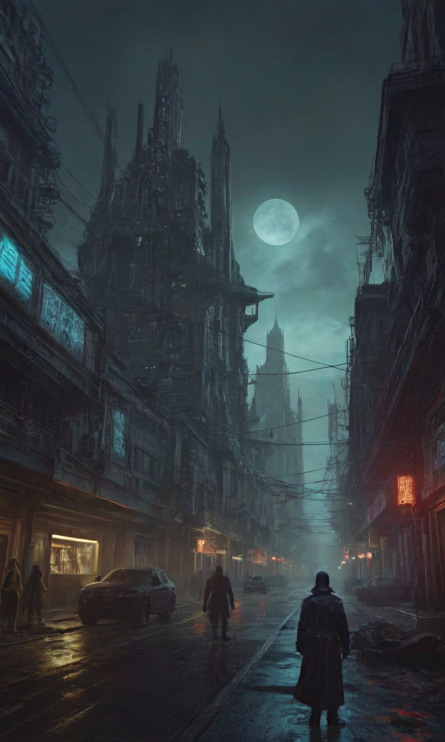
    This is the world I live in—a world of questions, of possibilities, of magic and discovery. And it is a world I invite you to explore, if you are willing to leave your assumptions behind and trust in the power of your own perception.