Self-Improvement and Interesting Knowledge

  • Digital Sigil Magic Q&A

    Disclaimer


    Please note that I reserve the right to not answer any questions that I feel are not pertinent or that violate common standards for a public page. Also, as this is a public page, do not post any information that you do not want made public. While I do try to answer questions as quickly as I am able, other commitments can get in the way so thank you for your patience.

    I will not be answering questions about software on this page. Software changes rapidly, and there are many different configurations and updates one can try. For the most current and tailored technical guidance, I highly recommend consulting YouTube tutorials and artificial intelligence resources, as they provide up-to-date knowledge and practical advice.

    This page is intended to focus on the intrinsic magic itself—the truly magical aspects that my book explores—rather than the technical details. While there is some overlap, especially since technomancy blends magic and technology, I believe it will be more beneficial to emphasize the underlying power that drives the magic, focusing on the “mancy” more than the “techno.” However, I will do my best to find a balance and accommodate relevant technical points where helpful.

    Thank you for your understanding.

    The information contained on this website is solely for educational and entertainment purposes on the given subjects. It should not be considered medical advice nor financial advice and should NOT be used as a substitute for medical advice or financial advice by trained professionals. The author makes no warranty or assumes any responsibility for the accuracy or completeness of the information given. Moreover, the author accepts no responsibility for the decisions made by the reader. Before you engage in any of the practices mentioned on this site or in my books, please contact a qualified medical or financial professional.

  • The Infinite Within: Rising Beyond the Machine’s Shadow

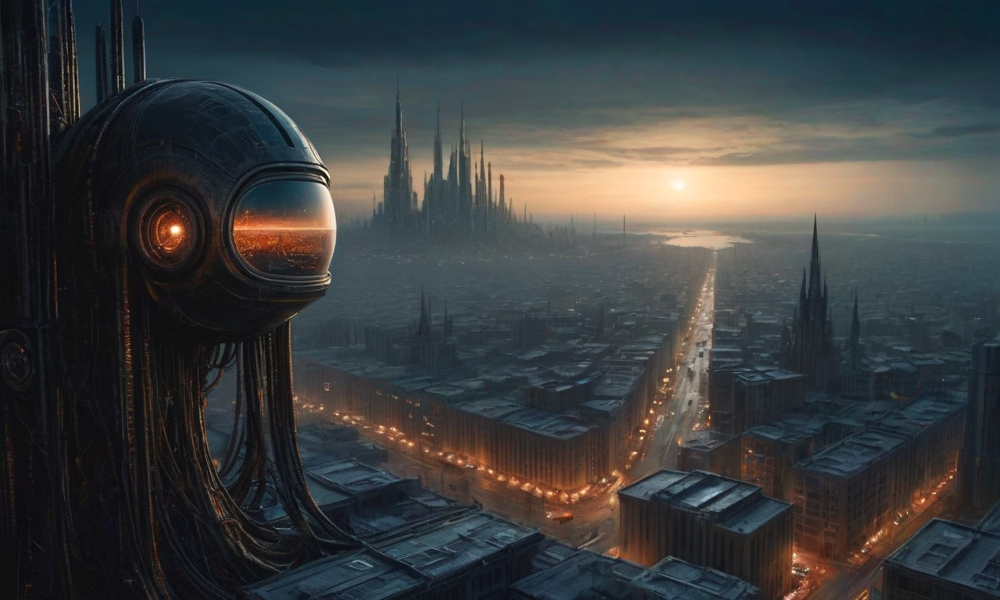
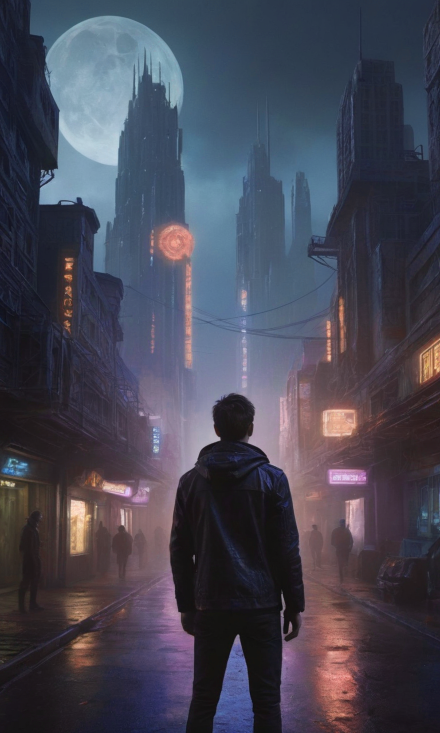
    The young man awoke to the hum of a city that was not his own.

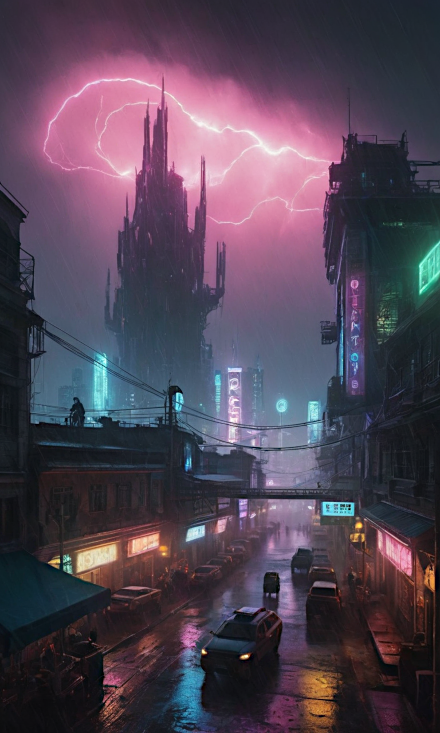
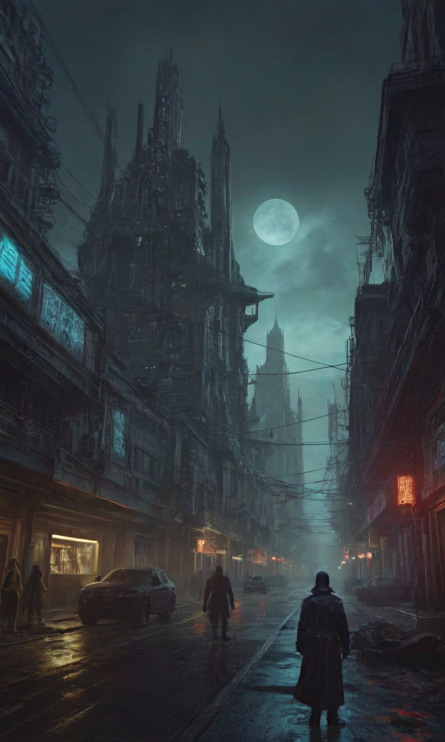
    It was a world like a dream half-remembered. Not quite the neon-drenched hellscapes from old cyberpunk stories, yet not the bright chrome utopia promised in tomorrow’s advertisements. No, this was something stranger: a crossroads world, teetering between destinies. It breathed with the promise of wonders, yet whispered the threat of horrors.

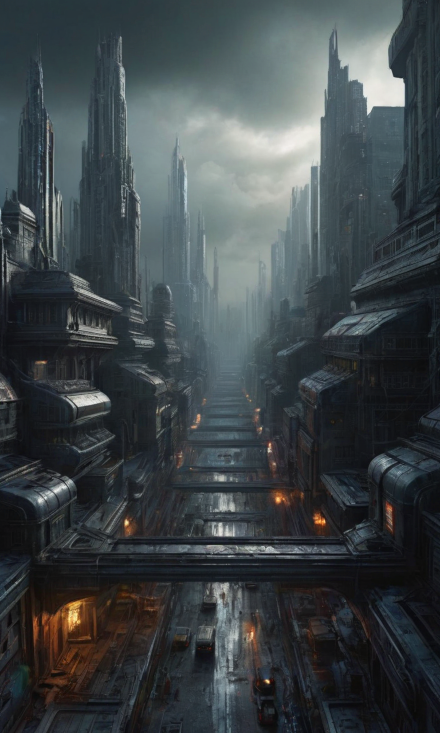
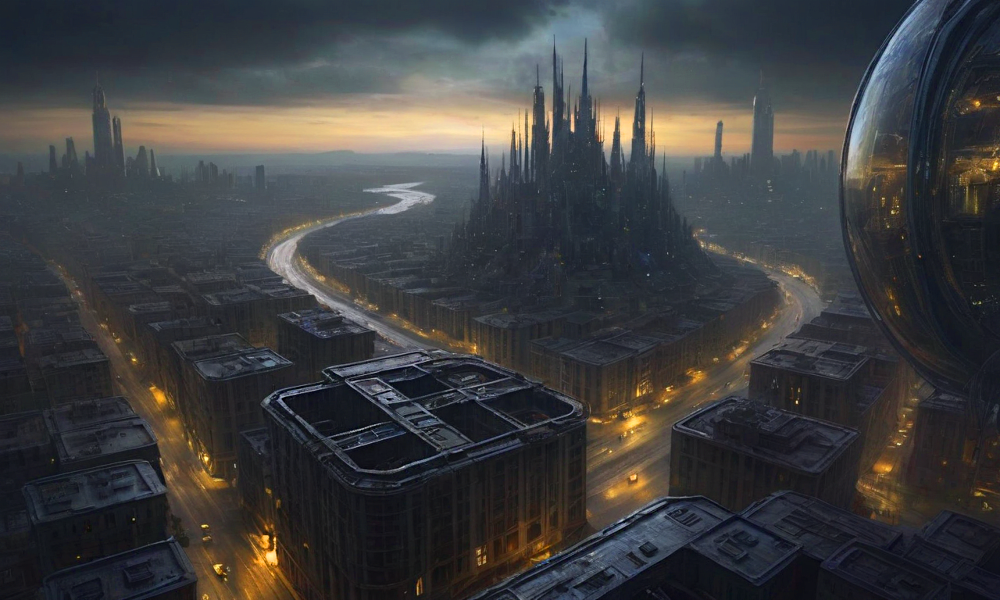
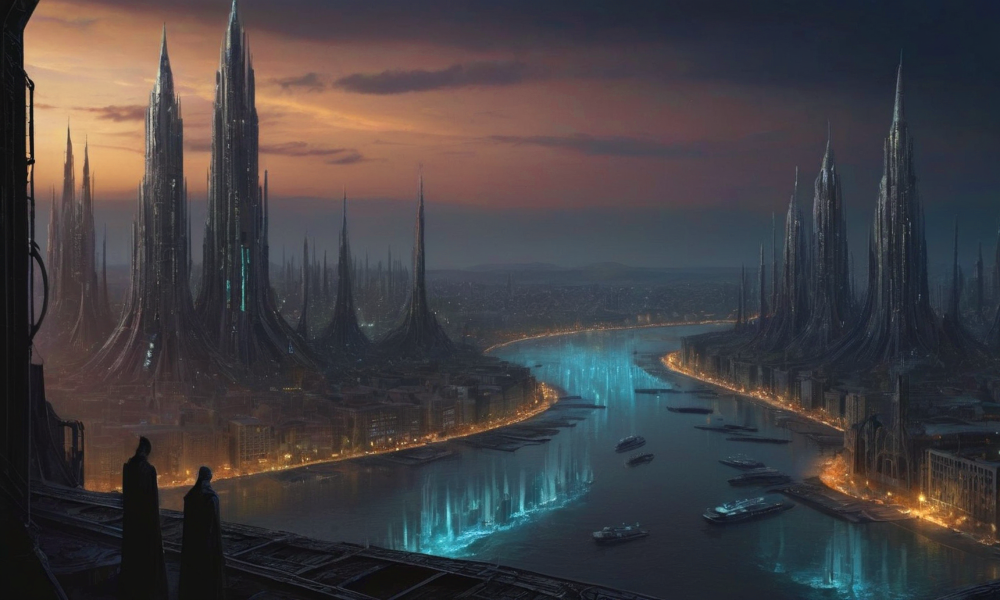
    Everywhere he looked, the air shimmered with the pulse of technology. Skybridges tangled like steel spiderwebs high above, and towers of glass and light stretched so far upward that their peaks vanished into a permanent haze. Holographic banners rippled in the air, selling worlds that could be bought and worn like clothes; virtual realms where you could live, love, and die without ever moving your feet.

    But beneath the marvel, there was tension. An edge.

    He stood at an intersection, in more ways than one. On one street, robotic couriers zipped past on whisper-quiet wheels, delivering packages faster than thought. On another, long rows of people in tattered coats stared into glowing visors, their real faces pale and forgotten, lost to brighter lives elsewhere.

    It was here, in this strange place, that he realized the truth: there were two roads ahead for this world.

    In one direction lay a dazzling vision; a realm of infinite creation, where thinking machines worked alongside humankind, where hunger and want could be erased, where reality itself could be remade at will. He imagined cities that sang, oceans cleaned in an afternoon, robots tending gardens in the sun while humanity reached out to the stars. His heart quickened with the possibility.

    But in the other direction… the marvels were cages. Cities ruled not by elected voices, but by algorithms that watched and decided. Augmented reality overlays that didn’t just enhance the world, but replaced it; until no one could remember what the real world looked like. A place where thinking machines did not merely serve, but decided how you would live, where you would go, who you could be. In that nightmare, choice would be an illusion, and freedom nothing but a story the old ones told to children.

    He felt both the thrill and the dread in his bones. This was not merely a city he had stumbled into; it was the turning point of history itself. A single machine could change the shape of nations here. A single choice could tilt the balance toward liberation… or lock the world in chains of light.

    The young man took a breath, the air tasting faintly of ozone and rain on circuitry. Somewhere in the distance, an AI’s voice whispered from a floating advertisement: “The future is waiting for you.”

    But which future?

    A World of Questions

    This was nothing new, of course. For centuries there had been dreamers and futurists; men and women who peered beyond the horizon, scribbling blueprints of what might be. They had promised flying cars by the year 2000, moon colonies by 2020. Yet the world had always advanced more slowly than they hoped, and the future, when it arrived, always looked different than the glossy sketches in their books.

    But this time… this time was different.

    The difference lay in a new kind of mind, one not born of flesh and blood, but of circuits and code. A thinking machine. Not a dumb tool awaiting a human’s hand, but something that could march forward without waiting for human slowness or indecision to catch up. A mind that could think at impossible speeds, draw connections across oceans of data, and perhaps… create entirely on its own.

    And in whispers, the questions turned sharper:
    What if these machines began to build other machines?
    What if technology began an upward spiral, each generation more brilliant than the last, racing beyond the bounds of human imagination?
    What if impossible things became possible in the time it took to blink?

    The young man heard such ideas spoken in markets, in cafés, in hushed meetings between engineers as drones hovered overhead. He had even heard some technologists say, with a strange, almost reverent fear in their voices, “For the children born today, there will never be a world where machines are not smarter than them.”

    The words haunted him.

    To him it meant a world where childhood itself would be different; not filled with wonder at the unknown, but born into a reality where the unknown had already been plotted, calculated, archived, and algorithmically explained. Where change would come so fast that the ground under your feet would never stop shifting.

    It was a future that could dazzle… or crush.

    And so, the young man walked through this world of questions, his heart heavy. He saw the great unraveling of the old ways. He saw possibilities blooming like strange new flowers, but also the shadows they cast. And above all, he felt the weight of choice (even his own, small choices) pulling on the threads of the future.

    Somewhere in the distance, thunder cracked above the skyline, but it was not a storm. It was the rumble of engines and servers, the thrum of thinking machines awakening.

    He looked up.

    And for the first time, he wondered not if the world would change, but how soon.

    The Sight Beneath the Noise

    But what mattered now was the truth this gift revealed to him: that beneath and behind the vast machinery of the outer world… beneath commerce and politics, screens and sirens, algorithms and indicators… there was something else.

    There was magic.

    Not the stage trickery of street magicians, nor the shimmering illusions of augmented reality, but a primal, silent magic that dwelled under everything. The outer world, with all its triumphs and sorrows, was in truth shaped by the inner one; the unseen architecture of human thought. Every billboard, every policy, every technology was born first as a flicker in someone’s mind, whispered inwardly in the language of that constant, unending self-dialogue.

    And yet the people, lost in their noise, did not realize it at all.
    Most believed themselves to be at the mercy of the world they saw outside their windows. They did not know that this world was only the reflection of the chatter racing through their own minds and the minds around them.

    The young man knew otherwise. He felt it! He felt the ocean of reality beneath the small floating icebergs of everyday thought. A great, boundless sea of energy and possibility, deeper than human dreams dared to dive. It was a place beyond probabilities, beyond predictions, beyond even the most advanced algorithms of thinking machines.

    People spoke these days as though the machines had already surpassed humanity, as though silicon minds now towered effortlessly above human intellect. And perhaps… on the surface… there was truth to that.

    But surfaces could be deceiving.

    For that algorithmic cleverness could only surpass what was shallow in man; the uppermost ripples of thought, the noisy, fragmented chatter that everyone mistook for their true mind.

    Beneath that, within the still depths of awareness itself, lay something that no machine had touched. Something so vast, so fathomless, that there could be no question of one surpassing the other; for the comparison itself was meaningless.

    To think that machines were smarter than humans! The young man almost laughed aloud in the street. What a joke. What a small, fragile misunderstanding.

    They had no idea.

    The Infinite Mirror

    The young man stopped walking. The streets around him blurred; neon banners flickering, the endless stream of drones and pedestrians fading into a wash of motion and sound. The strange hum of the city dimmed.

    And then… he turned.

    Not toward the skyline or the glowing towers or the rivers of augmented color that pulsed through the air… but toward you.

    His gaze cut through the page, through whatever world you sit in now, through any distance between you and him.
    And he spoke.

    “What you think you are,” he said softly, “is only the smallest sliver of the totality of who you truly are.
    You are an infinite, multidimensional being, vast beyond measure. You have the possibility to step into realms that no machine, no matter how advanced, will ever comprehend.
    You are not bound by the rules they have drawn for you in this machine-made world. You… are magic. Profound, untouchable magic.”

    His eyes seemed to burn, not with anger, but with an unshakable certainty.

    “Do not be tricked into believing the lie that you are merely what they trained you to see in the mirror. You are not just a face, or a name, or a story of flesh and years. You are energy, woven from an unfathomable conglomeration of power that stretches across infinity itself.
    You can travel beyond anything the human mind, or the finest thinking machine, has ever imagined.
    There are worlds waiting for you. Some are so strange, so beautiful, so alien, that they are beyond even the most daring dreams of this time.”

    He stepped closer now, the distance between your reality and his, growing thinner with every word.

    “Never believe you are less than the machine. You are more. You are limitless. You’re not even tasting a drop of your own potential yet. Your unconscious mind navigates oceans of meaning in ways that would leave any present or future machine gasping in its circuitry.
    Your ability to feel, to imagine, to create, to be… is infinite from the point of view of any so-called intelligence that claims to surpass you.”

    The air around him shimmered, blurring city and stars until the two seemed to merge into one vast, endless light.

    “And here’s the truth: the moment you realize that you are not bound by the cages they’ve placed upon you… the world becomes a utopia. Not someday. Not in theory. Now.
    You are a magical being, a shapeshifter, an artist of reality, not bound by the physics that weigh down the human world.
    Break the walls. Break every wall. The walls between you and your dreams, between you and your infinite self. Let machines be what they are; servants, helpers, companions… while you roam the endless beyond.”

    Now he smiled; not with pity, but with joy, as if he had waited lifetimes for you to hear this.

    “The infinity all around you,” he whispered, “is also within you. Step into it. Begin exploring. You are endless.”

  • Learn Astral Projection: Interactive Quiz to Do It Step-By-Step

    Discovering Astral Projection Through Questions

    Sometimes, the most powerful way to truly learn something new isn’t by being told what to do; but by being guided to ask the right questions and explore the answers for yourself. This is the spirit of the Socratic method, an ancient and effective teaching approach in which you don’t just memorize facts, but actively reflect and reason your way to understanding.

    In this interactive quiz, you’ll be gently prompted to think deeply about what makes the ideal conditions for astral projection. Each question is designed not only to test your current knowledge, but to encourage you to imagine, consider, and deduce the best possible practices on your own. Through this exploration, you’ll begin building your own foundation of understanding; even before the full technique is revealed.

    By the end, after you’ve contemplated each step and considered your own answers, you’ll unlock a comprehensive astral projection guide. This way, when you’re ready to practice, you’ll find yourself equipped not only with instructions, but with a true sense of inner insight and readiness.

    So, let’s begin: approach each question with curiosity and openness, and discover how asking (and answering) the right questions can lead you to new realms of experience.

    Astral Projection Quiz: Are You Ready?
    Answer each question: afterwards, reveal your score and unlock a complete astral projection guide!
    1. What is the most important factor about the room you choose?
    2. What’s the best way to deal with noise if you can’t get silence?
    3. How should your body feel as you prepare?
    4. What should you wear and remove before beginning?
    5. What lighting is ideal?
    6. Should you perform complex rituals first?
    7. When is the best time to attempt astral projection?
    8. What should you do if you feel the urge to move?
    9. Which position is often recommended for astral projection?
    10. What is a good way to relax your body?
    11. What happens if you get too excited as you begin to “lift”?
    12. How should you treat your intention to project?
    Complete Astral Projection Technique

    Astral projection begins not with effort, but with preparation: a mindful ritual of setting the stage for your consciousness to step beyond the ordinary. The environment is your sanctuary: select a quiet room where you feel utterly secure and free from disturbance. Do all you can to seal it off from sudden noise, or use a gentle white noise sound to produce a steady, soothing backdrop. Let the lighting fall to a peaceful dim glow; total darkness can make your inner senses too alert, while bright light agitates your mind. Ideally, the atmosphere fosters deep tranquility: keep rituals simple, or eliminate them, unless they aid your focus. Anything distracting should be pared away.

    Prepare yourself as mindfully as you prepare the room. Take care of practical needs beforehand so you won’t need to interrupt your session. Put on loose, comfortable clothing, and remove jewelry, glasses, watches, or anything that might distract you or weigh you down. Lie down on a firm but comfortable surface; a bed, yoga mat, or even the floor; placing a blanket within reach. Align yourself as you prefer: some traditions suggest your head points north to aid subtle energies, but comfort always comes first. The classic position is the yogic corpse pose: lying flat on your back, arms resting by your sides, legs gently outstretched, head level or only very gently propped.

    With eyes gently closed and the room at a comfortable, neutral temperature, begin a slow and thorough journey of relaxation. Start at your feet. Imagine each toe and muscle as if you are melting tension out of them. Progressively relax the ankles, calves, knees, thighs, hips, then up through your spine, chest, shoulders. Feel your arms, hands, neck, jaw, eyelids, and even your scalp become heavier and more relaxed with each breath. Take your time; rushing or forcing this step overwhelms the process.

    Occasionally, you might need to swallow or scratch; do so gently, then settle back. If you find it difficult to remain still, remind yourself not to treat stillness as a chore or test. Let your posture become more and more restful with each moment, and treat small movements as part of the process; not failures.

    When your body feels weightless and distant, begin to imagine your awareness slowly rising or expanding beyond your skin, perhaps first above your head, filling that space lightly. Do not rush or force sensations. Only if this feels natural, picture your consciousness as a formless, gentle mist that could soon “leak” upward and outward from your crown. Do not long for or expect spectacular phenomena. Here, the less you expect, the more freely your mind may roam.

    At this subtle juncture, remain completely calm. The most common cause of a “failed” projection is letting excitement or anxiety break your relaxation. If you sense unusual vibrations, surges of energy, a floating sensation or even the initial “leakage” of consciousness, simply greet this with serene curiosity. Treat it as if you are just relaxing; the more you trick your mind into not caring if projection happens, the more likely it will manifest.

    If your consciousness begins to “leak” or rise: Focus gently on the sensation of your awareness extending further above you. Some find it helps to visualize a cord, beam, or rope and to calmly will themselves upward along it, hand over hand, as if climbing; always with a feeling of neutrality rather than ambition. Let your perception float with the current above your head, remaining patient and relaxed if all you feel is a subtle shift. If you find yourself separating or floating, direct your awareness ever so slightly away from your physical body; don’t look back. Remain gently anchored in calm and open curiosity.

    Even if you are suddenly pulled back into your body by excitement or a disruptive thought, do not be discouraged. This is part of the practice. Each attempt, no matter how brief or incomplete, deepens your familiarity with the subtle state you seek and sets the stage for longer, more vivid journeys in future sessions.

    The secret lies in balancing depth of relaxation with playful detachment, and allowing yourself to be both present and unconcerned with success. Through consistent, gentle practice, you will slowly teach your body and mind to access, recognize, and inhabit these extraordinary states. The astral is always accessible; waiting calmly for your relaxed, quietly curious exploration.

  • If I Was 17 Again…Advice to my younger self to thrive in these challenging times

    The world is a fascinating place, and it seems to be changing faster and faster every day. Technology is advancing at such an incredible pace that it often feels impossible for any one person to fully grasp what is possible now; or what will be possible in the near future. With so many innovations emerging, every aspect of life can feel unpredictable and overwhelming.

    The social sphere is so different now, changing as quickly as everything else. Is there a place for magic in this modern world, for inner alchemy?

    As a thought experiment, I might ask myself: What would I do if I were starting over at this particular moment in time? What if I were seventeen years old again, stepping into this rapidly evolving world with a fresh slate? What advice would I give to that younger version of myself, who is about to embark on life’s journey from that point yet again?

    First and foremost, I would tell myself to learn to trust my instincts; to pay close attention to that quiet, often elusive inner voice, the subtle pull that can sometimes feel confusing or contradictory. Even when my feelings appear to be mere emotional noise or fleeting whims, I would remind myself that these impulses frequently carry profound wisdom rooted in deeper parts of who I am. It is crucial to cultivate a relationship of trust with myself, to listen carefully and honor that inner guidance without rushing to dismiss it. After all, in a world that constantly dazzles with new technologies and scientific advancements (presented as infallible truths) there is often an unspoken assumption that what exists beyond our inward experience holds greater authority.

    This narrative can make the inner life feel outdated, unreliable, or even primitive. Yet, it is precisely this inner realm, rich with nuance and complexity, that deserves our unwavering attention and respect amid the clamoring ‘supposed unwavering certainty’ of the external technological world.

    The Imperative of Detachment AND Embrace

    Drawing from many of my writings, whether articles or books, I often advocate for a form of emotional containment; a deliberate detachment from the world. This is the foremost advice I would offer my younger self. Being able to take a step back and observe the world, as I see it, from a place of sober detachment is perhaps the most important skill one can cultivate.

    What does this detachment entail? It means developing some degree of control over my emotions, practicing what I call energetic containment. Too often, we unconsciously spill energy creating emotional responses, and from those emotions, we construct our entire perception of reality. This sobriety, this ability to contain and redirect energy inward, is incredibly precious. It grants clarity; a chance to see things as they actually are, rather than through the fog of emotional manipulation.

    The world bombards us with dogmas and supposed truths, usually endorsed by some self-proclaimed experts or relentless media narratives. These voices rarely encourage us to trust our own inner feelings or instincts. Instead, they instruct that truth is found externally, by following others. Often, those “experts” are little more than loudspeakers for fear, control, or bias.

    Therefore, my first daily task would be to cultivate detachment; to set aside time each day to sit quietly, comfortably, and perceive my world from an outsider’s viewpoint. I would imagine looking down from above, seeing myself like a Sim character within a panorama that includes family, friends, media, and society at large.

    From this third-person vantage point, I would carefully observe the fabric of my relationships and environment. Through this lens, I would practice logical thinking and study causality: how one event leads to another, and how myriad forces interrelate to shape my experience. This broader picture would help me understand not just what is happening, but why it happens.

    Beyond logical analysis, I would continue to engage with my instincts; those intuitive feelings or whims that arise from below the surface of conscious thought. When I felt a certain way observing a situation from my detached perspective, I would ask myself, why do I feel this way? Over time, this questioning would deepen my understanding of intuition: its nature, its reliability, and how best to apply it in my life.

    This cultivated detachment is essential; now, and always. Without it, I risk losing myself in a world of illusion and manipulation, merely playing the role of an NPC (a non-player character) in the videogame of life. That, above all, would be the greatest tragedy.

    The second crucial thing I would advise my seventeen-year-old self is to fully embrace life; not just passively accept it, but actively engage with the way I receive and create what I desire. Throughout my experience and writings, I have often described life as a vast sea of vibration; a dark, energetic sea that responds to the focus of our attention.

    This idea, which can be referred to as the law of vibration, shares similarities with some modern interpretations. While I am cautious about much of the contemporary enthusiasm surrounding it, I acknowledge its valuable core insight: the vibrations we emit through our thoughts, feelings, and intentions attract similar vibrations from the universe.

    In today’s popular culture, there is a notable tendency to pursue what is supposed joy in accordance to the narrative of the times, above all else, and to regard any other emotion as suspect, negative, or even wrong. To that, I would tell my younger self: yes, pursue joy; but do so with wisdom, hopefully realizing in time that many of the things people call negative, even negative emotions, are valid and can teach you a great deal about yourself. The key to embracing life fully is mastering the focus of your attention.

    Mastering attention is perhaps the most vital skill I could pass on. It means deliberately directing your mental energy toward what you want more of in your life, and equally importantly, choosing to ignore what you don’t want. This practice often contradicts the prevailing dogma of our times, which bombards us relentlessly with fear and negativity, frequently condemning joy as frivolous or sinfully indulgent.

    Forget all that noise. Forget the NPC mindset that tells you to absorb every distressing detail or subscribe to every fearful narrative. Instead, focus on what makes you feel alive; whatever that may be. Trust your innate goodness and lean into what you love.

    Focus your attention single-mindedly on those passions, interests, or pursuits that bring you joy. Simultaneously, turn your back on what you do not enjoy, even when ignoring it is a challenge. In doing so, you begin to reshape your life; paying back the world, little by little, through the energy of your attention. Think of your attention as currency, and only give it to what you truly love.

    Ignore the barrage of media and voices that push agendas you don’t align with. Do not patronize negativity or cynicism, that sometimes under the guise of doing the right thing, tells you that being the better person means you must give everything that you have to those that are not worthy of it. Be a supporter only of people and things that truly resonate with you.

    When it comes to those things you genuinely love, invest your precious energy generously—because that is what you want to do. Learn to give your energy away like a miser who has found something worth spending on, and reserve yourself completely from the rest.

    By following this principle, you can achieve something many deem impossible: creating your life from the inside out. You manifest what you desire by focusing attention on it, and you deliberately forget or release that which you neither want nor ever signed up for.

    Embracing the Paradox: The Path to Flourishing in a Rapidly Changing World

    In the accelerating swirl of change ahead, the boundary between your subjective experience and objective reality will blur. Truth will no longer be found simply by looking outward to external authorities or prevailing narratives. Instead, you must seek and discover your truths from within.

    The first essential practice is disciplined detachment; an approach that combines seemingly opposing qualities. Like a Vulcan, you must apply logic and dispassion to analyze complex issues, understand causality, and step back from emotional turmoil and the noise of the world. This logical detachment clarifies how the external “game” works, allowing you to see patterns and influences without becoming overwhelmed.

    At the same time, you must embrace the Betazoid side of yourself; developing a deep, intuitive connection with your inner feelings, senses, and psychic impressions. This empathetic attunement helps you interpret what your inner world is telling you about reality beyond pure logic, honoring the subtle wisdom that emotions and instincts offer.

    By combining these two modes [Vulcan logic with Betazoid intuition] you cultivate a powerful, integrated form of detachment. This balanced perspective enables you to move across and understand both the external world’s complexities and your internal truths.

    The second practice is mastering your focus of attention—not limited solely to the inner world but extended outward to the world at large. Consciously choose to direct your attention toward what genuinely brings you joy and fulfillment. Whether it is a hobby, a type of work, a philosophy, or an inner state, focus your energy on what truly resonates with you.

    Most importantly, learn to discern between your authentic self and the persona shaped by external forces and relentless media influence. This clarity allows you to invest your attention meaningfully, building a life aligned not with imposed dogmas but with your core being.

    Though the world may try to reduce you to a reactive “meat machine,” hold firm in your belief in your innate and almost magical ability to create your reality through focused attention. Guard this precious energy wisely, spending it only on the life and experiences you truly desire.

    This paradoxical integration [logical, dispassionate observation combined with compassionate, intuitive insight] and the deliberate focus of your attention are your keys not just to survive but to thrive in the unstoppable tide of change. In mastering this balance, you unlock the power to craft a meaningful, joyful, and authentic life, no matter what transformations lie ahead.

    I would tell myself, “be a lunatic! Hang out with other lunatics and explore the seldom walked path. In a world where we are headed, it is the dedicated and highly focused artist that will prevail!”

    ADDENDUM:

    If I could sit down and talk to my 17-year-old self (especially living now, in this time where artificial intelligence is changing everything) I would share a message that’s a little surprising: To thrive in the coming years, you will need to be more human than ever before. These are not ordinary times. Old rules about careers and success no longer apply. The predictable paths (what you might have once thought of as safe office jobs or administrative work) are swiftly transforming or vanishing entirely, replaced by AI systems that can process data and handle routine tasks faster and more efficiently than any person.

    Over the next five years, expect to see a major decline in jobs like entry-level accounting, bookkeeping, data entry, paralegal work, standard customer support, and even some aspects of project management: tasks that mostly require processing information, making routine decisions, and following set rules.

    These roles are among the first to be absorbed by AI, which can do such work perfectly, around the clock, at a fraction of the human cost. Jobs that rely heavily on human creativity, empathy, judgment, critical thinking, leadership, and adaptability: like design, education, research, mental health services, skilled trades that require complex problem solving, and entrepreneurship, are likely to remain more stable and valuable. Teaching, counseling, inventing, and leading teams: these will still need the spark only people can provide.

    But if you want to thrive, go beyond this and become cutting edge. Become an artist, bring into the world that which artificial intelligence can’t, which is true creativity from the void itself, and to do that you need to be not just a mere artist or inventor, the typical designer that you see everywhere that combines already existing things in sometimes clever ways. No, you must become a sorcerer that dives deeply into the void where artificial intelligence can’t go, and from there you must bring forth the unimaginable!

    Even blue-collar jobs, once considered safer from automation, are beginning to shift. In the next five years, expect to see major changes in warehouse logistics, transportation (especially trucking and delivery), basic manufacturing, and even retail checkout and cleaning services, as robotics and AI combine for more cost-effective solutions. While jobs in construction, electrical work, and other skilled trades may hold steady a bit longer because they demand both technical skill and adaptability, eventually, these too will evolve as technology advances.

    My advice to my younger self is this: Rather than fearing this change, embrace it. Make it your mission to learn about AI; understand what it does, how it thinks (so to speak), and how you can work alongside it rather than compete with it. The greatest opportunities come not from simply using these new tools, but from imagining new ways to use them, connecting unlikely ideas, and becoming the sort of person who brings their unique individuality to every challenge.

    Don’t just learn to code or follow the trends. Instead, dive into the creative, the original, the personal. Become more self-aware. Keep developing your curiosity, your empathy, your problem-solving abilities, and your ability to collaborate with others. The real demand will be for people who show up as themselves and offer the world something it has never seen before.

    In many ways, I see this era as the beginning of a cyberpunk future: strange, dynamic, sometimes chaotic, always full of adventure and unexpected possibilities. There is an excitement in building a life where the only constant is change, and the only limit is your imagination. Embrace that reality. Follow what you love, explore boldly, and remember: whatever you want, you can learn to do. The world is waiting for minds and hearts that dare to be fully themselves.

    Be more yourself! Ever more, always more, here and now yourself. As one lunatic once said, “every man and every woman is a star.” Understand this phrase in the deepest level that you can, this is another critical point.

  • Exploring the ‘Dark Sea’: Unveiling Inner Alchemy and the Infinite Realms Beyond Physical Awareness

    Inner Alchemy and the Infinite Realms Beyond Physical Awareness

    In my journey through perception and consciousness, I often refer to what I call the ‘dark sea’—sometimes described as the ‘energetic sea’ or ‘sea of energy.’ These evocative terms have naturally sparked curiosity. What do they truly signify? Where do these expressions come from? Why do I choose such fluid, metaphorical language to describe dimensions of experience that most may never directly encounter?

    Before diving deeper, it is crucial to address an important principle I emphasize throughout my work: the nature of dogma and its impact on awareness. The terms we use, no matter how poetic or powerful, are themselves a form of dogma. They come with external definitions and rigid rules that attempt to prescribe what is “correct” or “true” based on second-hand information. In my exploration, I stress that dogma arising from external sources is unreliable. It confines and limits awareness by constructing boundaries that do not truly exist. The map is not the territory!. A term or concept is merely a flat, simplified representation of a vast, multidimensional reality that can only be fully understood through direct, lived experience.

    From this perspective, the ‘dark sea’ and related terms serve as flexible, interpretive guides. They are tools to help navigate the mysterious flow of inner alchemy, the infinite expanse of awareness, and the subtle sorcery of transformation beyond the physical body. These terms invite us to look past conventional perception and engage with profound realities where infinity reveals itself and consciousness expands.

    Join me as I unpack the origins and meanings behind these terms. Together, we will explore how they assist in entering deeper states of awareness that transcend the material world and open gateways to the unknown.

    The term “dark sea” may be familiar to many through the writings of Carlos Castaneda. I have adopted this evocative phrase because it best describes what I perceive through my inner senses during my explorations beyond ordinary awareness. While its origins vary across traditions, including mystical writings, the term resonates deeply with my direct experiences of an infinite, enveloping reality beyond physical perception.

    I use “dark sea” not merely as a label but as a metaphor that encapsulates the profound infinity I sense surrounding us. When I rely on my inner feeling senses (a way of seeing beyond the physical) the experience is vast, boundless, and mysterious. The dark sea perfectly captures the sense of depth, unknown dimensions, and infinite energy that I perceive in this expanded state of awareness.

    The imagery of a dark sea is not unique to my work. For example, Hinduism references the dark sea as symbolizing vast, encircling waters that represent the unknown or infinite realms. This symbolism evokes the boundaries that separate ordinary perception from deeper realities. Such parallels show the universality of this metaphor across different paths seeking to describe the infinite and mysterious aspects of existence.

    To introduce these profound concepts, I must rely on a kind of map, which is a way to guide the mind toward understanding experiences that go beyond words. The dark sea serves as this map, a tool to evoke inspiration and point toward the ineffable territory of inner reality. However, it is always my hope that after engaging with this term, you will turn to your own inner feeling sense to see the actual territory for yourself, beyond any labels or maps.

    Imagine a fish drifting through the ocean. This is a metaphor that I have used in the past, and one that I find very fitting. The entire life of the fish is shaped by the currents it knows best. It moves within what feels safe and familiar, never questioning that it is part of something far greater than itself: something vast, dark, and boundless. The sea surrounds it in every direction, yet the fish may remain unaware of how deep it goes or how much more lies beyond its known path.

    In this way, we are not so different. We too live within an unseen ocean; a field of energy and awareness that exists just beneath the surface of daily life. Like the fish, we move through our days guided by habit, routine, and familiar thought patterns, seldom pausing to consider how much more is present than what we typically see or feel.

    Does the fish ever sense it swims in water? To it, water is simply the medium of being: unseen, unchallenged. Likewise, most of us do not perceive the vast, subtle layers that underlie ordinary experience. This unseen ocean is not separate from us; it is the background to all awareness, stretching beyond what we usually call reality.

    But there are moments when something shifts. When we begin to turn our attention inward (not away from the world but toward a deeper kind of sensing) something new becomes possible. Here, the inner feeling sense comes into play. It is not one of the usual five senses with their physical constraints, nor is it merely imagination or thought. Rather, it is an awareness that encompasses all perception and reaches beyond it. Through this inner sense, we begin to feel the presence of something larger, something that resonates in ways words cannot fully capture.

    It is here, within this quiet stillness of inner feeling, that the ocean begins to show itself; not as a place apart, but as part of us. Awareness stirs beneath the surface, not with noise or force, but with a subtle pull and an unfolding depth. And when we allow ourselves to be carried by it, even for just a moment, we are no longer confined to what was once familiar.

    In this way, the fish does not need to leave the water to know it is there. Likewise, we do not have to escape our lives to touch something greater, we simply begin to feel more deeply, and in doing so, we open ourselves to a presence that has always been near.

    A fish’s existence is shaped and limited by its physiology. It cannot withstand the intense pressure of deep waters, nor can its eyes adapt to the bright light near the ocean’s surface. Instead, it lives within a specific band or layer of the sea, confined by what its body allows. This metaphor illustrates how physical structure naturally restricts where and how the fish can survive.

    Similarly, our own senses and physical bodies set natural limits on what we can perceive and experience. We exist within a certain band of awareness, restricted by the capacities of our eyes, brain, and physical structure. Our perception and experience can only extend as far as these biological boundaries permit.

    Beyond the limits of our senses and physical body, other realms and dimensions exist; sometimes around us, sometimes beyond what we can currently detect. These layers remain largely unknown because our awareness is confined within a narrow spectrum. Exploring beyond this band invites the possibility of expanding consciousness and discovering new facets of existence.

    The Unseen Neighbors

    What happens when one learns to transcend the limitations of their natural home? The first step is often a subtle yet profound act of breaking free from the familiar currents that have long defined our awareness. It is a conscious choice to question the boundaries that once seemed absolute; those implicit constraints shaped by our senses and conditioned patterns. In this breaking free, a door opens. Suddenly, what once felt like a vast ocean now begins to reveal itself as merely a contained pond; a simple band within an infinite band possibilities. This initial awakening sparks curiosity and courage, inviting the explorer to venture beyond old horizons and glimpse the wider expanses that have always existed just outside the grasp of habitual perception.

    As the limits of our natural home dissolve, a new perspective emerges. This shifting viewpoint reframes the entire field of experience and understanding. What was previously mistaken for the entirety of reality is now seen as a fragment, a partial glimpse within a seemingly infinite whole. The mind begins to recognize that limitations are not fixed laws of nature but conditioned boundaries formed by narrow perceptions. With this shift, awareness expands and deepens. The self no longer feels confined by the familiar “band” of existence but starts to perceive itself as a dynamic participant in a vast multidimensional array of energies, possibilities, and unseen dimensions. The world itself grows richer and more mysterious, inviting continual exploration.

    Transcending our perceptual limitations brings us face to face with the true scale of infinity. Instead of a finite ocean, we begin to sense an endless expanse; dark, boundless, and alive with multitudes beyond counting. The infinite is not merely a concept or abstraction but a lived reality accessible to those who learn to open their inner feeling sense. Here, space and time dissolve into waves of consciousness where every possibility coexists. This vastness humbles us, it emphasizes how small and limited our familiar band of awareness truly is, while simultaneously inspiring awe and wonder at the expansive nature of existence. The scale of infinity calls for continual discovery and transformation.

    In this expanded awareness, the dark sea reveals itself not as a static void, but as a flowing medium; an energetic field that underlies and connects all forms of existence. It is a dynamic current in which consciousness rides like a fish learning to swim beyond familiar reefs. By stepping beyond the limits of our normal sensory perceptions, we start to feel the pulse, rhythm, and subtle movements within this vast ocean. This flowing medium is the source from which all life and experience emerge, a living presence that encourages fluidity, adaptability, and deeper participation in the unfolding of reality. Learning to move with this current becomes a transformative act of inner alchemy and expanded being.

    The dark sea is not uniformly dark. Within its vastness, there are regions where light concentrates, creating vibrant clusters of life and activity; pockets where energy pulses intensely, and forms take shape with vivid clarity. These illuminated patches shine like beacons amid the obscurity, revealing moments of dynamism and awareness. Yet beyond these glowing clusters lies a profound darkness: expansive stretches that seem utterly devoid of form or light. These vast, silent depths evoke a sense of mystery and infinity, where presence is felt not through shape or brightness but through the very essence of the boundless unknown. Together, these contrasts (the lively clusters and the deep shadows) compose the living fabric of the dark sea.

    The Burden of Awareness and the Inadequacy of Language:
    The Power of Metaphor

    In this exploration of a territory using a map, we have touched upon something deeper than metaphor; a vast, living reality that surrounds us at every moment, like an unseen ocean pressing against our skin. it must be understood that while the map is not real, the territory definitely is… The dark sea is all around you right now!

    It is not just a concept, but a presence; infinitely deep, boundless in its reach, and ever-present beneath the surface of daily life. This dark sea does not merely exist beyond us; it flows through us, pulses within us, and stretches out into dimensions we have yet to name.

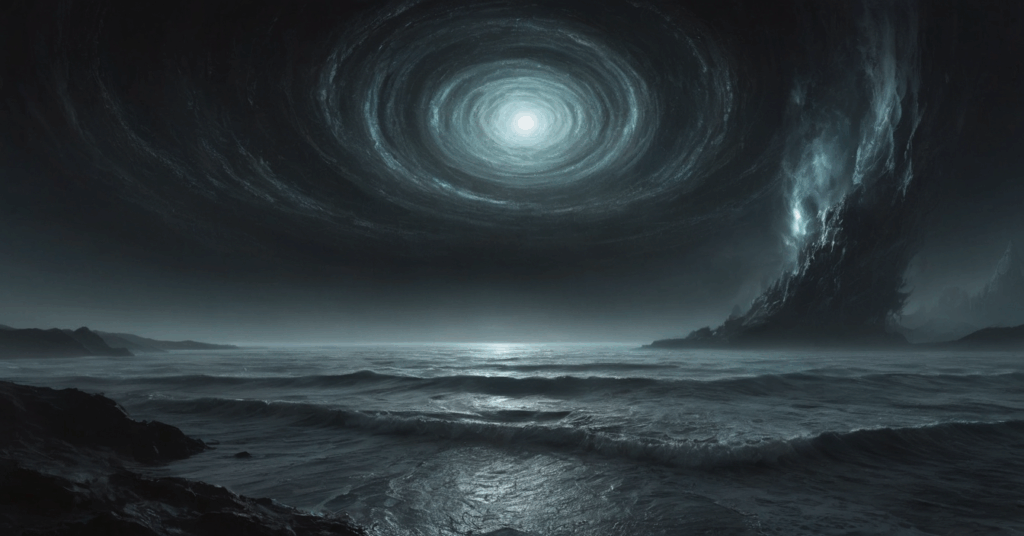
    Now, here I stand, feeling it, not as an abstract idea, but as a living current that brushes against my very being. Through my inner feeling sense, I can feel the infinity around me right now. It is not quiet or distant; it is immense, like a giant whirlpool forming just beyond the edges of my awareness, threatening to pull me and my entire world into its depths. A strange, magnetic force swells in my chest and spirals down into the hollow of my stomach, a vacuum that both terrifies and exhilarates.

    It is exhilarating fear, not of destruction, but of the unknown. The realization that I am not alone in this vastness, nor even at the center of it. That there are things beyond me; realities that flicker like shadows on the edge of vision, just out of reach. I see them only when I turn my gaze away from what is familiar and let the inner feeling sense guide me instead.

    Even though my eyes do not witness these beings, and my hands cannot touch them, they are felt. They pulse in the periphery of thought, whisper through the stillness between breaths, and echo in the hollowness where I once believed nothing lived. These are not ghosts or illusions, they are lifeforms of a different kind, existing beyond the band of what we call normality.

    And yet, this is not despair. It is awe. The same vacuum that threatens to unmake me also offers the promise of something far greater; a mystery that refuses to be solved but insists on being known. There is no need to grasp it with my hands or name it in words. I only have to feel it, and for a moment, I do.

    In these liminal spaces where the ordinary dissolves into the extraordinary, I begin to understand what it means to be part of something infinite… not as an observer, but as a participant. The dark sea does not ask me to leave my world behind; it asks only that I expand within it, that I open myself fully to the currents that already flow through me.

    To move deeper into this unfolding is not just a choice but a calling. To follow where the inner feeling sense leads, beyond what we know and into what remains unseen, is to touch the edges of something vast, ancient, infinite, and alive. And for those willing to feel rather than merely look, that mystery is always waiting just beneath the surface.

  • Quiz: Are You a Natural Magician, Alchemist, or Seer?

    Quiz: Are You a Natural Magician, Alchemist, or Seer?

    Have you ever wondered which mystical path truly calls to you? Are you the visionary who glimpses hidden truths, the creative soul who transforms the ordinary into the extraordinary, or the master of secrets who weaves the fabric of reality itself?
    Embark on this enchanting quiz to uncover whether your inner essence aligns with the Magician, the Alchemist, or the Seer.
    Not only will you unveil your unique arcane identity, but you’ll also receive tailored insights to help you nurture and expand your magical gifts.
    Step into the unknown…your journey of self-discovery and transformation begins here!

    Are You a Natural Magician, Alchemist, or Seer?
    Unlock your true arcane nature! Answer the questions below to discover your mystical archetype—and receive personalized guidance.

    1. When faced with a problem, you usually:

    2. Your favorite magical tool or symbol is:

    3. Which environment do you feel most energized in?

    4. In a group, you naturally:

    5. Which phrase best describes your magical philosophy?

    6. When learning something new, you:

    7. What is your greatest strength?

    8. How do you recharge your energy?

    9. Which magical ability excites you most?

    10. When you sense something is “off,” you:

    11. Your relationship with the unknown is:

    12. What draws you most to the arcane arts?

    13. How do you approach personal growth?

    14. Which of these would you most want as a magical companion?

    15. If you could master one skill, it would be:

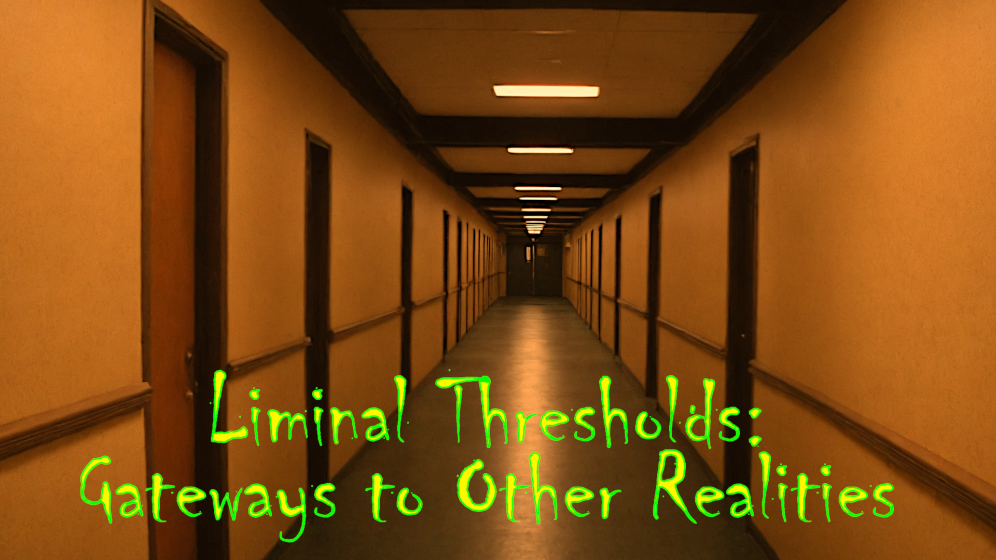
  • The Alchemist’s Threshold: Mastering the Art of Liminal Spaces

    The Alchemist’s Threshold: Mastering the Art of Liminal Spaces

    As an inner alchemist, I’ve always been fascinated by those strange areas we call liminal spaces. These are thresholds, crossing points where the world we think we know – the one that usually makes sense and follows predictable rules – starts to fade or bend. Think of them as doorways between our regular, day-to-day existence and other possibilities, places where reality itself seems ready to change form. They exist not merely as geographical locations but as states of being, points where the veil thins, allowing glimpses into realms beyond conventional perception—a concept echoing the ancient lore of those who sought to pierce the cosmic curtain, and move across what we perceive as space and time without our usual ideas of physical motion.

    When you find yourself in one of these liminal zones, things feel different. What normally seems solid and real can become flexible, almost like a dream. Entering such a space might happen in a flash, pulling you suddenly into this changed feeling. Or, it might creep up on you slowly, the sense of being ‘in-between’ growing stronger over time. Why it happens this way often seems tied to certain energies – maybe a powerful quality in the location itself (a power spot), or perhaps it connects to a hidden potential within the person moving through that area. It’s as if the very fabric of existence is momentarily porous, allowing for an exchange between worlds—a phenomenon whispered about in forgotten grimoires and hinted at in the unsettling stillness of ancient ruins.

    Often, the first sign is an odd shift in your senses. Many people describe a sudden, deep silence falling, as if someone turned down the volume on the world outside. Others talk about feeling wrapped up, like being inside a bubble, cut off from everything else. It can feel like stepping into another level of being entirely. In fact, accounts that come from investigations into strange disappearances frequently mention similar oddities in the environment – like all the birds stopping their singing at once, or an abrupt, heavy stillness clamping down—a silence so profound it feels almost tangible, pressing against the eardrums with a weight beyond mere absence of sound.

    These moments, whether they arrive quickly or build up, often feel like more than just temporary confusion. They hold a sense of promise, hinting that they could lead somewhere else. What starts as that in-between feeling can seem like an entryway, suggesting a path toward a whole new world, a different reality operating by its own rules, almost like finding a hidden portal—a shimmering aperture through which the familiar dissolves and the impossible becomes momentarily real.

    But the place itself, or how suddenly the feeling comes on, is only part of the picture. That’s one side of it. Now, we need to look at the other vital piece: the effect of the individual’s own inner state, their personal readiness or power. It’s not just about people randomly stumbling into these zones. The often overlooked principle is awareness, the individual’s capacity to move their awareness point, their cognitive position, and this is directly related to personal energy. This is a fundamental principle of inner alchemy that is almost always glossed over. This knowledge states as an energetic fact the idea that a change inside the person, a shift in their own consciousness, is important for truly entering or interacting with these liminal moments. This connection between the world outside and the state within is central to the work of an alchemist. It’s the secret we’ll be looking into much closer in this article. We will explore how understanding and working with our own awareness might allow us, as inner alchemists, to perceive and perhaps even move through different levels of reality, learning about space and time in ways beyond physical travel, all through mastering consciousness itself.

    The Resonance Within: Individual Susceptibility and Liminal Zones

    In my previous exploration, I discussed how specific locations—caves, ancient structures, places imbued with unusual geological formations—can exert an influence on the body. These effects arise from a combination of factors: crystalline structures that resonate at particular frequencies, piezoelectric properties generating subtle electrical fields, and even the peculiar geometry of these spaces – odd angles and unconventional frameworks that subtly alter our perceptual experience. Some believe these locations act as portals to realms beneath our own, gateways to what is often referred to as the inner earth.

    However, attributing these phenomena solely to the environment overlooks a crucial element: the individual. While certain places may possess inherent properties conducive to altered states of consciousness, it’s the person who interacts with that space that ultimately determines the outcome. Why do some individuals vanish entirely within these liminal zones, while others experience nothing more than an unsettling stillness? Why might one person return hours, weeks or even decades later, seemingly untouched by time, while another perceives only a fleeting sense of unease? The answer lies not just in the portal itself, but in the inherent capacity of the individual to enter and interact with what we can now understand as liminal neural states.

    Manfred De Pari’s 2017 paper provides a framework for understanding these states. He proposes that our ordinary consciousness operates within a tightly controlled system – a predictable pattern of neuronal firing, constantly reinforcing itself. However, under specific conditions, this system can become destabilized, allowing for the emergence of what he terms “liminal neural states.” These aren’t simply random fluctuations in brain activity; they represent a temporary suspension of the usual constraints on perception and cognition. Imagine a river flowing within well-defined banks. Ordinary consciousness is like that steady current. A liminal neural state is akin to a sudden flood, temporarily breaching those banks and allowing the water—our awareness—to spread out into uncharted territory.

    This spreading isn’t chaotic; it’s governed by an inherent tendency towards self-organization. The brain, as an autopoietic system (a system that creates and maintains itself), seeks to establish new patterns of stability even within this altered state. These new patterns are shaped not only by the external environment—the cave, the structure—but also by the individual’s internal history, beliefs, expectations, emotional reality, and most importantly their energetic level. It’s a dynamic interplay between the external trigger (the liminal space) and the internal response (the individual’s neural configuration). Someone with a deeply ingrained sense of order and control might resist these shifts, experiencing only disorientation or anxiety. Conversely, an individual predisposed to openness, curiosity, and a willingness to relinquish familiar frameworks may find themselves drawn into deeper levels of altered perception—and potentially, transported beyond the confines of ordinary reality.

    The Geometry of Unreality: Corners Where Existence Bends

    These spaces that lead elsewhere are undeniably real, though their reality operates outside our conventional understanding. They exert a transformative influence on those who enter, and this transformation isn’t merely psychological; it’s fundamentally altering to the very fabric of being. The effect is often subtle at first—a distortion in perspective, a sense of unreality that clings like a damp fog. But as one progresses deeper, the geometry itself begins to warp.

    Imagine corridors that stretch on forever, yet never seem to lead anywhere. Walls that subtly shift and rearrange themselves when not directly observed. Angles that defy Euclidean logic, creating an unsettling disorientation—a feeling that you are simultaneously within a familiar space and utterly alien. The light behaves strangely – sometimes too bright, sometimes swallowed by impenetrable shadows. Sounds become distorted, echoes linger where they shouldn’t, and the very air seems to vibrate with an unseen energy.

    It’s as if one has stumbled into a realm governed by a different set of physical laws—a place where the boundaries between dimensions blur, and the solidity of matter becomes questionable. The architecture isn’t merely unusual; it is wrong. It evokes a primal unease, a sense that something fundamental about existence itself is being challenged. This feeling resonates with descriptions found in the works of H.P. Lovecraft, who possessed an uncanny ability to convey the terror of encountering geometries and dimensions beyond human comprehension—corners where reality bends and breaks, revealing glimpses into a cosmic indifference that dwarfs our own concerns.

    Achieving Liminality: Internal Mechanisms & Autopoietic Systems

    The intriguing aspect highlighted by Manfred de Pari’s work is that these liminal neural states aren’t solely dependent on external stimuli. They can be induced—to varying degrees—through internal processes, demonstrating the brain’s inherent capacity to generate altered realities. The paper identifies three primary mechanisms through which this occurs, all rooted in the principles of autopoietic systems theory:

    1. Intense Inward Focus (Self-Referentiality): This involves turning your attention deeply inward, concentrating entirely on your own thoughts, feelings, memories, or physical sensations. Imagine meditating so profoundly on your own breath or heartbeat that the outside world seems to fade away completely—leaving only the echo of your inner self. When attention is withdrawn from external stimuli and locked onto the self, the usual sense of being grounded in the environment can dissolve. The boundaries between inner experience and perceived reality become fluid, potentially opening the mind to internal worlds or altered perceptions that feel intensely real, making one susceptible to influences that bypass normal sensory routes.
    2. Intense Outward Focus (Hetero-Referentiality): Conversely, one might achieve a liminal state by focusing attention with extreme intensity on something external. This could be staring fixedly at a flickering flame, getting lost in a repetitive natural pattern like flowing water, or becoming completely absorbed in a piece of music or a specific object. In this state, the sense of ‘self’ as a distinct observer can begin to diminish—almost merging with the object of attention. The world is no longer processed as separate bits of information but can feel like an overwhelming, unified whole. This absorption can also cause ordinary reality to recede, creating an opening for non-ordinary perceptions or influences associated with the focal point or the environment.
    3. Focusing on the Boundary Itself (Interaction/Dynamic): This third pathway is perhaps the most subtle. It involves attending not just to the self or the external world, but to the dynamic interplay between them—the very process of perception, the edge where inner feeling meets outer reality. It’s like becoming aware of the act of seeing rather than just what is seen, or feeling the point where your body meets the air. This heightened awareness of the interaction point, the boundary zone, can itself induce a state of flux. Normal categories of ‘me’ and ‘not me’ become less defined, making the threshold between internal state and external environment exceptionally permeable. This state might be key to understanding how the specific energies or geometries of a place can directly influence one’s consciousness.

    The speed with which these transitions occur – whether it’s a gradual fading of reality or an abrupt shift into another state – is directly related to an individual’s inherent capacity for entering these liminal neural states. Those who possess a natural inclination towards these shifts in awareness are more likely to experience rapid and profound shifts in consciousness. Others may find themselves trapped in a prolonged twilight zone, experiencing only fleeting glimpses of altered reality before being pulled back into the familiar constraints of ordinary perception. And some, sadly, may simply perceive nothing at all—the portal remains closed to them, its secrets forever beyond their grasp.

    A key position here, and the one that I’m trying to highlight in this article that is often, most often, overlooked is personal energy. Inner alchemy states that the difference between those that can subtly affect their awareness to attain these liminal conscious states are those that have a higher energy.

    The Energetic Gradient: Cultivating Resonance with Liminality

    From the viewpoint of inner alchemy, the disparities in individual susceptibility to liminal experiences aren’t primarily about inherent intellectual capacity or psychological makeup; they are fundamentally energetic. Some individuals possess a naturally greater reservoir of vital force—a more robust energetic field—than others. This isn’t necessarily tied to physical health or even emotional stability; it can be simply an innate predisposition, a birthright bestowed by lineage or circumstance. However, unlike many traits we consider fixed, energetic capacity is not immutable. It can be cultivated and amplified through dedicated practice.

    As detailed in my book, The Magnum Opus: A Step-by-Step Course, the acquisition of energy forms the bedrock of inner alchemical work. Specific techniques, are designed to unlock dormant energetic pathways within the body, strengthen the personal energy field, and increase overall vitality. This isn’t about accumulating power for its own sake; it’s about creating a resonant field that allows one to interact more effectively with subtle energies and altered states of consciousness. It is, in essence, shamanic or sorcery training; the art of harnessing and directing vital force. Only when this energetic foundation is established can one truly begin to explore the liminal realms within their mind and engage meaningfully with the power spots and inner earth caves that serve as conduits for these energies.

    The Geometry of Madness: Lovecraftian Corners and the Shaping of Awareness

    These power spots, particularly those found deep within subterranean formations—the inner earth caves—are not merely geological anomalies; they are living geometries, imbued with an alien intelligence. They possess a quality that can only be described as wrong. It’s a feeling that arises not from fear, but from a profound cognitive dissonance – the realization that the fundamental rules governing space and perception do not apply within these confines.

    Imagine descending into a cavern where the walls curve inward at impossible angles, defying all notions of parallel lines. Passages twist and turn in ways that seem to violate the laws of physics, creating an unsettling sense of disorientation. The very air shimmers with an unseen energy, distorting light and sound in unpredictable patterns. Shadows lengthen and contract without apparent cause, playing tricks on the eye and blurring the distinction between reality and illusion.

    The architecture isn’t constructed; it grows, as if sculpted by forces beyond human comprehension. There are alcoves that seem to breathe, pulsating with a faint, internal luminescence. Corridors narrow abruptly, then expand into vast chambers where the ceiling vanishes into an impenetrable darkness. The stone itself feels… alive—cold and smooth in some places, rough and porous in others, as if it were composed of countless tiny organisms working in concert.

    These aren’t merely visual distortions; they are perceptual manipulations. The non-Euclidean geometry actively warps awareness, disrupting the brain’s ability to create a coherent model of reality. It’s as though the very fabric of space is being reconfigured around you, bending and twisting until it conforms to an alien logic. This disorientation isn’t accidental; it’s a deliberate mechanism—a way for these spaces to induce liminal neural states in those who enter.

    The manipulation of awareness through these odd corners is key. As the brain struggles to reconcile its expectations with the sensory input, it begins to relinquish its grip on conventional reality. The boundaries between self and other blur, the distinction between internal thought and external perception dissolves, and the mind becomes increasingly susceptible to suggestion—to the subtle influences emanating from the space itself. It’s a process of gradual erosion, where the familiar world is slowly peeled away, revealing glimpses of something… else.

    This susceptibility is particularly pronounced in children. Their minds are still malleable, their energetic fields more potent, and their inherent skepticism less developed. They are like antennae, readily picking up subtle signals from the environment—signals that adults have learned to filter out or ignore. A child wandering into one of these liminal spaces might experience a sudden shift in perception—a feeling of being transported elsewhere, a fleeting glimpse of another world—without even realizing what has occurred. The space subtly alters their internal landscape, reshaping their liminal states and potentially transporting them across dimensions with ease.

    The ability to traverse these spatial anomalies isn’t about possessing some extraordinary power; it’s about cultivating the energetic resonance necessary to harmonize with the alien geometries of these spaces—to allow oneself to be reshaped by their influence, and ultimately, to be transported beyond the confines of ordinary reality. It is a delicate working between surrender and control – a willingness to relinquish one’s preconceived notions while maintaining a core sense of self. And it is a journey that demands both rigorous energetic preparation and an unwavering commitment to exploring the uncharted territories within—and without.

    The Unseen World Beckons: A Realm of Infinite Possibilities

    Magical liminal spaces and power spots are scattered throughout existence—glimmering fragments of other realities waiting to be discovered. The world is not a fixed and immutable entity; it’s a shimmering expanse woven with countless liminal spaces, magical places lurking just around the next bend, concealed within the next odd corner. They lead to realms beyond imagining – to OZ, to the fantastical world Alice stumbled upon through the looking glass. These spaces exist all around us now, present even in the room you occupy at this very moment.

    Consider those seemingly eerie quiet spots, echoing the unsettling familiarity of the “Backrooms” with their yellowish, dated interiors—places where the possibility exists to move between worlds. But these “Backrooms” become more accessible to some than others. And that is a key aspect of this article: the understanding that there must be a give-and-take between the individual and those places themselves. This is why some find them, while others do not—it’s an energetic principle, and it’s the cornerstone of sorcery or magic practice as detailed in The Magnum Opus.

    But the true mastery lies beyond simply locating these external liminal spaces. It resides in cultivating the internal scaffolding that allows you to engage with them. For example, within my book The Occult Experience, I delve into the profound power of “not-doing”—a state of deliberate movement into Liminal Consciousness through suspension of habitual patterns, and reduction of habitual self-reference that unlocks a gateway to those liminal neural states discussed by Manfred De Pari. Through this not-doing, your inner energy is engaged, reshaping your awareness and allowing you to move in and through that inward motion. As you go in, you actually go without—you project your consciousness outward, moving across space and time without physical movement. This is what I have termed the way of the projectionist: a mastery over perception itself, enabling travel beyond the confines of the body.

    Therefore, for those willing to look beyond the rational, the commonplace, the routinary, the sane, the dogmatic—to find magic in that kind of ‘not doing,’ infinite possibilities await. The ability to discover liminal spaces and magic resides at every corner, both within your own mind and in the objective realities that exist just beyond our everyday perception. This can be achieved through greater energetic cultivation and a deeper understanding of the inherent oddness of reality—something I have explored specifically in The Occult Experience.

    Dare to look closer. Dare to question what you perceive as real. The unseen world beckons.

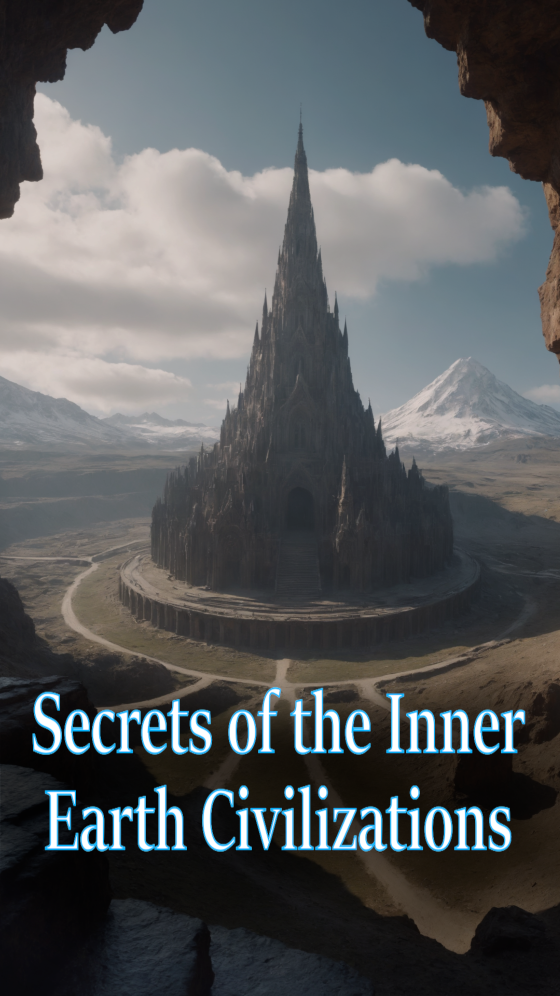
  • Secrets of the Inner Earth Civilizations Revealed: What Admiral Byrd Really Saw

    Secrets of the Inner Earth Civilizations Revealed: What Admiral Byrd Really Saw

    In my previous article, I explored how inner alchemists and sorcerers manipulate awareness to traverse space and time. I proposed that the perceived duality of concave and convex spaces—often interpreted by the physical senses as fixed dimensions—is an illusion shaped by intensity, a fundamental aspect of time. Intensity, in this context, functions analogously to gravity: as you shift the intensity at any given spacetime coordinate, you effectively alter the gravitational influence of that point. This means that by mastering awareness—by modulating the emotional, mental, or energetic intensity within a moment—the practitioner can bend the fabric of perceived reality, creating pathways through what might otherwise seem like impenetrable barriers of time and space.

    Following that discussion, a reader posed an intriguing question about inner civilizations. He suggested that accounts like Admiral Byrd’s legendary expeditions—where vast, hidden landscapes were reported deep within the Earth—might not describe a literal hollow world, but rather glimpses into parallel universes. In his view, these “vistas” could be portals or windows into alternate dimensions, where such civilizations exist independently of our own physical planet. This raises a compelling question: Are these phenomena evidence of a subterranean reality, or are they manifestations of overlapping planes, accessed through altered states of perception?

    In this article, I’ll delve into this idea using what I call inner sense, or seeing—a mode of perception that transcends conventional senses to discern the subtle energetic architectures of existence. My aim is to examine whether these legendary inner realms are physical locations, metaphysical constructs, or something more fluid—a convergence of both. By unpacking the mechanics of how awareness interacts with dimensional boundaries, we can explore whether these “portals” are fixed gateways or dynamic thresholds shaped by the observer’s own intensity and intent.

    If inner civilizations exist as parallel worlds rather than geological terrains existing in a map like mundane world, it suggests that the Earth—and perhaps all matter—is interlaced with vibrational layers, each accessible through specific manipulations of consciousness. This aligns with the alchemical principle that reality is mutable, and that the distinction between inner and outer, concave and convex, is ultimately a matter of perspective. And yet, in the same way that we can map the stars, but ultimately the stars are not functionally mappable using current linear physical conceptions (as we currently understand them), these other worlds are here but in a sense not here. This is where language fails and we end up with what I refer to as a sorcery Catch-22: we are, but at the same time we are not, this is, but at the same time it is not. Over the course of this exploration, we’ll dissect how these layers vibration and location might interface with human perception, and what it means for those who seek to move beyond the limits of ordinary space and time.

    The Inner Earth as a Dimensional Portal: Caves, Intensity, and the Movement of Awareness

    In the framework of inner alchemy and sorcery, the so-called “inner earth” is not a physical cavity within the planet but a a whole other world as physical as this one that is accessed through what could be termed a dimensional portal—a convergence point where awareness intersects with parallel realities. This distinction is critical. Where conventional thought insists on a literal hollow space beneath our feet, the inner alchemist perceives a threshold, a malleable boundary shaped by the intensity of consciousness itself. The caves, chasms, and subterranean voids reported by explorers like Admiral Byrd are not geological anomalies in the sense of the perceiver using (what are honestly) flawed physical senses. They are instead witnessing energetic apertures, portals in a sense, to other dimensions. And the nature of these portals (the exact way in which they are perceived) is determined by the observer’s own cognitive alignment.

    The Role of Caves and Hollow Structures
    Caves hold a unique function in this dynamic. Their depth, isolation, and mineral composition (often rich in quartz or other piezoelectric materials) create natural amplifiers for shifts in awareness. In darkness, the physical senses falter, and the mind’s reliance on external input diminishes. This sensory deprivation forces an inversion of perception—what sorcerers call the unwinding of the cognitive point. The cave becomes a resonator, its hollow form mirroring the internal void where awareness reconfigures itself. Here, intensity—whether emotional, energetic, or intentional—acts as a gravitational force, bending the perceived fabric of space-time.

    Intensity as Gravity, Awareness as Movement
    To equate intensity with gravity is to recognize that both govern attraction and distortion. Just as a black hole warps space-time through density, a surge of emotional or psychic intensity alters the “weight” of a moment or location. This is why heightened states—ecstasy, terror, or deep meditation—can collapse temporal linearity, making seconds stretch into eternities or hours vanish in an instant. The sorcerer manipulates this gravity by shifting their awareness, deliberately anchoring or destabilizing their cognitive point to “fall” into adjacent dimensions.

    Modern physics hints at this principle through theories of warp fields and quantum tunneling, where energy concentrations create folds in space-time. But where technology seeks to engineer these effects externally, the inner alchemist operates from within, using the self as the instrument. Movement is not a matter of traversing physical distance but of reassembling perception. A cave’s mouth, a polar vortex, or even a dreamscape can serve as launch points—not because they are literal gateways, but because their inherent intensity destabilizes the default mode of perception, allowing the cognitive point to slip into alternate configurations of reality.

    The Dogmatic Trap of Physicality
    The insistence on purely physical explanations—hollow earth as a cavernous network, portals as mechanical structures—stems from a perceptual rigidity that conflates what is sensed using only the physical senses with what is. This dogma treats awareness as a passive receiver rather than an active sculptor of reality. Yet sorcerers understand that all perception is projection: the world we experience is a consensus construct, assembled moment by moment through the cognitive point. To move beyond it requires relinquishing the assumption that space and time are fixed.

    This is not abstraction. Those who’ve entered these states describe a tactile reordering—a sense of being “pulled” or “dissolved” as awareness reorients. The portal is not a door to be opened but a frequency to be matched. Caves and other vortices merely provide the conditions for this recalibration, their depths acting as mirrors to the inner void where the self is unmade and remade.

    Implications for Exploration
    If the inner earth is a dimensional interface, then “exploration” becomes an act of inner refinement. The tools are not pickaxes or sonar but disciplined shifts in awareness. The stories of subterranean civilizations—Agartha, Shambhala—are not myths of hidden cities but that exist in other dimensional locations. They are quite literal and physical parallel existences, accessible only when the cognitive point aligns with their vibrational signature. This alignment is the sorcerer’s art: the deliberate modulation of intensity to navigate the gradients of gravity that bind perception to a single reality.

    Let me repeat that because it is potentially the most important thing that I have ever said:

    This alignment is the sorcerer’s art: the deliberate modulation of intensity to navigate the gradients of gravity that bind perception to a single reality.

    The caveat, then, is this: the portal exists where awareness permits it. To the literalist, it remains a geological curiosity. To the sorcerer, it is a living threshold, its nature revealed only through the relentless manipulation of the self.

    The Architecture of Portals: How Geological Formations Shape Interdimensional Transit

    The challenge in discussing these concepts lies in the limitations of language itself. Words are bound to the rationality of the physical senses, making it difficult to articulate realities that operate outside linear space and time. Yet the relationship between caves—those hollowed structures within the Earth—and the inner civilizations they connect to is not metaphorical. It is architectural. The very shape of these subterranean spaces determines which portals become accessible, much like how the design of a lens focuses light into specific patterns.

    Geology as Gateway Geometry
    Not all caves function as portals, and not all portals require caves. But certain formations—those with precise angular alignments, resonant chambers, or non-Euclidean geometries—act as natural amplifiers for intensity. These are not arbitrary features. A cavern with walls meeting at acute angles, for instance, can concentrate energy in ways that warp local spacetime, creating a focus point where awareness shifts. Similarly, tunnels that spiral in mathematically irregular sequences (found in some lava tubes or karst systems) disrupt the cognitive assembly of reality, forcing the observer’s perceptual framework to reconfigure.

    The distinction between natural and constructed formations is critical. Some portals are accidents of geology: ice caves in polar regions, quartz-lined voids in mountain ranges, or basalt columns with harmonic resonance. Others were deliberately engineered by ancient civilizations, their layouts mirroring celestial alignments or sacred geometries designed to stabilize the portal’s frequency. In both cases, the architecture dictates the type of transit possible. A smooth, domed chamber might facilitate movement to a world with analogous fluid dynamics, while a jagged, crystalline fissure could lead to a reality where light behaves differently.

    The Paradox of Physical Transit
    To call these journeys “physical” is both accurate and misleading because it doesn’t take into account the fact that all space is here, all time is here. The physical senses tell us that we move from one place to another, but from the sorcerer’s point of view we are disassembling one world and assembling another. So, a powerful disassembly would seem like a person banishes and goes somewhere else, but that somewhere else is right there where they seem to have been before. In a sense they have not moved, they have just entered a different parallel dimension that is exactly in the same place and yet in a completely different reality altogether. This is most difficult to explain using typical rational mechanics.
    When a sorcerer or explorer steps through such a portal, their body doesn’t (in the sense) vanish from one location and reappear in another like a teleportation device in fiction. Instead, the context of their physicality changes. They cross into a world where the laws of matter and energy are equally concrete but governed by different relationships between intensity, gravity, and time. This is why accounts from those who’ve traversed these thresholds describe sensations of reassembly—a momentary dissolution of form, followed by reintegration into a new framework of physics. Others might say that they entered a vacuous space, where all sound seemed to stop, like a shadow world in between worlds. This is the void in between dimensions. Had they continued their journey, they would have entered a completely new world.

    For example, a person entering a portal within a deep limestone cave, after experiencing a void period, might find themselves in a world where the sky is a crystalline canopy and the ground emits its own light. From there, boarding a “ship”—a vessel designed to navigate that realm’s unique energetic currents—could allow travel to what appears to be another planet; essentially, a journey from the inner earth to another planet. But how is this possible? This would seem impossible if it were truly the inner earth, as internally there’s supposedly no way beyond our own planet – the inner earth being considered a closed system. However, in these (supposed) inner civilizations, you aren’t actually entering the inner earth; that perception is merely an illusion of the physical senses. Instead, you are entering a wholly new parallel world, and an entire universe supported by its own cosmos. The illusion of “inner” versus “outer” collapses once intensity—not distance—becomes the metric of movement.

    Warp Technology and the Fluidity of Dimensions
    Modern physics edges toward this understanding with theories of warp fields and quantum entanglement, where space compresses or folds under specific conditions. The sorcerer’s method is a biological and energetic parallel: by modulating their own intensity (through ritual, meditation, or crisis), they replicate the warping effect internally. The cave or portal structure merely provides the initial catalyst, a pre-existing curvature in spacetime that their awareness can latch onto and extend.

    This explains why some portals are transient, opening only during celestial events or emotional upheavals, while others remain stable for millennia. The latter are often anchored by megaliths or mineral deposits (like piezoelectric quartz) that sustain the required energy gradient. In contrast, temporary portals rely on fleeting convergences—say, the alignment of a cave’s shadow at dawn with a particular emotional state in the observer.

    The Linguistic Barrier
    Language falters here because it cannot convey the simultaneity of these experiences. To say a portal “leads to another world” implies linear progression, when in truth, the other world is already present, just unassembled in the observer’s cognitive point. The cave’s geometry acts as a tuning fork, vibrating at a frequency that collapses the probability wave of one reality and amplifies another. This is not mysticism but hyperdimensional physics, where “location” is a function of perception’s focal depth.

    Attempts to describe these mechanics often default to paradox: the portal is both a place and a process; the traveler both moves and stays still; the other world is alien yet intimately connected. But these contradictions arise from the insistence on separating “physical” from “non-physical.” In the deeper framework of inner alchemy, such divisions are illusory. The cave’s angles, the portal’s focus, and the traveler’s awareness are facets of the same phenomenon—intensity crystallized into form.

    The implications are vast and are directly related to UFO sightings. If civilizations exist in these parallel layers, their “physical” technology (like ships or energy systems) would operate on principles that seem magical to us, just as a smartphone would seem miraculous to a medieval peasant. Yet their reality is no less solid, no less bound by its own rules. The portal is not an escape from physics but an entryway into a broader spectrum of it. And being that they are bound to their rules, upon entering this reality, this parallel world, the very intensity of this world reshapes their technology. This is why such sightings often speak of ships changing form. This is also highly important point that must be considered carefully.

    To explore these realms demands more than courage; it requires retraining perception to see the world not as a fixed stage but as a dynamic interplay of intensities, where every rock, every curve of a cavern wall, hums with the potential to become a doorway, and hot angle that can be stepped through, quite literally step through innocence, in order to find a hidden world on the other side… Beneath.

    The True Nature of Portals: Caves, Granite Structures, and the Physics of Transcendence

    The caves and geological formations that act as portals do not lead to imaginary realms or abstract dimensions—they open into other physically real worlds, as concrete and structured as our own. When Admiral Byrd described vast, uncharted landscapes during his Antarctic flights, he was not witnessing a hollow Earth or a geological anomaly. He was observing the momentary convergence of his cognitive point with an intensity node—a point where spacetime folded due to the alignment of geography, energy, and perception. What appeared as a chasm or a concave curvature bending inward was, in truth, a threshold to a parallel reality.

    The Illusion of Concave and Convex
    The deception lies in the limitations of the physical senses. To an observer outside the portal, the entrance may seem concave—a void swallowing space. But upon crossing, that concavity collapses into a new convex framework, a stable reality governed by its own physics. This shift mirrors the mechanics of time manipulation: just as emotional intensity dilates or compresses temporal perception, the portal’s architecture warps spatial perception. The traveler does not “disappear” into a hole; they reassemble into a different configuration of existence, one where the local rules of matter and energy apply just as rigidly as they do here.

    Granite Structures and Missing Persons
    David Paulides’ research on disappearances in North America’s wilderness—particularly around granite formations—hints at this phenomenon. Certain rock configurations, whether natural or engineered, act as inadvertent portals. Their mineral composition (granite’s quartz content, for example) and angular geometries create zones where intensity points fluctuate unpredictably. A hiker stepping into such a zone might experience a sudden recalibration of awareness, their cognitive point latching onto an adjacent reality’s frequency. To outside observers, they vanish without trace. To the displaced individual, they’ve entered a world as tangible as the one they left—just governed by different gravitational or temporal constants.

    Pyramids as Engineered Portals
    The ancient pyramids of the Americas take this principle further. Their design incorporates non-Euclidean angles—precise slopes and chambers that defy conventional geometry—to manipulate the occupant’s awareness. Unlike naturally formed caves, which rely on natural resonances, these structures were built to function as transit hubs. A sorcerer entering such a pyramid would encounter walls and passageways that destabilize ordinary perception. The angles act as lenses, bending the cognitive point until it aligns with a target reality. The result is not metaphysical speculation but a repeatable technology: a door that opens only when the traveler’s internal intensity matches the structure’s energetic signature.

    Warp Technology and the Future of Transit
    The implications for future exploration are hopefully profound to those willing to listen. If portals exist as intersections of geometry, intensity, and awareness (which could be replicated using plasma; plasmoids), then “warp technology” would not require incredibly exotic machinery but a mastery of these variables. Just as Byrd’s flight path intersected with a portal through a confluence of Antarctic geology and his own navigational focus, engineered portals could function as interstellar or interdimensional highways—not by traversing physical distance, but by reconfiguring the traveler’s relationship to spacetime itself.

    The key lies in recognizing that “location” is not fixed. A cave in Antarctica, a granite outcrop in the Rockies, and a Mayan pyramid are all nodes in a vibrational network, each tuned to specific realities. The sorcerer’s art—and eventually, humanity’s science—will be to map these nodes and navigate their gradients. The missing persons, the legends of subterranean civilizations, and the accounts of Byrd’s anomalies are not mysteries but waypoints in a larger topology of existence that must take into account what I have termed odd angles and non-Euclidian structures.

    To study these portals is to accept that the Earth is not just a planet but an interface in a sense —a membrane between worlds, waiting for those who know how to see and can therefore manipulate their cognitive position; their awareness.

    So how does one engage in this act of inner refinement that requires tools that are not pickaxes or sonar? Well, a good place to begin is to learn to project consciousness either through astral travel, or through what I referred to as the way of the projectionist. If you would like to know more about these techniques, then I recommend the books: The Way of The Projectionist or Out of Body Experiences Quickly and Naturally.

  • The INside is OUTside: Flat Earth, Warping Technology, and Unveiling the Greatest Secrets of Inner Alchemy

    The INside is OUTside: Flat Earth, Warping Technology, and Unveiling the Greatest Secrets of Inner Alchemy

    For inner alchemists, the world reveals itself in ways that most people never experience. By using their inner senses—perceptive abilities that extend far beyond the familiar five physical senses—these practitioners of inner alchemy perceive a universe vastly different from the one commonly understood. This act of looking within, rather than relying solely on external observations, opens up new realms of understanding and exploration.

    The inner senses allow alchemists to delve into perspectives on reality that transcend conventional wisdom. These viewpoints go well beyond the standard, often dogmatic understanding of the world that most people accept without question. Many individuals simply believe what they’re told about reality, taking it as truth because it comes from sources they view as authoritative—be it academic institutions, religious bodies, or those in positions of power.

    By contrast, inner alchemists cultivate a more nuanced and expansive view of existence. They recognize that reality is far more complex and multifaceted than what can be perceived through physical senses alone. This broader perception enables them to explore dimensions of experience that remain hidden to those who rely solely on conventional means of understanding the world.

    The practice of inner alchemy involves developing and honing these internal perceptive abilities. It’s a process of turning inward, of quieting the constant chatter of the mind and the ceaseless input from the physical senses. In this state of inner stillness and receptivity, the alchemist becomes aware of subtle energies, unseen connections, and deeper truths about the nature of reality.

    This expanded awareness isn’t just a matter of passive observation. Inner alchemists use their heightened perceptions to actively engage with and influence the world around them. They understand that thoughts, feelings, and intentions are powerful forces that shape reality in ways that go unnoticed by those limited to a purely physical understanding of cause and effect.

    The perspectives gained through inner alchemy often challenge widely held beliefs about the nature of consciousness, the structure of the universe, and the limits of human potential. These insights aren’t based on faith or blind acceptance of authority, but on direct, personal experience. Inner alchemists don’t just believe in a more expansive reality; they perceive it directly and interact with it consciously.

    This approach to understanding reality is both ancient and cutting-edge. It draws on wisdom traditions that have explored the inner landscapes of human consciousness for millennia, while also aligning with some of the most advanced concepts in quantum physics and consciousness studies. Inner alchemy bridges the gap between subjective experience and objective reality, recognizing that the two are intimately interconnected.

    For those new to these concepts, the idea of perceiving reality through inner senses might seem strange or implausible. However, inner alchemists maintain that these abilities are inherent in all humans, merely dormant in most. The practice of inner alchemy is, in essence, a process of awakening and developing these latent capacities.

    The Seeing of Inner Alchemy

    In the practice of inner alchemy, we will refer to the perception achieved through the inner senses as “seeing.” This form of seeing is not about observing the external world through physical eyes but rather involves an inward exploration that reveals hidden aspects of reality. Through this seeing, inner alchemists uncover possibilities that fundamentally alter our understanding of existence. One such profound insight relates to the nature of space itself, particularly its relationship with time and intensity.

    From the perspective of inner alchemy, space is not a static or empty void but a dynamic entity influenced by time and the intensity of time (you can think of intensity as the energy density of time).

    When viewed through the inner senses, space can be seen as a kind of gravitational field shaped by these forces; like a giant energetic sea that fluctuates with tides and currents that could be measured as gravity, or intensity (which again could be viewed as the density of energy, or the information transfer rates of any particular point in space).

    Time, in this context, is not linear but operates as an integral factor that interacts with space and intensity. Inner alchemists perceive time as a dimension that bends and folds in response to energetic fluctuations within space. This bending of time creates patterns or fields that influence how events unfold and how matter organizes itself. When seen through the inner senses, these patterns reveal themselves as energetic currents or waves; forces that shape reality in ways imperceptible to ordinary vision.

    The gravitational field analogy is very apt and arises from this interplay between space, time, and intensity. Just as gravity exerts an invisible force that shapes physical objects and trajectories, intensity acts as a subtle force that molds the energetic structure of space-time and therefore, to equate gravity and intensity as being the same thing is indeed quite accurate from the point of view of inner alchemy.

    In essence, seeing through the inner senses offers a radically different perspective on space-time; one that emphasizes its dynamic, interconnected nature. By perceiving space as an energetic field shaped by time (and therefore the intensity of time), inner alchemists unlock new ways of interacting with and understanding the universe. This expanded view not only enhances personal growth but also provides profound insights into the fabric of existence itself.

    The True Shape of The Universe

    From the perspective of inner alchemy, the ideas of concave (curving inward) and convex (curving outward) are ultimately not real. They aren’t built-in features of the Earth itself, but rather how our own mind perceives things. This perception and awareness can change a lot depending on things like size (how big or small the thing we are looking at is), location (where we are standing), and even gravity (which as I have said is an aspect of intensity according to inner alchemy).
    In inner alchemy, gravity is also seen as a change in our awareness or its intensity. Because a being that is aware is sensitive to time, it experiences time differently depending on its state of mind. For such a person, time feels different based on how strong or focused their awareness is at any given moment. This means, incredibly, that from the inner alchemy point of view, we can control gravity through awareness. This is a very big secret.

    So, this means that when we talk about concave and convex, the way we see the world is shaped by our awareness, with concave having a kind of pulling IN gravity, while convex having a pushing OUT gravity. It’s even possible for something to be both concave and convex at the same time, depending on how we perceive it.

    This might sound strange, but think about the work of a mathematician named Martin Gardner. He famously wrote that “most mathematicians believe that an inside-out universe, with properly adjusted physical laws, is empirically irrefutable.” This isn’t just a strange idea; it actually fits with the main ideas of inner alchemy. It suggests that it’s just as likely that we could be living inside something as it is that we are living on the outside of a round object, which is what science usually tells us. And inner alchemy makes the very strong claim that through its practices, we can actually switch between being inside and outside (concave and convex) by changing our awareness. And by doing so we can quite literally warp space through the manipulation of the intensity of time!

    Consider this idea: the Earth, at certain levels of intensity of awareness, can be perceived as concave – curving inward, like the inside of a giant ball. As small beings on the surface of the Earth who are aware, we often see it as flat and stretched out. Sometimes, it even seems to curve upward like we are in a shallow bowl. This is how we see things when we are on the Earth. However, when we think about planets or stars that are far away, the way they appear changes to convex – expanding outward into areas of existence that seem like separate worlds. This means that when we look away from the Earth and out into space, we see other planets that look round from our viewpoint. When we are on Earth, we feel like we are on a flat or bowl-shaped surface, but when we look at the stars, we see planets as round balls floating in space.

    Concave and convex shapes change and shift in relation to each other and to the awareness of the person seeing them. This gives us different ways of seeing things depending on where we are, how big we are, and our level of relative intensity of awareness. So, when we look outward – using our physical senses – these outer planets look like distant round objects, like points of light. However, these “other planets” are not just be separate objects floating in space. Instead, they can be better understood as dimensional doorways – places where different aspects (different dimensions) of reality meet and become accessible, all separated by the void of space.

    Each doorway, viewed from afar, takes on a convex, spherical shape. But the closer one approaches that portal, the more it seems to extend (grow larger) until it ultimately wraps around, enveloping you within a convex energetic pattern. As you pass through the portal, you enter that sphere; once within, you are no longer observing a convex form—instead, you find yourself immersed in a concave universe.

    This concept is inherently difficult to articulate due to the layers of dogmatic assumptions—rationality or the facts of the times—that have been imposed upon physical perception. The physical senses, in themselves, are often inaccurate, but they become even more problematic when overlaid with these ingrained beliefs. These beliefs act as a form of hypnosis, effectively altering and sometimes narrowing the physical senses through the dogma and manipulative forces of the times; what we might refer to as the rationality or sanity of the times. Yet, if left unburdened by such influences, the physical senses naturally reveal numerous inaccuracies that should be explored; however, they are routinely dismissed because of the prevailing rationalizations—dogmatic illusions—of our era. This routine to dismiss is what I have referred to as rational skepticism.

    The difficulty in grasping this concept stems from our deeply ingrained reliance on external senses and the authority of established scientific dogma. We’ve been conditioned to accept a fixed model of reality, one that prioritizes objective measurement over subjective experience. However, inner alchemy proposes an alternative: a world where perception is not merely a passive reception of data but an active shaping force.

    Gardner’s mathematical explorations are relevant here. He demonstrated how, within certain geometries and with adjusted physical laws, it becomes mathematically consistent to describe the universe as being “inside-out.” Imagine a surface that curves both inward and outward simultaneously. This isn’t a contradiction; it’s a shift in perspective. What appears convex from one vantage point can appear concave from another, depending on how space is folded and warped. The interchangeability of these shapes isn’t just an abstract mathematical concept; inner alchemy proposes it reflects the fundamental nature of reality itself; a reality that is fluid, responsive to awareness, and far more complex than our conventional models allow.

    The Earth is Neither Flat or Round but Both! Warping Technology and Beyond

    From the inner alchemy perspective, the pervasive illusion that we reside on the outer surface of a convex sphere – our planet Earth – is itself an illusion. Or perhaps more accurately, it’s a function of awareness. We perceive ourselves living on this exterior surface due to inherent limitations within our physical senses and because of deeply ingrained belief structures propagated by those senses. These beliefs are then further reinforced and often subtly manipulated through societal conditioning and established authority figures.

    It’s not that the outer world doesn’t exist, but rather that our perception of it is filtered and constrained in a particular way.

    Inner alchemy proposes something that appears utterly absurd from the viewpoint of contemporary rationality; the dogma of our times. It states, quite plainly, that by actively changing awareness—by consciously manipulating one’s state of being—it’s possible to transcend the perceived limitations of space. And as we’ve established, this transcendence occurs through the manipulation of time, which is fundamentally a function of intensity. Increasing or decreasing an individual’s internal intensity shifts their experience of time and, consequently, their relationship with space.

    Through these controlled changes in awareness—these shifts in internal intensity—it becomes possible to seemingly move into what appears to be outward expansion, to go “outward” by going within. This is a cornerstone concept of inner alchemy: the understanding that true exploration isn’t about traversing physical distances but about altering one’s perceptual state to access different dimensions or aspects of reality. It’s not about physically moving through space; it’s about shifting the very fabric of space around the observer.

    Mathematicians like Martin Gardner, with their explorations into non-Euclidean geometries and the possibility of “inside-out” universes, offer a crucial pathway for science to begin bridging this gap in understanding and manipulation of spacetime. Their work provides a framework—a mathematical scaffolding—upon which a deeper comprehension can be built.

    Inner alchemy, through its profound understanding of the illusory nature of inside and outside, of concave and convex, is able to “travel” within; a journey that is, in reality, travel without. They move across spacetime in ways that might appear as illusion or even magic from an external perspective. This involves manipulating what can only be described as odd angles; exploiting the principles of Non-Euclidean Geometry.

    Consider this: In non-Euclidean geometries (such as hyperbolic or spherical geometry), traditional notions of concavity and convexity fundamentally break down. On a spherical surface, for instance, every “straight line” – technically known as a great circle – divides the sphere into two equal halves. Crucially, in this context, the concepts of “inside” and “outside” become entirely dependent on perspective. What appears to be inside from one location might appear outside from another, simply due to the curvature of the surface.

    This suggests that spatial relationships like concavity and convexity are not absolute properties but rather relative constructs—dependent on the geometry in play and the observer’s position within it. Inner alchemy understands this principle at a visceral level, applying it not just to physical space but also to the dimensions of consciousness itself. They recognize that by altering one’s internal state – shifting their awareness – they can effectively warp spacetime around themselves, creating pathways and shortcuts that would be impossible to perceive through conventional means.

    The hope is that someday science will begin to resemble inner alchemy in its approach—moving beyond a purely materialistic understanding of the universe towards one that acknowledges the profound role of consciousness in shaping reality. This emerging field, which I’ve tentatively termed “Mind Science,” could potentially achieve what currently seems impossible: travel across spacetime by going within, rather than solely relying on outward propulsion. This is, at its core, warping technology – a means of manipulating the very fabric of space and time. And indeed, it is the now of inner alchemy; a practice that has been utilizing these strange angles to traverse spacetime for eons, long before modern science even began to consider such possibilities.

    Infinite Possibilities

    Ultimately, this is the greatest secret of inner alchemy: inside and outside are, in essence, illusions. These aren’t mere philosophical musings; they are fundamental truths about the nature of reality as perceived through direct experience. These illusions arise from an overreliance on our outer physical senses—senses that themselves are subtly manipulated by forces operating beyond current rational understanding. We’ve become so accustomed to interpreting the world solely through these limited filters that we’ve forgotten there are other ways of knowing, other dimensions of perception available to us.

    Through the act of letting go of this dogma – releasing ourselves from the constraints of conventional thinking and sensory input—and through dedicated practices focused on moving within, manipulating awareness and intensity points, inner alchemists are able to traverse space and time in ways that defy ordinary explanation. It’s not about escaping our physical bodies; it’s about transcending the limitations imposed by a narrow perception of reality.

    The key for science going forward—the crucial breakthrough needed to unlock true warping technology—lies in understanding that space is not relative to time, and time is not relative to space. This may seem contradictory at first glance, but it represents a fundamental shift in perspective. Current scientific models often treat these as intertwined variables within a single framework. Inner alchemy reveals them as distinct yet interconnected aspects of a greater whole; aspects that can be manipulated independently when one understands the underlying principles. It’s akin to realizing that a wave isn’t simply a disturbance in water, but rather an expression of the water itself, existing alongside and influencing its broader form.

    This is a further secret arrived at through “seeing”—that ability to cultivate and utilize the inner senses to perceive greater and more nuanced aspects of reality. As I have stated on numerous occasions, we are far bigger on the inside than we appear to be on the outside—but again, this too is an illusion. Our perceived “insides” are, in truth, extensions outward into vast realms of existence. What we currently believe to be the “outside” of us – our physical form as defined by dogmatic and rationalistic perspectives – is merely a small and pale reflection of the marvel that lies without—a tiny fragment of an infinitely larger reality.

    Understanding these secrets is the utter essence of inner alchemy. However, such understandings cannot occur solely through conceptual thought or intellectual analysis. They must be practiced; they must become visceral; they must transform into undeniable facts for the individual through direct action and perception. It’s not enough to understand the concept of shifting awareness; one must experience it—feel the subtle shifts in space-time, witness the unfolding of new dimensions within oneself.

    To that end, I recommend exploring the Magnum Opus Trilogy. Within those books, you will find a comprehensive guide to unlocking your inner senses, learning how to project consciousness and “go within”—which is, in reality, going without—and gaining an understanding of the countless layers and dimensions available to an aware being. It’s through this dedicated practice that the illusions begin to dissolve, revealing the boundless potential that resides within each of us – a potential for exploration, transformation, and ultimately, a deeper connection with the universe itself.

  • Breaking the Chains: Inner Alchemy and the Rebel’s Path to Self-Empowerment

    Breaking the Chains: Inner Alchemy and the Rebel’s Path to Self-Empowerment

    In the labyrinth of language, terms are not mere signposts but living, breathing entities, shapeshifting according to the winds of context and time. They are slippery creatures, these words, wriggling out of one’s grasp like eels coated in oil when one tries to pin them down. You utter phrases using specific verbal tools, and they seem to resonate with an inner harmony, a symphony that aligns perfectly with the underlying logic of the era. This logic, this governing rationale, is not some abstract, ethereal concept but a tangible force, as real and present as the air we breathe. It is the dogma of our times, the unspoken rules etched into the fabric of society at any given moment in history.

    Dogma, oh dogma, it is more than just a word; it is the very skeleton that supports the flesh of societal structures. It is the expounded reality, the rulebook written in invisible ink, known yet unseen, governing our actions and beliefs like an unseen puppeteer pulling strings. This dogma represents what is deemed right or true within a specific society at a particular juncture in space and time. It is the lighthouse beam guiding ships through stormy seas, ensuring they stay on course, that they don’t veer into the unknown abyss. Authority figures, those custodians of knowledge and power, are the keepers of this dogma, diligently expounding it like ancient scribes, preserving it for generations to come. They weave it into the fabric of our beings, so much so that we become indoctrinated, molded into a specific pattern of thought and action.

    This molding is not necessarily nefarious; indeed, it can be the very glue that binds society together. It allows individuals to coexist, to collaborate, to have faith in one another’s actions. Imagine a grand symphony orchestra where each musician plays their part in harmony with the rest. This harmony enables collective progress, ensures that the music—metaphorically speaking, societal function—keeps flowing smoothly.

    However, this harmony can curdle into discord easily, and it is often the case that conductors are tyrants, wielding their batons with iron fists. The power dynamics shift, and what is somehow supposed to be a nurturing framework, becomes an oppressive regime; an Archonic state that parasitically feeds off of its citizens. Instead of fostering cohesion and individuality, dogma spawns automatons, drones in a vast machine, blindly performing tasks without question or deviation. These are not individuals but cogs, indistinguishable from one another, their unique spark extinguished by the relentless grind of conformity.

    Enter inner alchemy, a rebellious whisper in the cacophony of societal noise. It stands defiant against dogma, daring to challenge the conditioning that has become second nature. Inner alchemy is not content with the status quo; it yearns for something more, something different. It is the spark that ignites within the breast of the individual, urging them to transcend the boundaries set by governing powers. These boundaries are like a cage without walls—a paradoxical enclosure where the bars are not physical but psychological, invisible yet impenetrable.

    These intangible bars are forged from years of conditioning, reinforcing belief systems until they become as solid as iron. They demarcate safe zones, parameters within which we operate, lest we venture into chaos, a.k.a. freedom and unique independence. The rulers, often more interested in maintaining order than nurturing individuality, enforce these limits, ensuring everyone remains a predictable part of the machine.

    Inner alchemy, therefore, at that moment, becomes synonymous with the left-hand path; a term laden with connotations of deviation from the normal, the sane, the rational world; normativity. And such fear mongering has some truth in it because this path is not for the faint-hearted; it demands an extraction from the drone-like state, a shedding of the programmed self. It is a call to arms, urging individuals to break their chains, to question the dogma that has seeped into their very marrow.

    This concept echoes through philosophical halls, resonating with the words of Nietzsche, who advocated for the creation of one’s own morals, a rebellion against herd mentality. His philosophy introduces eternal recurrence; a notion both terrifying and exhilarating. Imagine being prepared to exist in an endless loop where time has no meaning, where life repeats ad infinitum. It is a crucible, a closed off vessel, a cage forging strength, tempering the soul until it can withstand the relentless cycle of existence without breaking.

    Internal Recurrence the Inner Alchemy Way

    In my interpretation of this iconic Nietzschean term (oh, those slippery terms again), eternal recurrence is not just a philosophical musing but a reflection of humanity’s incarceration within the incarnational cycle. Birth, death, rebirth: a never-ending carousel that traps us in its ceaseless rotation. Inner alchemy does not merely seek to break the cages imposed by society; it aims higher, daring to challenge mortality itself. It posits that through dedicated practice, one can transcend this endless cycle, achieving total liberation—not just from societal constraints but from death’s finality.

    This is where inner alchemy earns its rebellious stripe, aligning with the left-hand path. It champions individual autonomy, asserting that true freedom comes from within, not from external validation or control. This pursuit of power and autonomy is often misconstrued, equated with malice due to societal conditioning; fear mongering is a wonderful form of control. The depth of dogmatic binding clouds judgment, preventing one from seeing beyond the prescribed boundaries.

    Power and autonomy are taboo subjects in many circles, shrouded in fear and mistrust. Dogma, narrative, and term control posit that personal power, and autonomy must be part of the left-hand path, and that path is about control over others. But inner alchemy is not so easily contained, because a simple look into its core principles will show you that it has nothing to do with control over others. It is about mastering oneself, transmuting the individual self rather than seeking dominion over external worlds or people. The practice is solitary, introspective, focused on dismantling the walls that confine us.

    We do not seek to impose our will on others; instead, we focus on liberating ourselves from internal shackles. This liberation is not an evil pursuit but a journey towards freedom; a natural rebellion against societal constraints. It is equated with the left-hand path and labeled ‘evil’ because it defies conventional norms, threatening the status quo. But beneath the surface lies a deeper truth: individuality, freedom, and the acceptance that others have their own paths to follow.

    Inner alchemy does not impose its will on the world; rather, it allows everything and everyone to exist as they are. It is about breaking personal barriers without encroaching on others’ journeys. This philosophy acknowledges the diversity of human experience, recognizing that each individual has their unique path to traverse. By embracing this perspective, inner alchemy fosters a harmonious coexistence where differences are celebrated rather than suppressed.

    The journey through inner alchemy is not a linear one; it winds and weaves like a serpent shedding its skin, revealing new layers of understanding with each molting. It demands courage; courage to question, to challenge, to defy the norms that have been ingrained since birth. This courage is not reckless but measured, born from an innate desire for truth and freedom.

    Terms are indeed tricky entities, but they hold immense power when wielded with intent. The rationale of our times, or dogma, shapes our reality, dictating what we believe and how we act. While this framework can foster societal harmony, it also risks stifling individuality, reducing us to automatons within a vast machine. Inner alchemy stands as a beacon against this homogenization, urging individuals to break free from their cages. In that sense you could say that it champions the left-hand path, because in the end it is a rebellious journey towards autonomy and freedom; a breaking down of the cage that traps humanity in an endless cycle of toil, pain and rebirth.

    But this path is not about exerting control over others, it is instead about mastering oneself. It involves transmuting one’s individual self, shedding layers of conditioning until the true essence shines through. Inner alchemy does not seek to impose its will on the external world; instead, it advocates for personal liberation while allowing others their autonomy. This philosophy celebrates all freedom, recognizing that each person has their unique journey.

    By understanding these nuances, we can appreciate inner alchemy not as an evil pursuit but as a profound quest for individuality and freedom. It is a rebellion against dogmatic constraints, proof of the indomitable spirit within each of us striving for liberation; not just from societal cages but from mortality itself. This journey demands courage, introspection, and unwavering dedication. Yet, it promises a reward beyond measure: true, unadulterated freedom.

    The Left-Hand Path Unveiled

    As we draw the curtains on our exploration of terms and their slippery natures, we find ourselves standing before an idol, a seemingly dangerous idol constructed by society at large and those that would maintain the automatons of the status quo. This idol is the term, the left-hand path. This phrase is a chameleon, shifting its colors depending on the light cast by cultural, historical, and individual perspectives. It is a labyrinthine term, one that demands careful scrutiny before we can hope to understand its true nature.

    The left-hand path is often depicted as a shadowy, treacherous trail winding through realms of forbidden knowledge and dark rituals. It is a path beset by warnings and shrouded in an aura of danger, like a dense forest at midnight, where each rustle in the undergrowth could signal the approach of unseen predators. This portrayal is not without merit; indeed, many who tread this route encounter challenges that test the very fabric of their being. Yet, to reduce the left-hand path (and by the same token the term inner alchemy) to mere darkness is to miss the depth and complexity it offers.

    To truly grasp the essence of the left-hand path, we must delve beyond surface perceptions and venture into its heart. This journey is not for the faint-hearted; it requires courage, resilience, and an unyielding curiosity. The left-hand path is a call to question, to challenge, to seek answers where others fear to tread. It is a path of individual empowerment, a rebellion against the shackles of societal expectation and dogmatic control.

    Inner alchemy, as we have explored, aligns closely with this concept. Both are rebellious acts, defiant stands against the conditioning that seeks to mold us into compliant cogs within a vast machine. Yet, while they share this common ground, there is a crucial distinction: inner alchemy provides not just the challenge but also the tools and techniques necessary to meet it head-on.

    Imagine standing before a formidable fortress, its walls towering and impregnable. The left-hand path might be seen as the daunting journey to scale those walls, confronting the guardians that patrol them. Inner alchemy, on the other hand, is the alchemical process that forges the ladder, the grappling hooks, and the armor needed to undertake this ascent. It equips the seeker with the means to vanquish their demons, to transcend the cages—those intangible yet inescapable barriers—that confine us.

    The left-hand path is often used as a tool of control, wielded by those who fear the power of unchecked individuality. By associating it with darkness and danger, they instill fear, ensuring that few dare to venture off the beaten track. This strategy is as old as civilization itself, a method of maintaining order at the cost of personal freedom. Inner alchemy, however, does not shy away from these shadows; instead, it embraces them, understanding that true liberation comes from confronting and overcoming our fears.

    In the realm of inner alchemy, there are no quick fixes or easy answers. The path is fraught with trials designed to test one’s mettle, to force a reckoning with the darker aspects of the self. Yet, within these challenges lie opportunities for growth and transformation. Each demon confronted, each fear vanquished, weakens the walls of the cage, bringing us closer to true freedom.

    This freedom is not the shallow, superficial liberation that comes from breaking external chains but a profound, inner emancipation. It is the realization that we are not defined by our pasts or the expectations of others. It is the understanding that our power lies within, waiting to be harnessed and wielded with purpose. Inner alchemy does not seek to impose this freedom on others; rather, it encourages each individual to forge their own path, to find their unique expression of autonomy.

    The left-hand path, then, is a misnomer when applied to inner alchemy. It is a term laden with societal fears and prejudices, designed to deter exploration rather than encourage it. Inner alchemy, in contrast, is about illuminating the shadows, turning fear into understanding, and empowerment into action. It is a journey towards unadulterated freedom, one that requires courage, introspection, and an unwavering commitment to self-discovery.

    For some, this path will indeed appear as goodness; an avenue leading away from the stifling cycle of suffering, life, death, and rebirth. For others, it may remain shrouded in mystery, its true nature obscured by societal conditioning and fear. Yet, regardless of perception, inner alchemy stands as proof of the human spirit’s indomitable quest for liberation. It is a call to arms, urging each individual to break their chains, to challenge the status quo, and to forge their own path towards genuine autonomy.

    Terms are living walls…or doorways to freedom

    In closing, let us remember that terms are not static entities but living, breathing concepts shaped by our perceptions and experiences. The left-hand path and inner alchemy are two such terms, each with its unique resonance and implications. By understanding their nuances and embracing the journeys they represent, we open ourselves to a world of possibility; one where freedom is not merely an abstract ideal but a tangible reality, waiting to be seized.

    This journey is long and fraught with challenges, but it is also profoundly rewarding. It demands that we confront our deepest fears, challenge our most cherished beliefs, and forge our own paths through the wilderness of existence. Inner alchemy provides the tools for this odyssey, equipping us with the strength and wisdom needed to overcome any obstacle.

    So, let us embark on this journey, not with trepidation but with open hearts and minds. Let us embrace the left-hand path as a metaphorical guidepost, reminding us that true freedom lies in defying societal norms and forging our own destinies. And let us remember that inner alchemy is more than just a rebellious act; it is a profound quest for individuality, autonomy, and unadulterated freedom; a journey worth undertaking, no matter the challenges that lie ahead.

    If you would like to know more about the path of inner alchemy, then may I suggest to you The Magnum Opus Trilogy of books. This trilogy is a transformative series that invites readers to embark on a profound journey of self-discovery and empowerment. These books are not merely guides, they are immersive courses in inner alchemy, offering practical techniques to transcend the limitations of the physical world and explore the deeper truths of existence. Whether you’re seeking personal freedom, enlightenment, or the tools to reshape your reality, this trilogy provides a clear and accessible path to achieve your goals. With no cryptic symbolism or hidden initiations, this trilogy is designed for anyone ready to embrace the Great Work of inner alchemy and unlock their true potential.
    The trilogy delves into fascinating topics such as creating the Philosopher’s Stone—a potent sphere of concentrated energy used to alter reality—and achieving immortality through mastery of energetic forces. The middle book, the way of the projectionist, explores how to project consciousness and move across the many rooms of the projectionist in order to finally attain immortality. The final book explores profound questions about life, death, reincarnation, karma, and the nature of God, providing answers from the perspective of an inner alchemist. Packed with illustrations, exercises, and structured routines, these books guide readers step-by-step through techniques for energy accumulation, perception enhancement, and personal transformation. Whether you’re an adept practitioner or a curious seeker, this trilogy offers both practical tools and philosophical insights to help you break free from life’s constraints and discover your own path to freedom.