
What if the greatest adventure of your life didn’t require a passport, a suitcase, or even your physical presence? Most of us live our lives within the strict boundaries of the biological machine, unaware that the ‘off’ switch to our physical limitations has been hiding in plain sight for millennia. From the high-altitude meditations of Eastern mystics to the documented anomalies of the Cold War, there is a persistent thread suggesting that your consciousness is far more mobile than you’ve been led to believe. It’s time to stop being a passenger in your own reality and learn how to pop the hood.
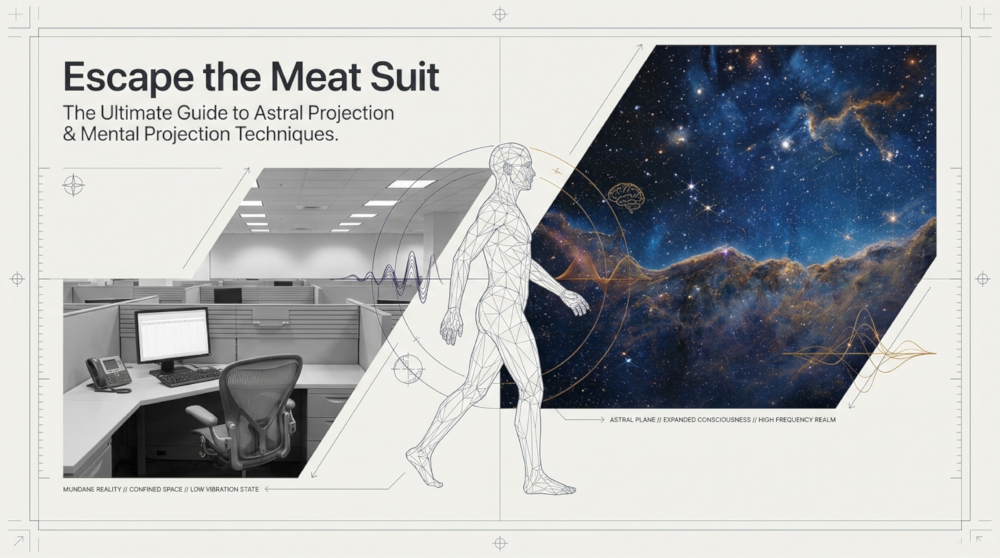
The Art of Mental Projection
A Journey Beyond the Physical Body, Beyond Linear Time, and Beyond the Known Boundaries of Human Consciousness
Mental projection is the art of shifting awareness from the physical senses into a vivid inner reality that feels just as real as the external world. It is the practice of stepping out of the ordinary and entering a realm where imagination becomes perception, where time stretches and bends, and where the mind discovers that it is far more expansive than the body it inhabits.
This is not simply a relaxation exercise. It is a doorway. A training ground. A method for exploring the deeper layers of consciousness that most people only glimpse in dreams. When practiced with intention, mental projection becomes a bridge between the physical world and the vast inner universe that lies beneath the surface of everyday awareness.
Understanding Astral Projection
The Experience of Consciousness Beyond the Body
Astral projection is the idea that your awareness can temporarily detach from the physical body and move freely through nonphysical environments. People who experience it often describe:
- Floating above their sleeping body
- Traveling through familiar locations with extraordinary clarity
- Entering symbolic or dreamlike landscapes
- Encountering beings or presences that feel intelligent and responsive
- Experiencing a sense of freedom from gravity, distance, and physical limitation
Whether interpreted as a spiritual journey or a psychological phenomenon, the experience is often vivid, coherent, and emotionally profound. It feels like stepping into a world where thought becomes movement and intention becomes action.
Psychological Time
The Inner Clock That Does Not Obey the Physical One
Psychological time is the experience of time that emerges when attention turns inward. When the mind becomes deeply absorbed in an inner world, the usual markers of physical time fade away. This is why:
- A fifteen minute meditation can feel like an hour
- A dream can contain days of experience in a few minutes
- A moment of intense focus can feel timeless
When someone learns to enter psychological time deliberately, the mind becomes capable of extraordinary expansion. It can explore inner landscapes with a richness that feels physical. It can experience long journeys in a short period. It can step outside the linear flow of seconds and minutes and enter a realm where time is shaped by attention rather than clocks.
This is one of the foundations of mental projection. The deeper the absorption, the more convincingly the inner world becomes a place you can inhabit.
A Deep History of the Art
Humanity’s Longstanding Fascination with Leaving the Body
The desire to explore beyond the physical body is ancient. It appears in myths, religious traditions, and spiritual practices across the world.
Ancient Egypt and the Bird Soul
The Egyptians believed that every person possessed several layers of being. One of these was the Ba, often shown as a bird with a human face. The Ba was free to travel during sleep or after death. It could visit the gods, roam the world, or return to the body at will. Tomb paintings show the Ba hovering above the sleeping or deceased body, suggesting that consciousness was never meant to be confined to flesh.
Eastern Mystics and the Path of Inner Travel
In Hindu and Buddhist traditions, the body is seen as a temporary vessel for a much larger field of consciousness. Yogis and monks developed meditation practices that quiet the senses until the mind becomes spacious and unbound. Ancient texts describe:
- Seeing distant places
- Communicating with teachers who are not physically present
- Entering realms of light and symbolism
- Experiencing unity with the cosmos
Medieval Accounts of Bilocation
During the Middle Ages, stories circulated about saints who appeared in two places at once. Saint Padre Pio and Saint Joseph of Cupertino were said to perform acts of charity far from the monasteries where their bodies remained in prayer. Whether interpreted as miracles or early accounts of consciousness projection, these stories show that the idea of the mind traveling independently has deep roots in Western history.
Shamanic Journeys Across the World
Shamans from Siberia, the Amazon, North America, and many other regions have long practiced spirit travel. Through drumming, chanting, fasting, or plant rituals, they enter altered states where they communicate with ancestors, animal spirits, or guiding forces. To them, the nonphysical world is not imaginary. It is a real environment with its own geography and inhabitants.
Modern Explorations and Scientific Curiosity
In the twentieth century, interest in out of body experiences grew alongside psychology and parapsychology. Researchers studied people who reported spontaneous episodes during sleep, trauma, or meditation. During the Cold War, governments explored remote viewing. Ingo Swann became one of the most well known participants in these programs. His reports helped shape modern discussions about the potential range of human consciousness.
Quantum Physics and the Possibility of Consciousness Beyond the Body
What Modern Science Suggests About the Flexibility of Reality
Quantum physics does not directly prove astral projection, but it does reveal that the universe is far stranger and more interconnected than classical physics ever imagined. Several concepts from quantum theory offer intriguing parallels to the idea of consciousness expanding beyond the body.
Spooky Action at a Distance
A Universe Where Separation Is an Illusion
Spooky action at a distance refers to the phenomenon of quantum entanglement. When two particles become entangled, they remain connected no matter how far apart they are. A change in one particle is reflected instantly in the other. This happens faster than the speed of light, which means it defies the usual rules of space and time.
- Distance may not be as real as it appears
- The universe may be woven together by invisible connections
- Information can move without traveling through physical space
If the universe itself is interconnected at a fundamental level, then the idea of consciousness reaching beyond the body becomes less far fetched. The mind may be tapping into a deeper layer of reality where separation is not absolute.
The Observer Effect
Consciousness Shapes What It Sees
In quantum experiments, the act of observing a particle changes its behavior. A particle that exists as a cloud of possibilities collapses into a single state when observed. This suggests that consciousness plays a role in shaping physical reality.
If observation can influence matter at the smallest scales, then focused attention may be more powerful than we realize. Mental projection may be a way of directing consciousness so intensely that it creates a vivid inner reality that feels physical.
The Holographic Principle
The Universe as a Projection
Some physicists propose that the universe behaves like a hologram. This means that the three dimensional world we experience may be a projection of information stored on a deeper, two dimensional surface. If reality itself is a projection, then the mind may be capable of navigating the informational layer beneath physical experience.
Mental projection could be the mind exploring the deeper structure of reality rather than the surface level we normally perceive.
Nonlocality and the Mind
A Consciousness That Is Not Confined
Quantum nonlocality suggests that information can exist outside the usual boundaries of space. If consciousness has nonlocal properties, then it may not be confined to the brain. It may be capable of extending beyond the body, perceiving distant places, or entering symbolic realms.
This does not prove astral projection, but it opens the door to the possibility that consciousness is more flexible than the physical body that houses it.
The Mental Projection Technique
A Simple Method for Entering Psychological Time and Expanding Awareness
The technique is simple, playful, and surprisingly effective. The goal is not to force anything. It is to create a vivid inner environment that becomes so real to your senses that your awareness naturally shifts into psychological time.
Step One
Find a quiet place and give yourself fifteen to thirty minutes.
Step Two
Relax your body with slow, deep breaths until you feel heavy and calm.
Step Three
Choose a destination. At first, pick a place you know well.
Step Four
Close your eyes and imagine the place with as much detail as possible. Feel the textures. Hear the sounds. Smell the air.
Step Five
Keep your attention anchored to the scene for fifteen minutes. If your mind wanders, gently return to the image.
The more consistently you hold the image, the more immersive it becomes. Eventually, the physical room fades and the imagined environment becomes the dominant reality.
A Guided Journey to the Beach
Entering Psychological Time Through Sensory Imagination
Close your eyes and imagine stepping onto a sun warmed boardwalk. The wood beneath your feet is smooth and slightly faded from years of salt and wind. The afternoon sun presses against your skin with a golden weight. As you step off the boardwalk, the sand shifts under your feet. It is soft, hot, and alive with tiny grains that slide between your toes.
A fruit vendor waits nearby with a cart full of bright citrus. He slices a lemon and hands you a piece. When you bite into it, the juice bursts across your tongue with a sharp, electric sting. Your mouth waters instantly. Your body reacts as if the lemon were real.
The gulls cry overhead. The ocean breeze carries the scent of kelp and salt. The waves roll in with a steady rhythm that seems to echo inside your chest. As the scene becomes more vivid, the physical world fades. You are no longer imagining a beach. You are standing on one.
If you stay with this experience long enough, you slip into psychological time. Minutes stretch into what feels like hours. The inner world becomes a place you can explore rather than a picture you are holding in your mind.
The Secret Power of Imagination
How Thought Becomes Sensation and Sensation Becomes Reality
- A thought of biting a lemon can make your mouth water
- A thought of standing on a cliff can make your heart race
- A thought of warming your hands by a fire can raise your skin temperature
These reactions show that the boundary between thought and physical experience is thin. Imagination can create sensations, emotions, and even physiological changes. This is one of the reasons mental projection feels so real. The mind responds to imagined environments as if they were physical.
What Mental Projection Means for Human Potential
Expanding Beyond Three Dimensions and Linear Time
Mental projection suggests that consciousness is not limited to the physical body. It suggests that the mind can:
- Explore inner worlds with physical clarity
- Experience long journeys in short periods
- Step outside linear time
- Access symbolic or intuitive knowledge
- Expand beyond the usual boundaries of perception
If these abilities are cultivated, they can transform how a person understands themselves and the world. Mental projection becomes a tool for creativity, insight, emotional healing, and spiritual exploration.
It becomes a way of discovering that the mind is not a prisoner of the body. It is a traveler. A creator. A witness to realities that lie beyond the surface of everyday life.
Recommended Reading
Out of Body Experiences Quickly and Naturally
This book focuses on direct experience and practical methods that can be applied immediately. It provides techniques that many readers find more useful than much larger programs because it stays focused on results.
View the Book









Leave a Reply