
Have you ever felt an unseen weight pressing down on your focus, pulling your attention into an endless spiral of exhaustion and noise? Throughout history, mystic traditions and ancient philosophers guarded a startlingly simple, counterintuitive secret to disarming the dark forces that seek to control human consciousness. It is a hidden weapon that costs nothing, requires no grand rituals, and strips malevolent entities of their terrifying power in an instant. Today, this age-old esoteric mystery finds its most urgent application not in ancient stone vaults, but right in the palm of your hand. Beneath the surface of our modern digital existence lies a subtle battle for your mind, your energy, and your peace. Uncover the forgotten practice that shatters the spell of the modern circuitry circus, reclaims your cognitive freedom, and turns the ultimate energetic trap into your greatest liberation.
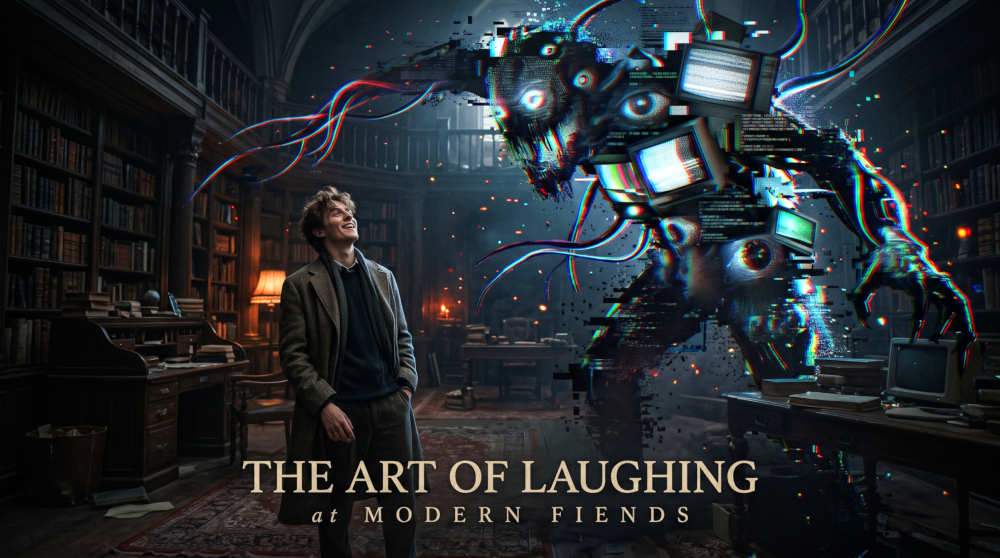
There is an old and surprisingly potent secret hidden in the dusty corners of global esoteric history. If you wish to destroy a demon, do not scream at it. Do not brandish heavy leatherbound books or engage in high-stakes spiritual negotiations. Simply point at its terrible countenance, open your mouth, and laugh.
Across centuries of mysticism, laughter has operated as a surprisingly effective method of exorcism. When a terrifying entity manifests to devour your sanity, mocking its grandiose theatrics completely strips away its power.
Within the realm of Chaos Magic for example, this principle was elevated from a curious historic quirk into a core magical technique. Practitioners of Chaos Magic discarded the heavy solemnity of traditional ceremonial magic, realizing that rigid rituals often feed the very anxieties they seek to banish. The famous Chaos magician and writer, Peter J. Carroll famously described laughter as the ultimate magical state, noting that it is a unique emotional response containing no opposite. Chaos magicians developed the practice of Banishing with Laughter, a technique where the practitioner intentionally belly laughs at the conclusion of a ritual, or in the presence of a menacing entity, to completely collapse the emotional tension sustaining the phantom. By treating a terrifying thought form as a ridiculous joke, you starve it of the psychic energy it needs to exist.
Yet long before modern Chaos Magic codified this into ritual instruction, the famous occultist Dion Fortune laid down the foundational mechanism behind this phenomena. In her classic work Psychic Self-Defense, Fortune observed that psychic attacks and tormenting spiritual presences cannot affect an individual without a viable point of entry. That entry point is almost always composed of terror, fascination, or self-serious panic. Fortune noted that the moment an individual shifts their internal state from fear to detached amusement, the energetic circuit powers down. The door slams shut. Laughter alters your psychological frequency so drastically that the encroaching horror no longer has anything to grab onto.
The Art of Laughing at Modern Fiends
It is easy to appreciate the utility of a good hearty chuckle when dealing with a medieval phantom or an abstract energetic parasite invoked by an overzealous occultist. But one must ask an important question. Can this exact same magical power be used to exorcise the unrelenting entities that haunt our modern daily reality?
Consider the modern internet. A vast, glowing, vibrating apparatus sits in our pockets and rests upon our desks, constantly demanding our vital energy. Endless repetition and sparkling glass screens steadily overwhelm human consciousness. Notifications and algorithms lure us into a perpetual state of hypervigilance. Insecurities are poked, outrage is inflamed, and precious hours vanish while little is offered in return beyond exhaustion. If ancient sorcerers recognized demons as predatory entities feeding upon human attention and fear, then the modern digital realm is arguably the greatest demonic ecosystem ever constructed.
So can we laugh at these modern digital fiends? Certainly! Doing so is a key technique in preserving our sanity.
Imagine, for example, sitting in front of a glowing rectangle while an endless cascade of frantic headlines, apocalyptic warnings, and fiery social commentary races past, all carefully designed to accelerate your pulse. Fear is the objective. Engagement is the objective. Ideally, the machine would have you drafting furious essays in comment sections at two in the morning. Now imagine pausing, looking directly at that glowing rectangle, and letting out a genuine, theatrical laugh.
The moment you laugh at the absurd spectacle of the outrage machine, the spell breaks. The glowing screen loses its terrifying majesty and reverts to what it actually is: a slab of glass and copper wired together to trick a potentially very self-important and serious hominid into staring at lights.
So let us trick the machine attempting to trick us. Smile at the screen you are using to read this article right now. That may sound contradictory, but it is a genuine practice.
While laughter has long been used to banish demons, a simple smile will suffice here. Direct it toward the screen itself. Not the article. Not the content. Aim it instead at the glowing rectangle competing for your attention, and at the bots and algorithms demanding so much importance.
In that small and almost absurd gesture, you refuse its claim upon your seriousness. The digital phantom is defanged in real time, not through conflict or resistance, but through a quiet refusal to grant it the gravity upon which it feeds.
The Half Dead Web and the Battle for Your Brain
The urgency of mastering this technique becomes painfully obvious when you look at the actual state of the modern digital realm. Researchers increasingly note that a massive portion of online traffic is no longer generated by living human beings. We are currently sharing our digital ecosystem with an endless horde of automated programs, algorithms, and artificial scripts… bots, as they are colloquially called. You might very well spend half your morning arguing passionately about local policy or pop culture with a piece of software running on a server in an anonymous data center.
The average person now spends between six and seven hours every single day looking at screens connected to the global network. That amounts to nearly forty percent of your waking life spent immersed in an engineered illusion. During those long hours, human consciousness is dragged through endless artificial dramas, ideological combat, and exhausting debates about topics that exist almost entirely as fleeting electronic noise. We lend our genuine human tears, our real physiological stress, and our precious life force to phantom arguments manufactured by scripts.
Participating in these online shouting matches without a sense of humor is the ultimate form of spiritual submission. It is like entering a haunted house, knowing full well that the ghosts are cheap plastic animatronics, and still screaming until your vocal cords bleed. When you realize that half the internet consists of lines of code designed to provoke you, taking any of it seriously becomes genuinely hilarious. Recognizing the absurdity of the digital outrage machine allows you to reclaim your focus. You cease to be a puppet reacting to every artificial twitch of the wire.
Surviving the Digital Circus Without Burning Your Phone
To be completely clear, the goal here is never self-flagellation, censorship, or absurd puritanical restriction. The idea that you can simply toss your smartphone into a river and go live in a log cabin like a nineteenth century hermit is a ridiculous fantasy. You need the internet. You need screens to do your job, pay your bills, get around your city, and communicate with the people you love. Attempting an extreme digital fast or trying to forcibly wean yourself off modern technology usually ends in miserable failure, because you are trying to fight modern life instead of understanding it.
This is not about going on a strict digital diet. It is about gaining absolute power over the function of your own attention, and learning to stop taking the digital world so seriously.
Consider a simple story. Imagine a person named Arthur. Arthur wakes up every morning, grabs his glowing rectangle, and immediately reads fifty terrifying opinions from strangers across the world. By seven in the morning, Arthur is convinced the sky is falling, his blood pressure is elevated, and he is ready to do battle in the comment section. One day, Arthur remembers the ancient esoteric secret.
He looks at his phone, sees a particularly aggressive notification designed to outrage him, and instead of gasping, he chuckles out loud. He looks at his phone as if it were a tiny, dramatic puppet putting on a very passionate, very silly theatrical performance. Arthur puts the phone down, makes a cup of coffee, and enjoys his morning.
Arthur did not throw his phone away. He simply stopped letting the puppet run his life.
But there is so much more that is possible for you. Breaking the immediate possession is surely important, but in order to truly win the war, you need to know more, do more. For example, you can also learn how to take your energy back; all that you have lost in the screen world reality!
Reclaiming Your Mind and your Personal Power in the Era of Infinite Noise
The modern world, the glowing screen, and our current societal apparatus would have us believe that we must worry about absolutely everything, all the time. The digital reality is everywhere, and its ability to penetrate our quietest moments cannot be easily brushed aside. The sheer power of this infrastructure is undeniable. You only have to look at historical events over the past few decades to see the transformation. Issues that once caused mild local discussion now trigger immediate, global, synchronized panic the second they pass through the digital amplifier.
Within this new world reality, consensus is engineered in seconds, panic is distributed instantly, and agendas dictate what you are expected to treat as fact or fiction. This environment is explicitly designed to keep your consciousness raw, reactive, and perpetually frightened. But running away to hide is an illusion. We must exist within this “screen” reality, which means we must learn to master our own attention. We must learn the ancient, potent art of laughing directly at our demons.
But, as I have said, we must do more than this.
To help individuals master this exact discipline that will allow you to win the war, I have written a new book focused on how to become a Cyber Stoic. This book provides a practical, witty, and deeply empowering roadmap for maintaining your mental clarity and spiritual independence inside the digital machine. It starts with the easy practical stuff. It gets you primed by showing you how to deal with the games, how to keep your head while others roll. But then it goes deeper, and then deeper still. It will show you how to reclaim your energy, how to become a true stoic of the modern age… a Cyber Stoic.
The book serves as a guide to reclaiming your cognitive independence and your personal energy from the algorithmic cuckoo machine. It provides clear, actionable tools to help you break free from outrage addiction, reclaim your daily focus, and look upon the chaos of the modern internet not with fear, but with the quiet, triumphant amusement of someone who has finally seen through the trick. It shows you how to re-absorb the energy you have lost; the power that you are giving the machine. It shows you how to stop playing the games, how to regain your sobriety and forethought. How the mind manipulation games really work. How mass consensus is created.
And as it does all this, it exorcises your many demons through the incredibly potent power of laughter.
The Cyber Stoic
Outsmart the algorithms, reclaim your daily focus, and break free from infinite digital noise with a witty, empowering roadmap to modern mental sovereignty.
Get the Book on Amazon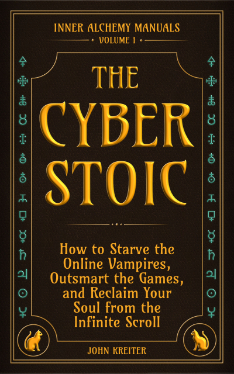

Leave a Reply