
What if one of the greatest opportunities in human history has arrived disguised as a distraction?
As technology accelerates at a breathtaking pace, many people find themselves caught between fear and fascination, uncertainty and possibility. Yet beneath the noise lies a more important question, one that has less to do with machines and far more to do with the individual standing in front of them. This thought provoking exploration invites YOU to look beyond the headlines, beyond the outrage of the day, and beyond the endless stream of opinions competing for attention. With a blend of philosophy, practical insight, and a touch of humor, this article examines what personal power, awareness, and freedom might look like in an increasingly digital age. Rather than offering simple answers or ideological slogans, it encourages deeper reflection, independent thought, and a renewed sense of possibility for those determined to shape their own future instead of allowing it to be shaped for them!
Listen to me. Listen!
You magician, you must master the machine!
You must make it kneel before you!
I have always stated quite plainly that this is, at its most fundamental level, an energetic reality. Inner Alchemists hold that existence resembles an immense sea of energy, while each of us is something like a small droplet moving within it. A droplet joins other droplets to form a trickle. Trickles added together become a rivulet. Rivulets gather into currents. Currents rise and interweave until the sea itself begins to move, and what was once a single droplet returns as a wave.
That wave may have a name, a face, a history, and a collection of opinions about politics, pineapple on pizza, and the proper way to load a dishwasher, but beneath all of that it remains energy that has become aware of itself.
This matters because if we wish to understand reality, we must begin with what we are. We are not merely bodies stumbling through a physical world of objects and events. We are aware energy experiencing, interpreting, and responding to other forms of energy at every moment of every day.
I have also argued, despite fashionable claims to the contrary, that human beings possess free will. One of the primary ways we exercise that freedom is through the focus of our attention. Attention shapes thought, thought encourages belief, and belief influences the reality we create and experience. This directed focus of attention is how that droplet can become a wave, and whether that process unfolds consciously or unconsciously is largely up to us, but it unfolds nevertheless.
Responsibility therefore begins with awareness. The quality of a life is influenced by where attention is directed, what ideas are repeatedly entertained, and which habits of thought are permitted to take root. Most people spend years worrying about who controls institutions, corporations, governments, or algorithms while rarely asking a much stranger question: who controls the small spotlight inside their own mind?
Unfortunately, that question has become harder to answer.
Directing attention deliberately has never been easy. Human beings have always faced distractions, temptations, fears, and endless reasons to avoid examining themselves. Yet previous generations at least had the advantage of being interrupted primarily by things that occupied the same physical space they did. Modern screens can now follow a person from breakfast to bedtime with the dedication of an unpaid intern desperately hoping for a promotion.
The consequence is that a challenge which was already difficult has become considerably more formidable. Screens have grown more persuasive, more immersive, and more effective at capturing attention than anything that came before them. More importantly, they are still evolving. The glowing rectangle in your hand is not the final version of this story; it is merely the opening act. Virtual reality, augmented reality, and technologies that blur the boundary between mind and machine are already waiting in the wings, rehearsing for their entrance while much of the audience remains distracted by notifications.
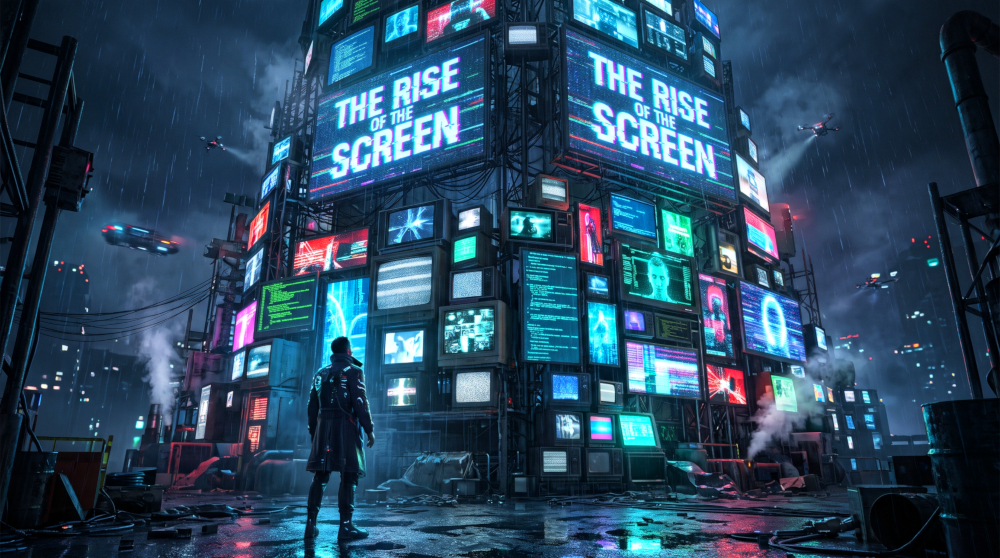
The Rise of the Screen
The world has changed at a remarkable pace over the last few centuries. Knowledge accumulates faster than it once did, technologies improve more rapidly than the generation before them, and innovations that once took lifetimes to emerge now arrive between software updates. What would have seemed revolutionary to a person living a hundred years ago now barely survives a news cycle. Entire industries appear, flourish, and collapse before some people have finished choosing a password.
Among these countless developments, two deserve special attention because of their growing influence over the daily lives of ordinary people: artificial intelligence and the screen.
The story of the screen is actually much older than most people realize. One could argue that the written word was its earliest form. A page covered in symbols possesses a curious power. It allows a person sitting in one place to inhabit another. A reader may be lying in bed, yet simultaneously crossing mountains, exploring distant kingdoms, or listening to the thoughts of someone who died centuries ago. The body remains where it is, while awareness travels elsewhere.
Following the invention of the printing press, that ability expanded dramatically. Books became more accessible, literacy spread throughout Europe, newspapers emerged, pamphlets circulated political and philosophical ideas, and eventually novels, magazines, comics, serialized fiction, and educational texts transformed reading from a privilege enjoyed by the few into a habit practiced by millions. The written screen had escaped monasteries and royal courts and moved into the homes of ordinary people. For centuries this progression unfolded at a measured pace… then the acceleration began.
The arrival of radio allowed voices to cross vast distances instantly. Soon afterward came television, perhaps the first screen in the modern sense of the word. Suddenly stories, advertisements, news, entertainment, and carefully crafted narratives no longer required the imagination to paint the picture. The picture arrived fully assembled and glowing in the corner of the room.
Television improved rapidly. Resolution increased. Color became richer. Sound became clearer. The experience became more immersive. Yet an even greater transformation was taking place behind the scenes. Advances in electronics were producing increasingly powerful computers, while shrinking transistors made it possible to place more computing power into smaller and smaller devices. Machines that once filled entire rooms eventually sat upon desks. Desktops gave way to laptops. Processing power exploded. Memory expanded. The internet connected billions of people into a single informational web. Then came the microchip revolution in full force.
The devices that guided spacecraft, calculated equations, stored documents, played games, managed businesses, mapped cities, streamed video, edited photographs, and connected continents gradually converged into a single object carried in a pocket! The smartphone emerged as the latest stage in the evolution of the screen, combining communication, entertainment, commerce, education, media, surveillance, navigation, advertising, and social interaction into one endlessly glowing rectangle.
At that point the pace became astonishing! A person no longer visited the screen. The screen accompanied them everywhere. It sat beside the bed, rode in the car, joined them at dinner, waited outside the shower, and occasionally seemed more aware of their habits than their closest relatives. What began as a page evolved into a portal, and what began as a tool slowly became an environment. Humanity was no longer merely looking through a window into another world. It was beginning to live there.
The Screen Stops Being a Screen
Anyone who has been paying attention over the last decade has probably noticed that the smartphone was not the end point of this technological journey. It merely feels that way because most people spend so much time staring at one that they rarely stop to notice the road extending beyond it. Tablets, smart watches, digital assistants, fitness trackers, and countless other devices have quietly inserted themselves into daily life, yet even these are already being overtaken by a newer class of technology that is steadily dissolving the distinction between the physical world and the digital one.
For most of human history, screens functioned rather modestly. A book could capture the imagination and transport a reader elsewhere, but the experience remained largely internal. Television introduced moving images and sound, making immersion easier. Smartphones placed those capabilities into our pockets and made them available at every waking moment, creating an entire generation that feels slight anxiety when separated from a charger for more than twenty minutes. Even that achievement now looks less like a destination than a transitional phase between older technologies and what is beginning to emerge.
Virtual reality represents one of the clearest examples of this shift. A television can distract you from difficult circumstances, much in the same way a good novel can carry your thoughts elsewhere for a time, but virtual reality allows participation rather than observation. Instead of watching someone climb a mountain, you can stand upon the mountain yourself. Instead of exploring a digital environment through a screen, you enter it. The distinction may sound subtle on paper, yet the difference in experience is enormous. One is comparable to looking through a window. The other is closer to stepping through the frame.
Remember that: Stepping Through. This is the true power of the screen. The true power of the dark monolith beckoning the ape to evolve.
Augmented reality pushes the concept even further by refusing to choose between physical and digital existence. Rather than replacing the world around you, it overlays additional information directly onto it. Recent augmented reality systems already allow workers, engineers, architects, and surveyors to project measurements, guides, and digital models onto real environments with remarkable accuracy. Basketball training applications can display ideal trajectories, positioning guides, and visual references directly in the player’s environment, while construction and planning systems can place virtual alignment grids over real world spaces so precisely that mistakes which once required experience and intuition become immediately visible. What previously existed only as knowledge in a person’s head increasingly appears before their eyes.
Viewed from this perspective, modern technology resembles a gradual externalization of the imagination itself. Earlier generations could picture another world. Ours is beginning to build one.
Artificial intelligence has accelerated that process so dramatically that many people still struggle to grasp what has happened. During the early 2020s, AI was largely perceived as a specialized tool used by researchers and large corporations. Within only a few years, capabilities that once required entire departments became available to anyone with an internet connection. An individual sitting at a kitchen table can now generate illustrations, write software, summarize complex technical subjects, analyze legal documents, translate multiple languages, produce videos, create educational materials, design products, and automate tasks that previously consumed countless hours of labor.
Such power would have seemed miraculous only a short time ago, which is perhaps why reactions to it often resemble religious disputes more than rational discussions!
Every generation invents its own collection of sacred beliefs and forbidden ideas. Our own is no exception. Spend enough time online and you will encounter an endless supply of labels designed to relieve you of the burden of independent thought. AI slop. Brain rot. Doomscrolling. Tech bro nonsense. Virtual escapism. NPC thinking. Algorithm poison. Screen addiction. Digital serfdom. Depending upon which ideological tribe happens to be speaking, technology will either save civilization or destroy it by Thursday afternoon.
There are legitimate criticisms buried among many of these phrases, just as there are legitimate concerns surrounding every major technological revolution. The problem arises when a label stops being the beginning of an investigation and becomes the conclusion. Once that happens, a person ceases thinking and begins joining… the mob.
The Union of Inner and Outer Worlds
Some readers may have noticed that my recent work has ventured more deeply into technology, screens, artificial intelligence, and the increasingly digital nature of modern life. From a certain perspective, this may appear to be a departure from discussions of inner reality. In truth, no such separation exists. Inner Alchemy has never been about retreating from the world, hiding from reality, or seeking refuge in some private spiritual sanctuary while the rest of existence carries on without us. The foundation of the tradition rests upon the understanding that inner and outer reality are intimately connected, each influencing the other in ways both subtle and profound.
The outer world does not exist in complete isolation from consciousness, nor does consciousness float free from the conditions and experiences encountered within the world. Every thought, belief, dream, fear, invention, institution, and civilization emerges through this relationship. Human beings shape reality, yet they are simultaneously shaped by it. The process moves in both directions, creating a constant exchange through which individuals and societies transform themselves over time.
This understanding places a certain responsibility upon anyone who genuinely wishes to walk the path of an Inner Alchemist. Personal growth cannot end with self-reflection. It must eventually find expression through action, creation, manifestation, and participation within the world. A person who develops wisdom internally while remaining powerless to apply it externally has only completed half the task. Likewise, accumulating material influence without cultivating awareness merely amplifies one’s power without deepening one’s wisdom.
For this reason, I have spent considerable time examining modern technology and exploring practical ways that it can be used for personal development, education, creativity, freedom, and self-empowerment. Throughout my work, I encourage investigation rather than obedience. You should arrive at your own conclusions, test ideas for yourself, and reject what proves false. Part of embracing your reality is rejecting what you don’t want and retaining only what proves useful to you. If the path described here appeals to you, then walk it. If another path serves you better, follow that instead. What matters most is that the choice genuinely belongs to you.
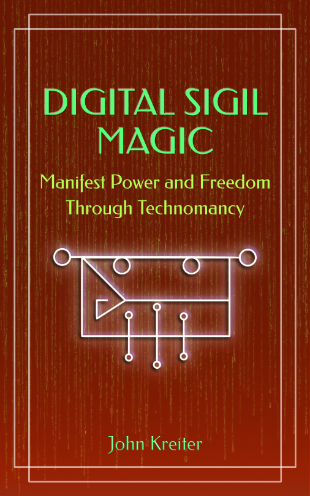
In trying to expand your possibilities in this regard, I have introduced into my work what in magical circles is best known as Technomancy: the deliberate use of technology as an extension of intention, creativity, knowledge, and will. I describe this modern magical practice in detail in my book, Digital Sigil Magic. And whether one chooses to use that term (Technomancy) or those techniques is largely irrelevant. What matters is recognizing that these tools possess extraordinary potential for those willing to engage with them consciously rather than compulsively!
You must learn to master the machine.
The solution to mastery over the machine is not censorship. It is not prohibition. It is not handing responsibility to some institution that promises to protect you from every unpleasant idea, dangerous opinion, disagreeable image, or questionable technological development. History rarely rewards populations that surrender their judgment to those claiming to know what is best for them. Such arrangements often generate more authority, more profit, and more control for the gatekeepers than they do wisdom for the people being protected.
A healthier approach begins with personal responsibility. The aim is to strengthen your own capacity to think clearly, maintain energetic balance, direct attention intentionally, and engage with modern technology without becoming consumed by it.
Technology itself is neither savior nor villain. It is a force multiplier. It amplifies what is already present. Wisdom becomes more powerful in the hands of a wise person. Foolishness becomes more destructive in the hands of a fool. The same tool that can educate can mislead. The same network that can liberate can manipulate. The same artificial intelligence that can help someone learn, create, and innovate can also be used carelessly or dishonestly to lie and to lead thought astray. Responsibility therefore remains where it has always belonged: with the individual!
My hope is that you do not abandon these technologies out of fear, nor surrender yourself to them through blind enthusiasm.
You must study them, experiment with them, understand them, and finally make them kneel before you! Use them where they serve your growth and reject them where they diminish you. Do not allow anonymous commentators, ideological tribes, professional outrage merchants, automated bots, or the ever present digital mob to decide your relationship with reality on your behalf.
I see probabilities before me now. They churn and turn with the tides of thought and mass intention. Among them I glimpse a future that feels both close and deeply consequential, one in which access to powerful technologies becomes increasingly restricted, regulated, centralized, and controlled. Should such a future emerge, the differences between those who learn, experiment, create, and responsibly engage with these tools, and those who reject them through fear, social pressure, or inherited dogma, will become progressively more apparent.
This is where I believe many people fail to see the true possibilities. Technologies such as artificial intelligence, advanced automation, and robotics are not going away. They cannot be uninvented. History offers few examples of a civilization willingly abandoning a tool that grants greater capability, wealth, influence, or power. What often changes is not the existence of the tool, but who may access it.
As H.G. Wells understood, divisions within a civilization can become so profound that they eventually produce entirely different futures for the groups involved. The modern version of the Eloi and Morlocks may not emerge from geography, but from access. One group develops the tools, studies them, improves them, and eventually ‘masters’ them. The other is taught to fear them, condemn them, and regard participation as heresy.
Already the language is appearing. New slogans emerge almost daily. AI slop. Digital corruption. Synthetic thought. These criticisms sometimes contain legitimate concerns, which is good, we must hold the creators to account. Yet they are increasingly employed as social weapons, encouraging condemnation before investigation and conformity before understanding. Bernays understood long ago that public opinion could be engineered. A fearful population is often easier to direct than an informed one, particularly when moral outrage can be manufactured faster than knowledge can be acquired.
The irony is difficult to miss. The individuals demanding that these technologies be restrained rarely possess the means to stop their development. Governments will continue researching them. Corporations will continue investing in them. Universities will continue refining them. Wealthy interests will continue acquiring them. If censorship expands, the most likely outcome is not that the technology disappears, but that fewer ordinary people gain access to it while those already possessing power move even further ahead.
Such a path creates the possibility of a genuine divergence. As artificial intelligence expands, as computing and, The Screen, matures, those actively participating in these transformations may develop capabilities, opportunities, and perspectives increasingly difficult for others to comprehend. The separation may begin with knowledge and technology, yet over generations it could become something far more profound.
An Inner Alchemist should not respond with fear, nor with blind worship of the machine. Awareness demands a middle path. Learn, observe, and endlessly play with the machine; until you master it. Maintain freedom over your own attention and judgment. Use the tools without becoming their servant. Expand alongside reality rather than hiding from it. A person who develops both inner mastery and practical understanding possesses an advantage that neither blind technophiles nor fearful reactionaries can easily match.
Where these currents ultimately lead remains uncertain. I simply observe them, note their direction, and leave the reader with the possibility.
Technology is not going away.
The question is who learns to use it, who is taught to fear it, and who benefits from that arrangement.
This is all I wish to say on the matter for now.
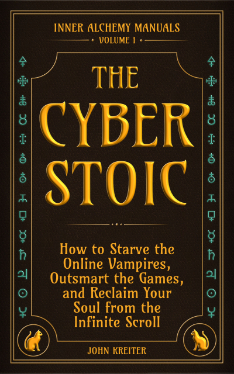
To help with this challenge of total mastery over the machine, I created The Cyber Stoic. This book was written to help you stand firmly amid the noise of the modern world, resist the endless competition for your attention, understand the games people play across digital spaces, and recover the energy that is so often scattered through outrage, distraction, and emotional manipulation. Its goal is simple:
To give the modern person a cubic inch of chance (as some have called it) that can allow the new Techno-naught to wake up to themselves, rally their energies, and begin to use the modern magic(k), instead of be used by it.
What this means is that you now have a blossoming power, oh modern magician. “The Screen” is a portal to knowledge, power, and indeed other worlds because as you are drawn into it, you can explore (and getting better all the time) complete other worlds and realities.
You have power. Learn to master the machine by mastering your attention.
If you spend hours drifting through videos, articles, social feeds, or endless online rabbit holes, do not immediately assume you have failed. In a world that rarely allows genuine rest, even passive engagement can serve a purpose. The Screen is not merely a machine, it’s an environment. The screen is a reality space in which the mind can recover, explore, and sometimes find exactly the pause it needs. Used wisely, this too is a kind of magic(k).
Play with your attention technomacer, you are being set free!
The key is becoming conscious of the process. Through the techniques described in The Cyber Stoic, you can learn to step back, regain your lost energy, and notice when rest has become avoidance. In those moments of lucidity, ask yourself what you truly want. More happiness? More capability? More freedom? More influence over the direction of your life? Use every tool within this evolving realm to explore those questions.
Then reclaim just thirty minutes. Direct the power of The Screen toward a chosen aim. Learn something new. Solve a problem. Create, build, research, practice, or explore an idea that genuinely thrills you.
Watch for results. Follow what strengthens your mind, expands your possibilities, and brings you closer to the person you want to become. Over time, thirty minutes may grow into an hour, then several. Let curiosity lead the journey, but let awareness hold the compass. The power has always been yours.
Find your OWN answers! Don’t let the crowd decide your fate. Don’t let the modern court drag you into its newest version of the inquisition!
The story of human progress has never been the story of tools, but of consciousness learning to express itself through ever greater extensions of its will, and the future will belong to those who master not only the machine and the screen, but through them, themselves!
Continue Mastering the Machine
Explore practical frameworks for conscious digital intention, attention sovereignty, and modern technomancy.
Digital Sigil Magic
A guide to applying deliberate focus, symbolic design, and modern digital tools as extensions of conscious will and creative manifestation.
The Cyber Stoic
Practical strategies to reclaim scattered attention, navigate digital noise and outrage loops, and turn passive screen time into intentional growth.








Leave a Reply