
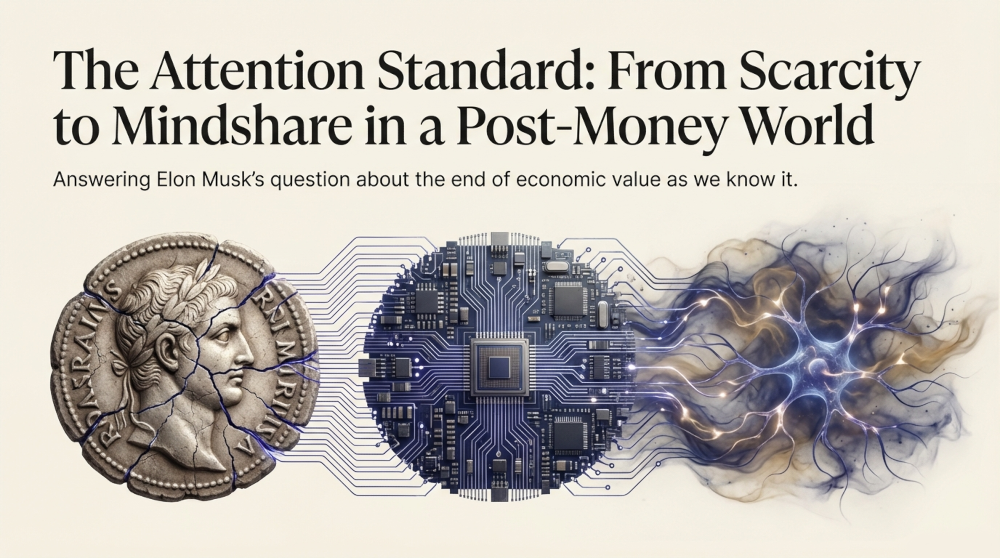
In my last article, I shared a few predictions for 2026. This time, I’m going further… into a future that aligns with Elon Musk’s vision of near-zero production costs, exploring not just what that means, but how it might actually unfold.
Imagine what happens when production becomes effortless, when the systems we rely on, begin to evolve beyond economics as we know them? In this piece, I explore the quiet shift already taking shape beneath our economies and what it might reveal about the world that’s coming next.
The ideas may challenge what you think you know about money, work, and worth!
P.S. This is a deep read. If you’re short on time, the conclusion offers a really quick overview, but the full article holds the real insight. The meaning (the why and how) reveals itself only in the nuance.
I am a writer, a speaker, who is meant, as part of my current, as part of my connection to a path I refer to as inner alchemy, to reveal certain aspects of this way towards freedom.
But there are many different directions that this speaking can take and on occasion I may sidetrack into different subjects that might seem unrelated to my original goals, but that are in fact deeply intertwined because for an inner alchemist there is no difference between the inner and the outer world, as they are both in a sense reflections of the other.
In this modern era, humanity as a species has become incredibly outward focused, that is deeply focused in the physical world, as opposed to the subjective or spiritual side. Due to this outward focus, technology reigns supreme and science (more accurately scientism) has become the new theology of the age.
Because of this, my speaking and revelations have adapted to fit the language of this outer focused world. And using those terms then I could say that right now, the human collective stands at a turning point within the framework of this contraption and outer measurement focused era.
Technology itself is forcing a return to inner focus you could say, whether people want this kind of change or not, it’s coming. I explore this shift in my book _Digital Sigil Magic_ and past articles, so I will not dive too deep into that here. Briefly I could say that technological innovation has hit a point where, through the contraptions of the times, it is now possible to create a liminal space between the physical outer world and the inner psychological reality within us (we call that liminal in between world: The Digital World). And as this liminal space grows, the separation between inner aspects of ourselves and outer aspects will begin to blur, the subjective and objective reality of humanity will eventually meet.
This technological meeting point is something that has colloquially been termed the singularity, which one could interpret as an apocalyptic event in the true Greek sense… apokálypsis: an unveiling that transforms how we see reality.
In this moment, urgent questions arise. As a speaker whose work centers on revelation, I must step slightly beyond pure inner alchemy and awareness expansion, which is my usual focus, and instead talk a little about what lies ahead.
…
Not long ago, I watched a panel of thinkers discuss humanity’s future, focusing on how robotics and artificial intelligence will reshape society. The group included Elon Musk and others.
They pondered a world where money loses meaning because machines take over production. They envisioned a time when creating anything becomes so cheap and simple that prices for all goods drop to near zero.
Elon Musk’s core idea is straightforward yet profound. Robots and AI will handle every step of making products: mining raw materials with tireless precision, assembling parts in fully automated factories, and even designing improvements on the fly. Energy from advanced sources like solar or fusion will power it all at minimal cost. Human labor, the biggest expense in traditional economies, vanishes entirely. A smartphone, car, or house that once cost thousands to produce will require almost no money or effort, just raw computation and electricity. Abundance replaces scarcity, making the old price system irrelevant overnight.
This sets the stage for what follows: a complete redefinition of value itself!
Grok’ing The Future
In this podcast (Spotify link), Elon Musk reiterates how everything will become extremely cheap or perhaps even free in time, due to this technological revolution sweeping through our world. But when pressed for exact details on the timeline and mechanics of how this shift would unfold, he admitted candidly that he did not know precisely how it all would come about, and he suggested openly that if anyone had concrete ideas or pathways forward, he was all ears and eager to hear them.
Well, taking him at his word, and with the sincere hope that you the reader may profit from grasping (Grok’ing) the nature of these profound developments as they unfold over the next few decades, I will throw my hat into the ring, as it were, and take up that challenge head on.
Specifically, in this article I want to explain in clear detail how we transition from our current cash based society, rooted in familiar dollars and coins, into a radically different society that eventually may not need any money in the traditional sense at all.
This journey reveals hidden layers of value that have always existed beneath the surface of our economy.
With that said, I would like to start by saying that I am no expert. I am certainly not an economist nor am I any kind of traditional expert in these matters, and what I write here is for entertainment purposes only. But as I write about in my books and on the site, the nature of the inner alchemy that I study has allowed me to expand certain parts of my awareness. In particular, I am on occasion able to perceive events and possibilities beyond my point in space and time. Using current terminology, this means that I am able to look beyond my present moment and, using my inner senses, see alternative points in space and time that bring about different possibilities. These possibilities, in accordance with their intensity and positional relevance, have the power to alter our future. In other words, think of me as a kind of oracle, one that speaks for, in accordance with the parlance of the times, entertainment purposes only😊
The Future World
So, as I project into the future, I see the following changes that will be necessary to bring about the world Elon Musk and others describe. First, we can lightly touch on the transition from fixed currency to digital currency. I say lightly because this shift has already received much thought, and a little research on your part if you’re interested, will reveal the basics.
Basically, the Western world is undergoing a transformation where inflation and debt render the current currency nearly worthless, leaving no choice but to overhaul it and redefine its worth.
Consider how this unfolds. In earlier times, silver stood as a finite precious metal alongside gold, anchoring the value and wealth of regions and nations. Coins and reserves tied directly to these metals ensured stability through their scarcity, mined at real cost and limited in supply. But the dollar severed itself from gold decades ago, floating free on promises and trust. Now, its worth has eroded to almost nothing as central banks print endless supplies to chase growth. This money printing stems directly from towering debt, where governments and banks deem it wiser to flood the system with fresh bills than confront the bills they cannot pay. Inflation surges as too many dollars chase too few goods, quietly taxing savers while propping up the illusion of solvency.
In such an environment, digital currencies emerge as the reset: flexible, programmable, and unbound by printing presses, they promise scarcity through code, like Bitcoin’s hard cap, or adaptability through smart contracts, sidestepping the endless dilution of fiat. This is not mere theory; it is the logical next step as trust in paper fades and new systems code value into existence.
Such a transition will bring about positives and negatives. The negatives stand out clearly and carry real weight. Digital currencies, with their blockchain ledgers recording every transaction in unerasable detail (meaning that any and all transactions cannot be erased deleted or removed), hand governments and corporations a total view of personal finances. No cash anonymity remains; every coffee purchase, donation, or savings shift becomes trackable data. Regulators could freeze wallets instantly for noncompliance, tax evasion, or dissent, while central bank digital currencies let authorities program spending limits, expiration dates on funds, or even social credit scores that block access entirely. Freedom erodes as privacy vanishes, turning money into a leash pulled by those in power.
There will of course be ways within ways.
People will not all fall easily under this digital currency overwatch. The dollar monopoly crumbles as competitors rise, from decentralized cryptocurrencies like Bitcoin to state backed options tied to the Chinese yuan or European digital euro; in other words there will be more than one digital currency to be had. Astute individuals can play these rival systems against each other, spreading wealth across borders and blockchains to evade single points of control.
This then becomes a transition that evolves for years, as many competing digital currencies evolve and are created by different nation blocks; in the future, the digital dollar may not be the only kid, or the “gold-standard” digital currency to come.
And it must be understood that this move from paper money to the digital dollar is already underway and clearly visible in silver’s skyrocketing price. Silver surges because it remains a finite, physical store of value untouched by printers or algorithms. As dollars flood markets, their purchasing power collapses, driving investors to hoard real assets. Silver’s climb signals the dollar’s death spiral: each printed trillion dilutes trust, pushing scarcity seekers to metals whose scarcity and worth hold when paper fails. In this environment, digital currencies are rushing in to fill the void, promising coded scarcity where fiat falters.
This new reality maps out simply. Over the next five years or so, digital wallets become everyday tools, central banks launch their coins, and crypto volatility settles as adoption grows and as large nations and blocks of nations all begin to create their own form of digital currency. By decade’s end, hybrid systems blend fiat remnants with blockchain rails, silver and gold tokens thrive as hedges. Then, as robotics slash production costs, physical money potentially fades entirely around fifteen to fifty years out, yielding to attention based value we explore next. The path feels turbulent but inevitable, from printed illusion to coded competition, then pure mindshare!
But how do we go from this to the world that Elon Musk envisions, where the cost of production drops so low that things become so cheap some can even be free?… assuming we avoid self-destruction and technology keeps advancing as predicted…of course.?
Well, to understand how we move from paper money to free, which of course is not truly free as I will explain later, you must grasp that while digital currency carries many negative possibilities like heightened state control, it also offers advantages that serve as needed conditions for this new technological revolution. The era of paper money has ended. We must evolve to handle the growing complexity of the future, and within that complexity, digital currency provides tools that will drive down the value of material products.
Of particular note stands the ability of digital currency to operate with flexibility and ever increasing complexity. As it diversifies yet stabilizes into a reliable world system, digital currencies enable the creation of smart contracts, self executing agreements coded directly into the blockchain. Ethereum pioneered this, where contracts run automatically when conditions meet, no middleman required. A buyer sends funds, the code verifies delivery, and ownership transfers instantly. But this goes further.
Imagine contracts that set dynamic pricing for goods, where an item’s cost fluctuates in real time based on perceived demand, supply signals, or even social buzz.
Take a smartphone as example.
A smart contract might peg its base price to production costs, which plummet with robotic efficiency. Yet it adjusts upward if viral memes spike demand, or downward if competing models flood feeds. Fixed tokens enter the contract, but output varies: ten units today buy one phone at peak hype, twenty tomorrow when attention wanes. Market variances feed in via oracles, real time data hooks that pull stock levels, review scores, or trend metrics. The contract calculates worth on the fly, allocating product quantity proportional to token value against live conditions. Sellers gain precision, buyers get fairness tied to true utility. This fluidity, impossible with static dollars, prepares ground for abundance, where base prices near zero and value hinges purely on desire, paving the way for what I will call: the memetic economy ahead.
The Memetic Economy
It is indeed the case that eventually this kind of contractual value system will bring about, together with increasingly cheap production costs as Elon Musk points out, a point where many things will become free. But will they really be free?
In order to understand the lowering of prices of production and how this will affect both those creators, those companies that are creating those products, and the consumers themselves, we must look into existing systems, in particular I will bring your attention to something called Vine.
Amazon Vine is a program where Amazon hand-picks certain customers and lets them request products for free in exchange for thoughtful, honest reviews. From the reviewer’s side it looks like “free stuff,” but it actually functions as a structured trade: products on one side, and time, attention, and credibility on the other.
How Vine works for reviewers
- Amazon invites reviewers based on their history: how many reviews they have written, how detailed those reviews are, and how helpful other shoppers have found them.
- Once in Vine, a reviewer can browse a special catalog of products and request items, which are then sent at no charge.
- In return, the reviewer is expected to actually use the product and write a genuine, well-explained review, not just a quick star rating.
Of Note: Some people believe that being a Prime member improves the chances of being invited or getting better offers, because Prime members tend to buy more, review more, and interact more with the site. Even if Amazon does not state this as a formal rule, being a Prime Amazon member (A Member of the Tribe of Amazon as it were) often correlates with the kind of activity that makes a reviewer attractive to the program.
Factors that shape your “tier” as a reviewer
Vine does not publicly lay out rigid user tiers, but in practice a reviewer’s “standing” is influenced by several variables:
- How many reviews you have written and how consistently you review.
- How detailed, clear, and balanced your reviews are.
- How other customers rate your reviews.
- The categories you tend to review.
- Whether you are a Prime member(?).
Over time, reviewers who stay active and produce useful reviews tend to keep receiving more or better product opportunities, while those who go quiet or write low‑effort reviews often see fewer offers.
How Vine works for sellers
On the seller side, Vine is a way to give away some units of a product to selected reviewers in order to get early, credible reviews on the product page. Sellers:
- Enroll eligible products in the program.
- Provide units that are shipped out free to reviewers.
- Hope to gain more reviews, clearer feedback, and better conversion on their listings.
The “tiering” here is more formal: only certain types of accounts and products can be enrolled, and the products must meet minimum listing standards (images, descriptions, etc.) and usually have few existing reviews.
Why it isn’t actually “free stuff”
Although no money changes hands from the reviewer’s side, the exchange is very real:
- The reviewer spends time: picking items, waiting for delivery, unboxing, trying the product, and composing a review.
- The reviewer spends attention: focusing on the product carefully enough to describe what works, what doesn’t, and who it’s for.
- The reviewer spends reputational capital: every review shapes how other shoppers see that reviewer’s trustworthiness, and those reviews can influence many buying decisions.
In that sense, Vine is not simply “free goods for nothing.” It is an exchange where the product is traded for a form of labor (careful evaluation) and for the scarce resource of FOCUSED ATTENTION. The review becomes a kind of payment: a visible, lasting contribution that helps the product gain traction and helps Amazon’s marketplace function.
The New Anchor of Worth
Amazon Vine operates as a clever contractual system where reviewers exchange their time, focused attention, and honest evaluations for free products, creating a form of value transfer that feels effortless but demands real effort. This setup challenges the old notion of “free stuff” because the reviewer’s input generates something far more valuable than the physical item: visibility and social momentum for the product.
To grasp how this evolves into a broader economic shift, we need to connect it to memetics, the study of how ideas, behaviors, and information spread like genes in a population, competing for attention and replication. In Vine, reviewers become unwitting meme agents, propagating product ideas through their words, which then battle for mindshare against rival products in the digital marketplace.
Traditionally, value has been measured by tangible anchors. Under a gold standard, worth tied directly to a physical commodity; coins held intrinsic scarcity because they represented a fixed amount of mined metal, making trade straightforward but rigid. Fiat currencies like the dollar loosened this by relying on government backing and collective trust, allowing money to represent abstract purchasing power without a one-to-one physical tie. Yet even fiat struggles with the speed and nuance of modern value creation because cash transactions are linear: you pay once, own the thing, and that’s it; no built-in mechanism for ongoing replication or competition based on cultural traction.
Cash excels at buying goods but falters at capturing the viral, self-amplifying essence of attention, where a product’s true worth emerges not from its cost but from how many minds it occupies, how widely it’s discussed, and how eagerly people share it.
Enter the memetic economy, where products transcend their material form to become ideas vying for dominance. In this new standard, a product’s value is derived from its memetic fitness: its ability to spread, stick in people’s heads, and inspire organic evangelism. Vine exemplifies this perfectly: a reviewer doesn’t just get a gadget; they invest effort in unpacking its story, strengths, and flaws, then broadcast that narrative to thousands via Amazon’s platform.
This act turns the reviewer into a meme vector, replicating the product’s concept across social networks. If the review resonates (say, highlighting a clever feature others echo) it gains traction, spawning more talk, more searches, more buys. Suddenly, the product’s worth skyrockets not because of its price tag but because it’s now a hot topic, crowding out competitors in search results and conversations. Consumers themselves fuel this expansion, acting as decentralized marketers who pit one product’s meme against another’s in a Darwinian contest: the blender that sparks “life-changing kitchen hack” memes outcompetes the generic one gathering digital dust. Here, popularity metrics, in the form of review counts, social shares, trend velocity, become the new currency by quantifying how much collective brain space a product commands. Effort from users, like Vine Voices’ detailed posts, amplifies this, creating a feedback loop where attention begets more attention, and the most compelling ideas dominate.
This memetic shift redefines markets because it decouples value from scarcity of atoms (like gold or dollars) toward scarcity of cognition. Human focus is finite, so the product that monopolizes it wins disproportionately. Vine isn’t charity; it’s a micro-economy of meme propagation, where the reviewer’s labor trades for goods but yields exponential returns for the seller through heightened desirability. From the reviewer’s view, their “payment” is effort, but they gain status as trusted voices, access to exclusives, and indirect influence in the attention economy.
Cash can’t orchestrate this elegantly because it’s too static; once spent, it doesn’t self-replicate or adapt based on cultural virality. Digital currencies, however, unlock unprecedented flexibility, especially those with smart contract capabilities like Ethereum. Imagine a cryptocurrency tokenizing memetic value directly: instead of flat payments, value flows via programmable conditions mirroring Vine’s tiers. A product’s token might grant “reviewer ranks” as NFTs or tiered badges: bronze for newbies (basic access to test items), silver for consistent posters (priority picks), gold for viral influencers (exclusive drops plus revenue shares).
Contracts could auto-adjust worth dynamically: if a review garners 1,000 helpful votes, the reviewer earns bonus tokens. If the product trends on social media, all prior voices get retroactive uplifts. These conditions vary by variables like review depth (measured by word count or sentiment analysis), audience engagement (likes, shares), or even cross-platform spread (mentions on X or TikTok).
In Ethereum-style systems, smart contracts enforce this without middlemen. A Vine-like protocol could mint product-specific meme tokens at launch; reviewers stake time (via on-chain proof of review submission) to claim them, with payouts scaling by impact: low-effort reviews yield pennies in tokens, while a breakout review that sparks 10,000 impressions mints a windfall. Tokens themselves become tradable assets, their price surging with the product’s memetic success, letting early voices cash out on the hype they helped create. Unlike dollars, which ignore these dynamics, such systems bake in memetic incentives: higher tiers demand more effort (e.g., video reviews for platinum access), fostering fiercer competition among meme agents. Products rise or fall by how contractually they reward propagation, turning every user into a stakeholder in the idea’s survival.
This heralds a new market economy where value is fluid, attention-driven, and contractually engineered. Goods aren’t endpoints; they’re memes in motion, valued by replication rates rather than shelves full of inventory. Vine previews this utopia (or dystopia?) showing how everyday reviewers, through tiered exchanges, propel products into cultural relevance, proving that in the age of infinite goods, the ultimate scarcity is our gaze, and the savviest systems will pay us to direct it.
The Robots Are Coming… And They Are Bringing Cheap iPhones?
In the next phase of this economic evolution, as robotics and artificial intelligence drastically slash the costs of creating products (think automated factories churning out goods, robots mining raw materials with pinpoint efficiency, and AI optimizing every step of production) the true worth of things shifts dramatically. Physical production becomes almost free, like printing money in an infinite supply, so value detaches from atoms and labor costs. Instead, it anchors in what economists might overlook but inner philosophers have long knownas: human attention. Attention is the ultimate scarcity because each person has only so many hours in a day to notice, desire, and spread ideas. Products win not by being cheapest to make, but by captivating minds, turning passive observers into active promoters.
Picture a company like Apple in this world. To thrive, it mustn’t just build sleek devices; it has to weave them into the fabric of daily life through memes…those sticky ideas that spread person-to-person like gossip!
Apple succeeds by flooding the culture with iPhone stories: viral unboxings, “game-changing” app demos, and endless debates on forums about the next upgrade. Each customer becomes a meme-actuating unit, a walking billboard who shares photos, posts reviews, and convinces friends. This memetic web gives Apple relevance and stability; without it, even flawless hardware gathers dust. The company’s worth explodes not from sales volume alone (since production is dirt cheap), but from how desperately people crave its ecosystem; needing the phone, watch, and earbuds as extensions of identity.
More products mean more entry points for memes, creating a flywheel: launch a new AirPods model, spark TikTok challenges, draw in millions more agents, inflate the company’s cultural gravity. Old money metrics like revenue fade; new ones track mindshare (search trends, social mentions, loyalty scores… joining the Apple Club?) gauging how many lives orbit the brand.
How Does a Company Gain Worth and Value?
In a future where robotics, AI, and ultra cheap labor drive production costs to near zero, a company’s true wealth emerges not from manufacturing alone but from its organizational structure, which channels collective focus into unmatched innovation and product depth. Even if every individual owns a personal robot or replicator capable of churning out everyday goods, a company stands apart by dedicating vast attention to mastering complex creations that deliver escalating happiness, ease, and utility, like breakthrough designs or tailored experiences no solo effort could match. Employees and stakeholders gain worth through elevated status within this powerhouse, plus access to the collective’s amplified potential for breakthroughs, turning affiliation itself into a source of enduring economic Tribal value.
This system self-organizes because relevance demands creation. A company rises by inventing things people didn’t know they needed, then fueling memetic firestorms to make them indispensable. Need drives it: if robot arms can fabricate anything, the bottleneck is desire!
Companies compete to hack human psychology, A/B testing designs for maximum shareability. A gadget that sparks “must-have” envy outpaces a functional but forgettable rival. Over time, worth aligns with utility plus virality: how many people integrate it into routines, evangelize it unprompted, defend it online, or join the company’s Tribe. This isn’t hype; it’s evolution. Products that fail to meme die quietly, while winners scale to billions in perceived value, measured by the human network they command.
We Are Going Up
Now zoom out to humanity’s grand pivot: evolution beyond Earth. As populations push into space (asteroid mining for rare metals, deep-sea harvesting on Earth, or Mars habitats) traditional economies crumble under vast distances and infinite resources. Robotics make extraction trivial; AI handles logistics..
Direction comes not from central planners, but from memetic signals. Companies specialize deeply, becoming sole providers for tailored lifestyles. Imagine a firm mastering zero-gravity habitats: it supplies every tool, meal pack, and suit for seekers of orbital life-style realities. These users become its tribal wards in the form of loyal dependents whose lives depend on the company’s output. In return, they evangelize ferociously, posting “day in the life” vlogs from the station, turning the brand into a survival meme. “Only [Company X] gear kept me alive up here” spreads like wildfire, drawing recruits, investors, and copycats…
This dynamic propels expansion. Detecting untapped value (a platinum-rich asteroid or untamed lunar regolith; the company mobilizes. But it can’t go alone; geography is destiny in memetics. It recruits wards as pioneers: top meme agents (those with huge followings, proven loyalty) get first dibs on new frontiers, equipped with branded tech. They stream the adventure: “Mining asteroids with [Company X] bots!”, infecting Earth audiences with FOMO.
Success loops back: new resources fuel more production, more specialized goods, more wards hooked into the ecosystem. The company carries its essence (attention networks) with it, like a virus hopping hosts. Wards aren’t employees; they’re extensions, spreading the “gospel” of the company’s prowess as the best creator for that niche, be it space food, radiation shielding, or hydroponic farms.
Competition intensifies this. Each firm fights for more memetic agents (people) because they’re the fuel. A bigger agent pool means stronger signals: more buzz detects opportunities faster, funds riskier bets via crowdfunded tokens, and overwhelms rivals in cultural space. Borders blur; a deep-sea mining outfit eyes Pacific trenches because its fish-farming wards crave sustainable proteins, their memes pulling investment. Scale breeds monopoly vibes: the top company owns the meme for “reliable Mars living,” supplying 90% of colonists, who in turn recruit from Earth.
In practice, this unfolds stepwise. Early adopters (tech-savvy wards) test prototypes in extreme spots like Antarctic bases, meme’ing results to refine. Hits scale: viral deep-sea drone footage funds submersible fleets. Space beckons next as asteroid operations start with agent-crewed robot swarms, wards piloting remotely while hyping yields. Colonies follow: Mars outposts where company-supplied domes house entire crews, their social feeds becoming recruitment reels. Direction emerges bottom-up: wards vote with attention, upvoting promising ventures, starving flops. Digital contracts (like Ethereum’s) automate tiers; gold agents stake claims on new hauls, earning shares based on propagation metrics.
Humanity hurtles outward this way, untethered from scarcity. Companies aren’t faceless corps; they’re meme engines, directing evolution by who captures the most eyes. Probes to Europa? Funded by wards meme’ing “ocean worlds” hype. Interstellar arks? Powered by trillion-agent cults around fusion drives. Risks concentrate (lose the meme war, and your firm evaporates) but winners birth new civilizations, proving attention isn’t just alchemy; it’s the compass for our species’ next horizon. Readers, see it simply: in a post-scarcity cosmos, what matters is who dreams loudest and spreads farthest. Companies win by turning us all into their voices, carrying humanity starward one shared story at a time.
Conclusion
Value has always hinged on human attention; the invisible force that assigns worth to whatever captures our collective gaze. Gold once reflected that focus through scarcity and effort, fiat transmuted it into faith, and digital currencies encoded it into algorithms. But beneath every system, the true backing has always been the same: belief amplified by attention.
As production costs collapse and scarcity withers, attention emerges as the final frontier of value. When anyone can produce anything, worth flows toward what cannot be automated: the magnetic pull of meaning, emotion, and story.
Companies no longer win by building more, but by commanding the mindshare of millions. They evolve into tribes powered by shared obsession, transacting in loyalty and identity rather than currency. The digital tokens and smart economies they spawn become less about exchange and more about belonging.
In that world, money’s illusion falls away, revealing what has driven it all along: the collective act of noticing. Fiat masked it. Digital currencies expose it. Post-scarcity will sanctify it. As material abundance spreads, value reattaches itself to the only scarce resource left…us.
Human attention becomes the engine of everything: economies, culture, and expansion itself. Companies transform into meme-powered civilizations, their reach measured not in output but in devotion, not in profit but in participation. When creation costs nothing, attention defines everything.
In the end, when everything can be made by machines, only our attention will decide what’s real and important. This means that as abundance reshapes the human cosmos, the true frontier will not be matter or energy, but the human mind itself.
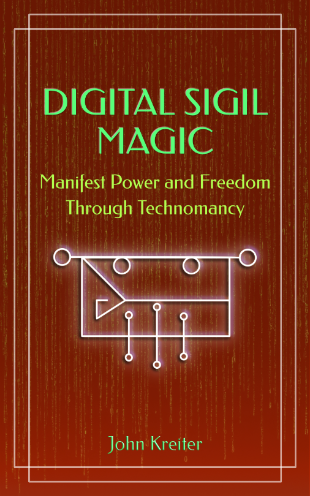
If you would like to dive deeper into this shift, I suggest exploring Digital Sigil Magic.
Explore the Book
Digital Sigil Magic The book unveils the true arc of movement towards the Singularity over the coming decades and, more crucially, reveals the raw power of human attention to manifest individually liberating realities free from memetic cages, so that a lone individual can learn how to forge paths of personal sovereignty.
View on Amazon
In the end, this shift from dollars to digital contracts to pure attention has the potential to open real doors, not more walls and traps. As production costs fall near zero, freeing us from endless work just to survive, we can learn to expand beyond all material and physical restrictions.
Companies will compete to serve entire lifestyles but never forget that you hold the power: your focus decides the winners, letting you back what uplifts rather than enslaves. As new freedoms emerge, choose your tribe, shape your world, explore stars, but always fight the cage as you let go of the material illusion.











Leave a Reply to Joseph Curwen Cancel reply