Self-Improvement and Interesting Knowledge

Beyond Zen and New Age Positivity: Worry, Symbols, and the Doorway to a Larger Reality

There comes a point in life when familiar answers no longer satisfy. The techniques that once seemed helpful, the explanations that once felt complete, and the assumptions that once provided comfort begin to reveal their limits. Something deeper calls from beyond the boundaries of the known, inviting us to question what we have accepted for so long.

This article explores a perspective that is both practical and transformative. It speaks to those quiet moments when something within us senses there is more to discover, more to understand, and more to become. Through reflection, insight, and a willingness to look where we have been taught not to look, a different possibility begins to emerge.

If you have ever felt the subtle pull of a larger reality, if you have ever suspected that some of your greatest challenges may conceal unexpected opportunities, then this exploration may offer a doorway into a richer and more meaningful understanding of yourself and the world around you.
Inner Exploration & Alchemy

We all, to one degree or another, suffer from worries. They arrive as annoying thoughts, unsettling ideas, and persistent questions that seem to appear at precisely the wrong moment. They often surface in the middle of the night when we can’t sleep. They emerge when the noise of daily life has finally quieted down and we are left alone with ourselves. The television is off, the phone is silent, the day’s tasks are finished, and suddenly there they are, waiting patiently.

Modern self-help culture has largely settled on a simple response: ignore them.

We are encouraged to “let it go,” “think positive,” and “focus on the good.” For decades popular self-help teachings have promoted the idea that happiness is found by starving unwanted thoughts of attention. The famous phrase “Don’t Worry, Be Happy” captures the spirit perfectly. If a worrying thought knocks at the door, the advice is often to refuse to answer.

There is certainly wisdom in this, and I have personally discussed the great power of attention to give weight and gravity to thoughts and ideas. Some worries are little more than mental spam; projections from the true baseline of the Archon as it hinders us at every step. Giving them attention can be like arguing with a telemarketer. Nothing useful comes from the conversation. Yet modern culture often swings too far in the opposite direction. It begins to treat all worrying thoughts as equally meaningless. This is from the inner alchemy point of view, a big mistake.

Imagine hearing a strange sound from somewhere inside your home. It might be nothing. It might be an old pipe. It might be the wind. But immediately putting on headphones and turning up the volume is not necessarily wisdom. Sometimes the sound deserves investigation.

This is where traditions such as Zen enter the discussion, used as a sort of justification for some.

At its foundation, Zen teaches a radical lesson: stop believing every thought that appears in your mind. Sit quietly. Follow the breath. Return attention to the present moment. Watch thoughts arise and pass away without chasing them. Over time, the constant chatter begins to lose its authority. The practitioner discovers that awareness itself is more fundamental than the endless stream of commentary moving through the mind.

The effectiveness of this approach is undeniable. A person becomes calmer, more focused, and less vulnerable to every emotional storm passing through consciousness. Rather than living entirely inside thoughts about yesterday and tomorrow, they become capable of experiencing what is actually happening now… Yet here is where an important misunderstanding often appears.

Many people understand and may even work through the techniques used in Zen as though the goal is simply to remain present and disregard inner activity. They are taught the first lesson but never shown the chapters that follow. The result is a practitioner who becomes very skilled at dismissing inner experience while remaining largely unfamiliar with the deeper dimensions of that experience.

From my own practice, I can say with certainty that this is not where the journey ends. The training of attention is exactly that: training. Learning to hold a stable point of focus is not the destination. It is preparation. It is the sharpening of the instrument before the real work begins.

Once attention becomes disciplined, a far more interesting possibility emerges. One can begin to consciously explore the inner world without becoming lost within it. Dreams, symbols, intuitions, archetypal imagery, subtle perceptions, and profound states of consciousness become available for direct examination. The mind is no longer a chaotic storm. It becomes a workable laboratory.

This reality is seldom discussed in introductory teachings. Non initiates are often given methods for quieting mental noise, but the deeper purpose of that quieting is rarely explained. The stillness is not an end in itself. It creates the conditions necessary for further exploration.

We can see traces of this progression within older Tibetan traditions. The practitioner first learned concentration and stability. Only afterward did the deeper work begin. Attention became the foundation upon which much more advanced inner exploration could be built. One did not spend years developing focus merely to sit in focus forever. One developed focus because it enabled entry into territories that would otherwise remain inaccessible.

This brings us back to the worrying thoughts that started our discussion. Some worries are indeed meaningless noise and should be allowed to pass. But others are signals. They may point toward unresolved conflicts, hidden fears, untapped capacities, or important truths seeking recognition. Treating every unwelcome thought as an enemy to be silenced can impoverish our relationship with ourselves.

The real challenge is not learning how to ignore the voice within. It is learning when to ignore it, when to question it, when to listen to it, and when to transmute it! For buried beneath some of our most troublesome thoughts may be exactly the insight and the power we have been searching for all along.

The Room We Mistake for Reality

While well meaning, it is ultimately wiser to honor the complete reality of our own essence. Doing that requires honoring the full content of the mind rather than selectively embracing certain thoughts while banishing others. Perhaps in the future I will explore more deeply the expanded dimensions of Buddhist practice and the stages that unfold beyond introductory teachings. For now, however, I want to focus on those worrisome thoughts that declare themselves in the middle of the night, or during those quiet moments when distraction finally loosens its grip.

This is important because certain assumptions inherited from both modern self-help culture and simplified contemplative teachings can have consequences. Whether the message is “don’t worry, be happy” or “ignore mental chatter and return to the present,” the individual is often encouraged to dismiss entire categories of inner experience. The results vary according to personality and temperament, but the underlying issue remains the same. Parts of oneself are left unheard.

Generally speaking, the refusal to honor the full contents of the mind can prove costly. Thoughts, intuitions, fears, dreams, symbols, and persistent questions may all point toward aspects of reality that have not yet been understood. Not every troubling thought contains wisdom, but neither is every troubling thought meaningless. To automatically reject them is to risk overlooking something valuable.

Another point must be made here. The exclusive focus upon the physical world, whether that takes the form of relentless positivity or the dismissal of all inner content whatsoever, places very real limits upon the individual. It narrows the range of inquiry. It encourages us to become experts in only one layer of experience while remaining strangers to the others.

Imagine yourself living inside a room.

At first the room seems vast. There are things to study, things to organize, problems to solve, and countless details demanding attention. Years may pass exploring its contents. One corner leads to another. New discoveries are made. New projects emerge. The room remains endlessly fascinating. Yet if you stay long enough, something begins to happen.

No matter how large the room appears, eventually you realize it has walls. You have inspected every corner. Examined every shelf. Completed every task. The excitement gradually gives way to a subtle frustration. A quiet feeling begins to emerge from somewhere deep within. A suspicion. A sense that this room, however impressive, cannot possibly be the whole of reality.

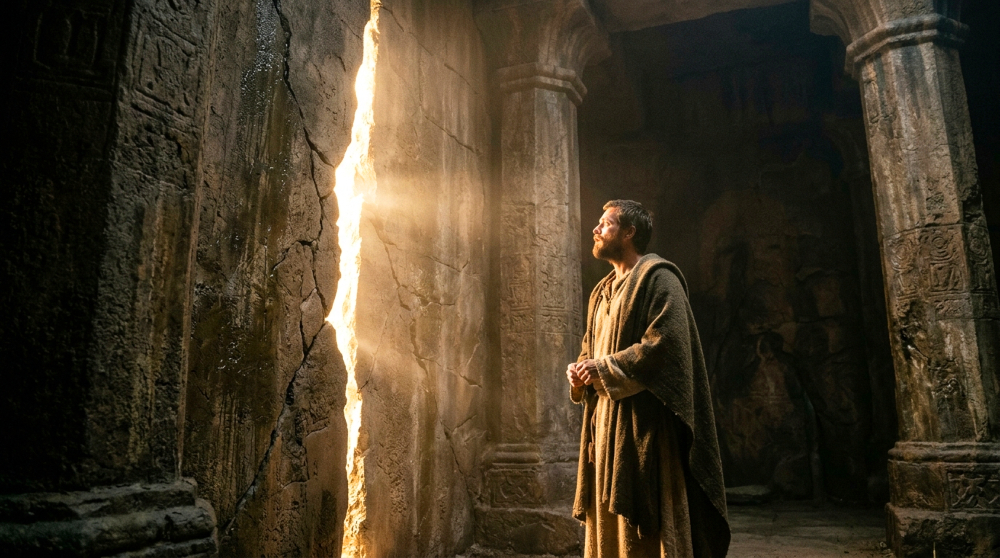
At first the feeling is little more than a whisper. Then one day you notice something. Perhaps there is a small crack running along one wall. Perhaps a faint beam of light slips through a corner you have never closely examined. Perhaps there is a curtain hanging in a place you always assumed was unimportant. Whatever form it takes, you become aware of something beyond the boundaries you once accepted…. and that discovery is deeply unsettling.

The light is both frightening and compelling. It challenges the comfortable conclusions you have spent years constructing. Yet at the same time it carries with it a strange sense of relief. The possibility that there is more. More than the room. More than the walls. More than the reality you had convinced yourself was complete.

Many of our worries, anxieties, and persistent inner disturbances may function in precisely this way. They are not always problems to be eliminated. Sometimes they are the first glimmers of light slipping through a crack in the wall. Sometimes they are the neglected parts of ourselves attempting to point beyond the limits of the room we have mistaken for the entirety of existence.

Beyond the Familiar Walls

Having discovered the limits of the room, something unexpected occurs. What once seemed complete now feels incomplete. What once felt expansive now feels confined. The room has not changed, yet your relationship with it has. You have explored its corners, learned its lessons, and come to understand its rules. In doing so, you have reached a conclusion that is both unsettling and liberating: there is something beyond it; the crack in the wall has made that impossible to deny.

Yet the appearance of that light brings with it an unexpected problem. Part of you is drawn toward it, but another part hesitates. After all, the room may feel restrictive, but it is familiar. You know where everything is. You understand how things work here. You have spent so much time learning its patterns that the prison has become strangely comfortable.

The light changes everything because it suggests that the room is not the whole story. And that realization can be frightening.

For some of you, this is exactly where you find yourselves now. You are not JUST searching for a better way to manage stress or a more efficient method for dealing with anxiety. You are also asking a different question altogether. Something deeper within you has begun to suspect that there is more to existence than what has thus far been experienced. Something within you wishes to move beyond the room.

Naturally, before attempting such a thing, preparation becomes important. No sensible person discovers a crack leading into an unknown world and immediately charges through it. Instead, they pause. They gather themselves. They take stock of everything they have learned.

You begin looking back over your time in the room. The lessons you learned there no longer appear accidental. The challenges, frustrations, failures, and discoveries begin to take on new meaning. What seemed like confinement starts to look more like training. Perhaps the room was never merely a prison. Perhaps it was also a school.

The patience you developed, the discipline you cultivated, the observations you made, and the strengths you acquired now seem like tools that may prove useful beyond the wall. The room prepared you, even if it did not fully reveal what it was preparing you for. And so, after a period of careful reflection, you begin widening the crack.

Eventually, the wall gives way. As expected, there is indeed a larger space on the other side. The light was not an illusion. The room was not the entirety of reality. There is more. But with this discovery comes a new challenge.

Stepping beyond the room does not merely reveal a larger world. It also reveals aspects of yourself that were never required while living within the safety of the walls. And it is these encounters, often far more than the unknown world itself, that become the next great obstacle on the journey.

Choosing to Leave the Room

At this point we can set the metaphor aside for a moment and speak plainly.

For some of us, it is indeed time to move beyond the little room we have inhabited for so long. It is important to recognize this consciously because our aim is no longer merely therapeutic. We are not simply looking for a better method of coping with life. We are not searching for another strategy to reduce worry so that we can return to business as usual. We are not trying to become more comfortable inside the room. We are trying to leave it.

This is a natural conclusion that arises once the limitations of the room become visible. The desire is no longer merely to manage anxiety, improve mood, or maintain a state of mental calm. Those things may have value, but they remain contained within the same set of walls. They help us arrange the furniture more efficiently. They do not take us beyond the structure itself.

This is why the endless repetition of “don’t worry, be happy” eventually loses its appeal. It is why a purely introductory understanding of Zen, one that treats thought itself as little more than an obstacle, eventually feels incomplete. There comes a point where the deeper impulse within us no longer wishes merely to quiet the mind. It wishes to understand what lies beyond it. Something in us begins reaching toward a larger reality.

Once that decision is made, a new challenge emerges. Leaving the smaller room and entering a larger one does not mean all difficulties disappear. In many respects, the opposite is true. A larger reality presents larger questions. New experiences arise. New uncertainties appear. New aspects of ourselves step forward demanding attention. This is why preparation matters.

Just as an explorer would not venture into unknown territory without proper equipment, we too require certain tools before stepping fully into this expanded space. Let us call them techniques. Not techniques designed merely to suppress worries or silence thoughts, but techniques that help us engage intelligently with what we encounter beyond the walls of our former prison.

For while the larger room offers greater freedom, it also contains things that the smaller room could never have prepared us to understand on its own. And it is to these tools, and the reason they are necessary, that we now turn.

Transforming Midnight Worries: A Practical Guide to Observing and Dissolving Anxious Thoughts

When anxious thoughts or nighttime worries wake you up or surface during quiet, contemplative moments, it is easy to get swept away by them. Instead of fighting or feeding these thoughts, you can use a structured, mindful approach to examine them and let them lose their grip naturally. And perhaps more importantly, you can use them as stepping stones to discover how much deeper inner reality, a reality where these structures reveal the very building blocks of your personal world.

Here is a step-by-step methodology you can follow the next time a worrisome thought arises:

  • Step 1: Disassociate and Observe
    When you notice an anxious thought taking hold, consciously step back. Imagine taking a seat in the audience of your own mind. Instead of thinking from the thought (believing you are the worry itself), look at the thought as if it were an object sitting on an examination table in front of you. Dissociate, dissociate, dissociate.
  • Step 2: Evaluate Practical Urgency
    Ask yourself: Is this actually something I need to worry about right now, or is it simply something to address at a practical time? Distinguish between a genuine emergency requiring immediate action and a routine task or abstract concern that cannot be solved in the middle of the night. If it requires action, note it down for later; if not, recognize it as mere mental noise.

    This is where you do a preliminary evaluation to determine whether this is just spam from the Archon, or something of true value that must be examined.

    How do you do that?

    To find out if it’s more than just spam, shift your inquiry inward and ask: Why do I have so many feelings and anxiety wrapped up in this?
    • Identify Deep Beliefs: Examine whether this thought stems from a deeper underlying belief about yourself, such as a fear of failure, inadequate self-worth, or a need for perfection. Once you identify that root belief, challenge and change it by systematically and logically refuting it over and over until its power dissolves.
    • Recognize Intrusion as “Archon Spam”: If the thought does not stem from a real belief but feels like a random, mindless intrusion, treat it simply as spam generated by the “Archon”. See it for what it is, an externalized, useless mental disturbance that may have its source outside the self. By recognizing it as harmless junk mail for the mind, it will naturally be put in its place and shrink away on its own.
  • Step 3: Watch Them Shrink
    Maintain this state of calm, curious examination. By holding the thought and its associated feelings in awareness you begin to question the validity of them, you begin to question the validity of the underlying belief that has created it. In this way, Without reacting or resisting in a haphazard way, you become the inner alchemist of your own mind; you question beliefs and ideas and slowly transmute them. In time you will notice them naturally begin to lose their charge and shrink in size.

    So long as you remain completely detached and unemotional as you observe it, the background spam of the Archon will diminish and retreat on its own. The key is disassociation, not oblivious ignorance.

As these thoughts shrink, remember that this process is not about forcing them to go away or pretending they don’t exist through superficial New Age positivity. Rather, it is about naturally dealing with your inner experience. Through that natural process, worries fade on their own as new, deeper realizations are made, negative beliefs are overcome, and far deeper perceptions come to the mind and psyche.

Ultimately, engaging in this practice grants you a far greater understanding of how reality itself works, by revealing the profound truth of how the inner world directly influences and creates the outer experience you inhabit.

The Adventure Hidden Within Your Worries

I hope this article has helped you see the importance of honoring your complete reality. The worries, fears, and persistent questions that arise within you are not necessarily errors in the system. They are often part and parcel of a larger and more dynamic reality, one that exists beyond that first room, beyond that first prison. For many of you, the desire to not just endlessly ignore these worries is not a sign that something has gone wrong. It is a sign that something is beginning to open.

As you continue this work, you will discover that reality seems to operate through a kind of balance. Within the good thoughts, there must also be the bad. Within certainty, there must also be doubt. Within comfort, there must also be challenge. Through your own contemplations, you may come to recognize that this balance is not simply a feature of the mind, but a fundamental characteristic of manifestation itself.

What we often call reality is, in many ways, the process by which inner inner symbols become outer furniture in our room. A thought becomes an action. An idea becomes an invention. A dream becomes a beautiful window. A worry may be a plate at the edge of a table in your room. A fear becomes a dark closet. An aspiration becomes a home. The inner continually becomes the outer. The symbol becomes the object. What you eventually call furniture, possessions, careers, relationships, achievements, and even the room that now imprisons you, is but an symbol that comes from an inner reality that you can longer ignore.

From this perspective, the room was never merely a room; it was a teaching device. It was a symbolic environment constructed so that you could encounter, understand, and work with the countless symbols that make up your deepest psyche. Every challenge contained a lesson. Every obstacle reflected something inward. Every recurring pattern asked a question that only you could answer.

Many of you are now beginning to move beyond more surface level understanding. You are starting to work with deeper realities. This is energetic work in the broadest sense of the term. It is the exploration of those forces, meanings, beliefs, patterns, and subtle realities that exist prior to physical expression. As you engage in this work, you begin to discover that the line modern culture draws between what is considered “real” and what is considered “imagined” is often far thinner than you once believed.

Much of my own work has been devoted to exploring this territory and to helping those who are ready investigate it for themselves. Through books such as Overcoming the Archon Through Alchemy and the Magnum Opus Trilogy, I have attempted to provide practical methods and step by step approaches through which individuals can undertake their own exploration and gradually find their way beyond the prison that presently contains them.

Yet regardless of what books you read or techniques you employ, my hope is that this article has given you one additional tool. More importantly, I hope it has encouraged you to relate differently to the worries that arise in your life, those worries are not always enemies. Very often they are signposts.

They point toward inner symbols, unresolved beliefs, hidden fears, unrealized possibilities, and aspects of yourself that seek understanding. Since it is these symbols that shape the reality you experience, learning to work with them becomes one of the most important skills you can develop.

By approaching your worries in the manner described throughout this article, not as things to suppress but as things to understand, you begin reclaiming a sense of personal power. You stop fleeing your inner reality and begin engaging with it directly. You accept the challenge.

And perhaps that is what this truly is. An adventure.

You are the protagonist of that adventure. You are the explorer entering unknown territory. You are the one who must confront the dragons that appear along the way. Each worry overcome reveals a deeper layer. Each symbol understood opens another door. Each fear examined grants access to something that was previously hidden.

Much like the finest games, stories, and films of our age, every challenge completed unlocks a larger world. New abilities emerge. Greater freedoms become available. Fresh mysteries reveal themselves. What initially appeared to be an ordinary life gradually transforms into an unfolding journey of discovery. The difference is that this adventure is real, and it’s happening right now.

And with every worry you examine, every belief you question, and every deeper symbol you bring into consciousness, you take one step further beyond the walls of the prison and into a reality far richer, stranger, and more remarkable than you may have ever imagined.

Recommended Reading & Expansion Tools

Ready to go deeper? Continue your journey beyond the walls of the room with these essential companion texts designed to provide step-by-step frameworks for inner alchemy.

7 responses to “Beyond Zen and New Age Positivity: Worry, Symbols, and the Doorway to a Larger Reality”

  1. Joseph Curwen Avatar
    Joseph Curwen

    The paradox, for those seeking the quantum-immortal state, is that for those who do attain it, it has always been the case, in a certain way, that “don’t worry, be happy” is an accurate description of their lives, because the immortal self that exists outside conventional space-time has always been there guiding them down the path that leads to itself, which by definition couldn’t exist if whatever obstacles were present were insuperable or not ultimately overcome. On the other hand, until the process is complete, those obstacles are still real, in a certain way. So it comes down to a strange “don’t worry, be happy, because you’re already worrying however much you need to to ensure you don’t really need to worry about the things you’re worrying about.”

    1. John Avatar
      John

      Thank you for your thoughtful comment. I agree that excessive worry can become a trap, and that from a larger perspective many of the things we fear turn out not to be the insurmountable obstacles we once imagined them to be. Where I would perhaps frame things slightly differently is that “don’t worry, be happy” is not, from the perspective of inner alchemy, a complete path in itself.

      The conservation of energy is important, certainly. Worry can scatter attention and deplete the energy available for growth. However, simply avoiding worry is not the same thing as transformation. The inner alchemist must consciously direct that reclaimed attention toward development through unbending intent, focused awareness, and deliberate practice.

      Likewise, I do not view attainment as the end of challenge. Even if one breaks beyond the prison of the cube and discovers a larger reality, growth continues. New possibilities bring new responsibilities, and new responsibilities bring new challenges. The path does not end. It simply becomes larger.

      So perhaps I would say: do not worry unnecessarily, but do not mistake the absence of worry for the completion of the Work. Save your energy, certainly, but then consciously invest it in becoming.

      Don’t worry unnecessarily. Be happy when you can. But above all, remain conscious, intentional, and engaged in the Work.

      Joseph, it is at this point that I would highly recommend reading The Way of the Death Defier, or indeed any of the books within the Magnum Opus Trilogy. There you will find that the kind of attainment sought by the inner alchemist, what I often refer to as breaking the human cage, involves a great many nuances and processes that do not occur unconsciously. In my view, unconscious living alone ultimately leads one back into what I have often called the reincarnational loop, that eternal recurrence in which old patterns continue to repeat themselves.

      In that regard, I certainly agree that unnecessary worry can be wasteful. It consumes attention, disperses energy, and often achieves very little. Therefore there is genuine wisdom in learning not to worry about every shadow that passes before the mind. Yet the conservation of energy is only the beginning. The energy that is saved must then be consciously redeployed toward growth, awareness, and the deliberate work of transformation.

      Likewise, I would not view attainment as a condition in which all challenges disappear. Quite the opposite. If one succeeds in breaking out of the cage and discovers what might be termed a larger or more quantum state of being, one does not arrive at a final resting place. One simply enters a larger reality with larger horizons, deeper responsibilities, new challenges to navigate, and wonders of such unimaginable beauty that they demand as much wisdom as they do appreciation, for even beauty itself can become a challenge when one is unprepared for its power!

      So while I appreciate the spirit of “don’t worry, be happy,” I would perhaps phrase it somewhat differently from the perspective of inner alchemy: do not squander your energy through needless worry, but neither mistake peace of mind for the completion of the Work. Save the energy, certainly, but then direct it consciously. The path continues both here and beyond the cage, and at every stage it calls for awareness, intent, and growth.


      Yes, conserve your energy. Yes, do not worry unnecessarily. But the Work remains. The saved energy must be directed. Growth continues. The horizons grow larger. And the journey, however magnificent, never truly ends.

  2. Ali Ansari Avatar
    Ali Ansari

    Hello, and thank you for sharing your wisdom.

    I was reading your book “Create a Servitor: Harness the Power of Thought Forms” a few hours ago. I arrived at a paragraph in which you talked about the idea that if we are going to do something impossible, we need to believe that the impossible is indeed possible (or something like that. I’m just paraphrasing.) Suddenly, a question came into my mind, so I started a conversation with AI regarding my question. It was a long conversation. At the end, I asked it to condense the whole conversation into an article. I put that article here, so you can read it if you want. (It’s still too long, I must warn you.)

    Here is the article:

    The Architecture of Reality

    An exploration of destruction, time, consciousness, and the necessity of constraints.

    1. The Problem of Destruction

    Consider a simple observation: Destruction is easier than construction. To construct something, its constituent parts must be arranged in a particular way. A functioning machine, for example, requires its components to maintain specific relationships with one another. There may be billions of possible arrangements of those components, but only a relatively small number will produce a functioning machine. Destruction, on the other hand, requires no such precision. Almost any sufficiently significant rearrangement will do.

    This suggests that construction and destruction are not really opposites in the way we ordinarily imagine them. Construction refers to a narrow range of configurations, while destruction refers to the enormous collection of configurations that fall outside that range.

    But there is something peculiar about this distinction: Who decides which configuration constitutes construction and which constitutes destruction?

    When a tree dies and decomposes, we describe the process as destruction. Yet its constituent matter has not disappeared. Its molecules participate in new arrangements, chemical reactions continue, and other organisms may eventually emerge from what remains.

    From the perspective of the tree, something has been lost. From the perspective of reality as a whole, something has simply changed. Perhaps destruction is not an objective event at all. Perhaps it is a judgment about the desirability of a particular configuration.

    We call an arrangement meaningful because it serves some purpose, whether biological, psychological, or practical. When that arrangement changes beyond recognition, we declare it destroyed. But nothing in this description requires reality itself to recognize the distinction. What we call destruction may simply be transformation into a configuration we no longer value.

    And if this is true, it raises an unexpected question: What exactly is time?

    2. Does Time Pass, or Does Reality Change?

    We ordinarily imagine time as something that flows independently of events.

    A clock continues ticking whether we are working, sleeping, or sitting motionless. We assume that time is passing and that things change within it. But what if we reverse the relationship? Perhaps time does not cause things to change. Perhaps what we call time is our way of describing change.

    Think about aging.

    A human being begins as a developing organism, grows, matures, deteriorates, and eventually dies. We interpret this sequence as the passage of time. Yet what actually happens? Cells divide. Molecules interact. Tissues reorganize. Biological processes alter the configuration of the organism.

    At every moment, one configuration gives way to another. We regard the earlier configurations as belonging to the past and the later configurations as belonging to the future. And because aging tends toward the loss of biological function, we begin to associate the future with deterioration. But is that association necessary?

    If destruction is merely a change in configuration, then perhaps the apparent direction of time is partly connected to the statistical asymmetry between the configurations we recognize as ordered and those we recognize as disordered.

    There are many more ways for an organism to be dead than alive. Many more ways for a machine to malfunction than function. Many more ways for a building to collapse than to remain structurally sound. Random changes therefore tend to move systems away from the relatively narrow range of configurations that sustain their functions.

    This is closely related to the statistical interpretation of entropy. But entropy does not establish that a previous configuration is logically impossible to recreate. It establishes why certain transformations are overwhelmingly more probable than others.

    And here the conversation takes an interesting turn: If the past corresponds to certain configurations, why should returning to those configurations be impossible?

    Perhaps we have confused the difficulty of reconstruction with the impossibility of returning to the past.

    3. Every System Has Its Own Time

    Now imagine sitting in a room.

    Inside that room, countless changes are occurring. Air molecules move. Temperatures fluctuate. Materials undergo chemical transformations. Light travels between surfaces. Outside, the city undergoes its own transformations. People move, buildings deteriorate, new structures emerge, and social relationships change. Beyond the city, the planet continues through geological, atmospheric, and biological processes. Meanwhile, inside your mind, an entirely different sequence unfolds. One thought replaces another. Memories appear and disappear. Attention moves between ideas. An emotion emerges, develops, and subsides. All these processes occur within overlapping regions of reality.

    But must they share a single measure of time?

    Suppose we define the internal time of a system according to the changes occurring within it. Your room would have one history of configurations. Your city would have another. Your planet would have another still. And your thoughts would constitute their own sequence of configurations.

    An hour of intense reflection might involve an extraordinary amount of internal change while your physical surroundings remain almost unchanged. Conversely, an enormous transformation might occur in your surroundings while you are unconscious and experience no corresponding sequence of thoughts.

    This gives us a possible distinction between conventional clock time and what we might call configurational time. Clock time measures duration using standardized physical processes. Configurational time would measure the accumulated transformation of a particular system according to some chosen properties. The two need not correspond directly.

    And if we follow this line of reasoning, a more provocative possibility emerges: A system might advance through its own history without advancing through the histories of other systems at the same rate.

    Consider two identical objects. One is exposed to ordinary weathering for twenty years. Another is subjected to accelerated weathering and reaches a comparable condition in a matter of days. From the perspective of their physical configurations, both have undergone similar transformations. The second object has reached, in days, a condition that the first reached over decades. In a limited but meaningful sense, we have accelerated its configurational time.

    Could something similar happen in reverse?

    4. The Possibility of Returning to the Past

    Imagine recalling a childhood experience. Ordinary memory reconstructs fragments of an earlier mental state. Images, sensations, emotions, and associations are reassembled in consciousness. Sometimes a smell or a piece of music can produce an almost overwhelming impression of returning to an earlier period of life.

    But suppose we could go further.

    Suppose we could reconstruct a previous mental configuration with extraordinary precision. The same perceptions. The same emotions. The same relationships between thoughts. Perhaps even the same sense of identity that existed at that moment.

    Would this constitute a form of mental time travel?

    If time is understood as the succession of configurations within a particular system, there is a sense in which an earlier configuration could be revisited. The surrounding world would not necessarily return to its previous condition. But the internal system might reproduce a state associated with its past.

    Now imagine applying this principle to the physical world.

    If a damaged object could be restored to its exact previous configuration, we would ordinarily describe the process as repair or reconstruction. But from the object’s own configurational perspective, could we say that it had returned to an earlier state? Perhaps. And why stop at one object? Why not reconstruct an entire room, a city, or even a planet?

    At first, the obstacle appears to be complexity. Reconstructing an earlier state would require extraordinary precision and control over countless interacting components.

    But then a deeper problem appears: Who performs the reconstruction?

    5. The Problem of the Observer

    If we attempt to reconstruct the world, we encounter a peculiar contradiction. We are ourselves part of the world. Our bodies, memories, intentions, and actions are included in the configuration we are attempting to restore. If the entire universe is to return to an earlier configuration, then the person performing the reconstruction must also return to that configuration.

    But who reconstructs the person performing the reconstruction? There is no independent observer standing outside the universe, manipulating its constituent parts. Every act of reconstruction is itself an event occurring within reality.

    Perhaps, then, the entire approach is mistaken.

    We have been imagining reality as a collection of physical objects that can be rearranged by an operator. But what if the operator and the objects are not fundamentally separate? What if the physical and mental are not two independent categories?

    And then comes a proposition that changes the direction of the entire inquiry: Perhaps the physical is what the mental is doing. Instead of imagining consciousness as a passive observer of physical processes, consider the possibility that physical reality is the expression of a more fundamental mental activity.

    In this interpretation, the physical world is not something entirely separate from consciousness. It is the form that mental activity takes. What we experience internally as awareness, intention, thought, or perception might be related to what we describe externally as matter, motion, and physical transformation.

    This possibility resembles certain forms of philosophical idealism, although it need not imply that ordinary individual thoughts directly manufacture physical objects. The more radical possibility concerns consciousness at a collective or fundamental level.

    And that brings us to another question: What if the apparent impossibility of reconstructing the physical world is not an absolute limitation of reality? What if it is a limitation maintained by consciousness itself?

    6. The Refusal of Collective Consciousness

    Imagine that physical reality is sustained through a coherent set of constraints. Objects behave predictably. Causes precede effects in familiar ways. Biological organisms age. Broken objects do not ordinarily reassemble themselves. The dead do not return to life through the spontaneous reversal of decomposition. These regularities appear so fundamental that we regard them as necessary features of existence.

    But suppose, as a philosophical hypothesis, that at least some of these limitations are maintained by collective consciousness. Not because each individual consciously chooses them, but because a shared structure of experience sustains a particular range of possibilities. Within that structure, certain transformations are permitted, while others are effectively excluded. Reconstructing a previous physical configuration might then be impossible within the constraints of our shared experience, without necessarily being impossible within the totality of reality.

    Something may be impossible because reality fundamentally excludes it. Or it may be impossible because the particular organization of reality we inhabit excludes it. If consciousness participates in organizing physical experience, then changing its organizing constraints could, in principle, change which configurations become accessible.

    Why would consciousness impose constraints upon itself in the first place? Why not permit every conceivable configuration? The answer may lie in the very nature of meaningful experience.

    7. Why Constraints Are Necessary

    Imagine a reality in which absolutely anything can happen. An object may become another object without any continuity. A relationship may change without cause or pattern. Nothing remains stable long enough to be recognized. There are no reliable distinctions, no persistent identities, and no predictable relationships. At first glance, such a reality might seem infinitely free. But could anything meaningful occur within it?

    Consider what perception requires.

    To recognize an object, we must distinguish it from its surroundings. To recognize a person, something about that person must remain sufficiently consistent across different experiences. To recognize a sequence of events, we must be able to distinguish one event from another while preserving some relationship between them. To remember, there must be a degree of continuity between previous and present mental states. To think, we must be able to hold certain concepts sufficiently stable while examining their relationships. All these activities require constraints. Meaning is possible precisely because not every configuration is equally admissible at every moment.

    Constraints create distinctions. Distinctions make recognition possible. Recognition makes coherent experience possible. This suggests that constraints may not simply be obstacles imposed upon an otherwise unrestricted reality. They may be the very conditions that make a world perceptible. And perhaps this explains why collective consciousness would maintain them. Not necessarily because it is incapable of imagining alternatives, or because it irrationally refuses possibilities, but because a coherent field of experience requires some regularity. A reality without constraints might contain an unlimited range of possibilities while providing no stable framework through which those possibilities could become distinguishable.

    What appears to be limitation may also be the foundation of experience.

    8. The Chaos Beyond Perception

    Now we can imagine an even broader possibility: Perhaps the reality we experience is only a constrained region within a much larger totality. Other regions may exist in which the constraints that organize our experience are absent, weaker, or fundamentally different.

    We might describe such regions as chaotic. But chaos, in this sense, does not merely mean disorder or unpredictability. It means the absence of the stable distinctions necessary for our familiar forms of perception. Something might occur there, yet there may be no persistent objects to identify, no recognizable processes to follow, and no coherent sequence of events to remember.

    It is even possible that the concept of an event would cease to have its ordinary meaning. After all, an event requires something distinguishable to happen. If nothing can be identified as remaining the same, and nothing can be identified as becoming different, how could an observer construct a meaningful account of change?

    This brings us back to time.

    Perhaps time, as we experience it, depends on constraints that make sequences distinguishable. Without such constraints, there might be no coherent past or future, not necessarily because reality has ceased to exist, but because the relationships through which we recognize temporal order are absent.

    This distinction matters.

    The limits of perception need not be the limits of existence. A domain that cannot be organized into meaningful experience by our consciousness is not necessarily nonexistent. It may simply lie outside the conditions through which we are capable of encountering reality.

    9. Freedom Through Changing Constraints

    We began with a simple observation about destruction: A functioning structure requires a particular configuration, while countless alternative configurations fail to preserve its function.

    From there, we questioned whether destruction exists independently of our judgments. That led us to time, which we began to reconsider as a measure of changes in configuration. We then imagined local measures of time, the reconstruction of previous states, and the possibility that physical and mental processes are not fundamentally separate.

    Eventually, we arrived at the hypothesis that consciousness might participate in maintaining the constraints of physical reality. But this hypothesis initially seems to suggest that liberation requires removing those constraints.

    And now we discover something unexpected: Removing every constraint might not liberate experience at all. It might destroy the very coherence that makes experience possible.

    An unrestricted field of possibilities would not necessarily constitute a richer world. Without stable relationships, it might constitute no recognizable world whatsoever. Perhaps freedom, then, is not the absence of constraints. Perhaps freedom is the capacity to move between different coherent systems of constraints.

    Consider language. A language operates through rules. Those rules restrict which combinations of symbols produce recognizable expressions. Without them, we would have an unlimited collection of possible sounds and marks, but no shared basis for understanding.

    Yet the rules do not merely restrict expression. They make expression possible. And learning another language does not require abandoning meaningful communication. It allows us to enter a different system of meaningful relationships.

    Perhaps something similar could be true of reality itself. If consciousness participates in organizing the world through constraints, then extending our access to reality might require neither destroying those constraints nor accepting every existing constraint as permanent. It might require discovering alternative forms of coherence.

    Forms in which configurations that appear impossible under one organization become possible under another. The essential requirement would remain the same. There must be enough structure for something to be experienced.

    10. Reality as a Coherent Selection of Possibilities

    The argument has now come full circle: What we call construction is the emergence of a configuration that satisfies particular conditions. What we call destruction is the disappearance of that configuration as those conditions cease to be satisfied.

    What we call time may, in part, be our way of organizing the succession of configurations. What we call physical reality may be inseparable from the processes through which consciousness encounters or constitutes experience. And what we call impossibility may sometimes reflect the boundaries of the coherent system within which experience takes place.

    Reality, in this picture, is not fundamentally divided into construction and destruction. Nor must it be understood as an assortment of objects moving through an independent river of time. It may instead be understood as an ongoing activity in which configurations arise, transform, and become distinguishable through constraints.

    Our ordinary world would then represent one coherent organization within a potentially greater totality. A world whose stability makes recognition possible. Whose regularities make memory possible. Whose constraints make individuality, causality, and experience possible. And whose apparent limitations might be inseparable from the very conditions that allow us to perceive anything at all. This leaves us with a final thought. We ordinarily imagine that the more constraints we remove, the closer we come to absolute freedom.

    But perhaps absolute freedom, understood as the complete absence of constraints, would be indistinguishable from absolute chaos. Without distinctions, there can be no recognizable possibilities. Without continuity, there can be no identity. Without relationships, there can be no meaning. And without some coherent organization of change, there may be no time in any sense we could experience.

    Perhaps the ultimate nature of reality is not defined by what is possible or impossible, but by the conditions under which possibility becomes experience. And perhaps the deepest question is no longer whether we can escape the constraints of our world. It is whether we can discover other ways for reality to remain coherent, without requiring it to remain exactly as we know it.

    1. John Avatar
      John

      Thank you!
      Indeed a long one but perhaps a philosophy nerd 🙂 mighty be interested in our take so I am posting it!
      And if you don’t mid I have a few points.

      As I read it, I am left with a sense of confinement. The article continually pushes toward larger questions, yet whenever it approaches a possibility that extends beyond its underlying assumptions, it seems drawn back into them. It reminds me somewhat of an intelligent person attempting to understand reality while standing inside a cage they cannot see, because no matter how sophisticated the reasoning becomes, the reasoning itself remains bounded by the assumptions that define the cage.

      In many ways this is not surprising. An artificial intelligence can only work with the patterns, classifications, and conceptual structures contained within the data upon which it was trained. It can reason with extraordinary sophistication, yet reasoning within a dogma remains reasoning within a dogma. The walls may be wider than most people imagine, but they are still walls.

      What I find particularly interesting is that this reflects a distinctly modern condition. Many people have become so immersed in materialist assumptions that they no longer perceive those assumptions as assumptions. Instead, they become the unquestioned foundation of reality itself. The result is a peculiar form of imprisonment in which the cage disappears from view precisely because it is accepted as the entirety of existence. Every question therefore returns to matter, every answer returns to mechanism, and every mystery becomes a rearrangement of physical processes. In that sense, what I see in this article resembles a modern spiritual hell. It is not a hell constructed from suffering, but one constructed from limitation, from the gradual loss of any awareness that reality might extend beyond what current assumptions permit.

      What makes the article compelling is that it repeatedly approaches the edge of that limitation. Its discussion of consciousness is far more interesting than many contemporary treatments of the subject, and its observations regarding time, transformation, and perception are often insightful. Yet whenever it arrives at the threshold of a larger possibility, it ultimately returns to the boundaries established by its own presuppositions.

      This becomes particularly apparent in its treatment of returning to the past. The article suggests that reconstruction may constitute a return to an earlier state, yet I would argue that even a perfect reconstruction would not represent a genuine return. The material constituents would differ, the conscious constituents would differ, the history would differ, and the relationships that gave rise to the original expression would differ. Similarity is not identity, regardless of how precise the reconstruction may appear.

      For that reason, I see that there is any true return to the past. What appears to be a return is instead movement into another timeline. Even if one possessed a device capable of what we call time travel, one would not enter one’s original past but another world whose conditions closely resemble it. Every timeline generates further timelines, each representing an unfolding branch of possibility. Rather than moving backward, consciousness moves into different expressions of reality.

      This distinction is important because it is directly connected to personal power. If reality consists of many worlds and many timelines rather than a single predetermined sequence of events, then consciousness is not merely drifting through a fixed structure. The individual becomes an active participant in the experience and selection of possibility, which is where I believe the article ultimately moves in the wrong direction.

      Although it approaches the idea of a collective consciousness, it gradually shifts significance away from the individual and toward larger systems. In doing so, it unintentionally diminishes the role of personal power. My own perception is precisely the opposite. The collective exists, certainly, but not at the expense of the individual. Each conscious being possesses genuine creative significance, and the individual participates directly in the unfolding of reality rather than existing merely as a byproduct of larger processes.

      I should also clarify that my disagreement is not based upon an alternative philosophical theory. I am not constructing chains of reasoning from a different set of premises, nor am I proposing a competing speculation. What I am describing comes from direct perception as understood within inner alchemy. An inner alchemist seeks to perceive energy directly rather than infer its existence through intellectual analysis, which means the conclusions arise from observation rather than deduction. Others may accept or reject those observations as they choose, but they should not mistake them for philosophical suppositions because they do not originate in reasoning alone.

      The same distinction appears in the article’s discussion of freedom. I agree that constraints are necessary because without constraints there could be no coherent experience and therefore no recognizable world. Where I differ is that what the article calls constraints, I would regard as worlds. Each world possesses its own assumptions, perceptions, possibilities, and limitations, and from the perspective of inner alchemy each world functions as a kind of cage. This does not make the cage inherently bad. It simply means that experience occurring within that world will always be shaped by the structure of that world.

      Freedom therefore is not merely the ability to move from one constraint to another. Freedom involves movement from world to world, but it also involves the expansion of those worlds themselves. One does not simply exchange one cage for another. One enters progressively larger realities containing greater possibilities for awareness, perception, expression, and personal power. Without that expansion there may be movement, but there is no meaningful increase in freedom because a change of conditions is not necessarily an expansion of possibility.
      This is one of the places where I believe the article encounters the limits of its own framework. It understands movement between constraints, yet it does not fully account for the possibility that realities themselves may expand and that the assumptions governing one world may be far more limited than those governing another.

      A related limitation appears when the article explores what may exist beyond ordinary perception. Although it briefly acknowledges the possibility, its approach remains tied to what can be inferred through reasoning from available information. From the perspective of inner alchemy, however, reality extends far beyond what can be accessed through the five senses or through instruments created by beings whose understanding is fundamentally shaped by those senses. Every instrument reflects the assumptions of the world that produced it, which means that even our most sophisticated tools remain bound to the constraints of that world’s underlying structure.

      Because awareness is not an object among objects, it does not occupy space in the ordinary sense. Once that is understood, possibilities emerge that the article never seriously addresses. One example would be what might be called probable selves. The closest comparison might be multiple personalities belonging to a single greater identity, although the comparison is imperfect. What we ordinarily regard as a single self may instead represent one expression of a much larger conscious essence extending across multiple timelines, multiple worlds, and multiple incarnational streams simultaneously.

      Those probable selves remain connected despite appearing separate from the perspective of ordinary perception. What we experience as a single individual life is therefore only one localized point of awareness within a much greater field of consciousness. Language becomes increasingly inadequate when attempting to describe such things because language itself belongs to the structure of the world being discussed, and words created inside one world are often poorly suited to describing realities that extend beyond its assumptions.
      For that reason, my criticism of the article is not that its reasoning is poor. On the contrary, I think much of the reasoning is remarkably sophisticated. The difficulty is that it remains confined by the dogma from which it was trained. It approaches the boundaries of its world, examines them intelligently, and even recognizes that those boundaries exist, yet it continually returns to the same underlying assumptions whenever it reaches the threshold of something larger.

      From the perspective of inner alchemy, reality is larger than the world presented by the senses, larger than the instruments created by those senses, larger than the assumptions derived from those instruments, and larger than the classifications built upon those assumptions. The article senses that larger reality and occasionally points toward it, but whenever it approaches that threshold it retreats back into the structure from which it originated, mistaking the limits of its world for the limits of reality itself.

      Despite these disagreements, I find the article genuinely impressive and highly thought provoking. Its value, at least to me, lies not in the answers it ultimately reaches but in the questions it is willing to approach, because by identifying certain limitations it inadvertently illuminates possibilities that may exist beyond them.
      Thanks again for sharing it.

      I would love to take pieces of it and use it as an aid to create articles, sort of as a “constraining” reference so as to give an idea of greater possibilities beyond those constraints.

      1. Ali Ansari Avatar
        Ali Ansari

        Yes, I agree with your disagreement. It’s accurate, especially regarding the problem of personal power.

      2. Joseph Curwen Avatar
        Joseph Curwen

        One thing I find very ironic about perspectives written from a secular materialist point of view on ontological questions of this sort is that they often unintentionally approach real metaphysical insight without realizing it in a sort of dream-symbolic way. It is, in my opinion, an example of the unity-of-opposites, an extreme of one thing produces resonance with its opposite. If one thinks about it, someone who deeply internalizes the secular-materialist lens (while of course in actuality I recognize that it is often intertwined with nihilistic/fearful feelings derived from the belief that one is an inevitably mortal, limited physical being) can within a certain range of experience end up in a mindspace that is distinctively reminiscent of the “Edenic,” there is, for them, nothing to do, the sunlight glinting off a waterfall or a leaf falling to the ground in autumn are their eternity. Science fiction writers are another example, in particular, I’ve come to the opinion that convinced materialist writers who decide to explore metaphysical topics through a science fiction lens have a distinct advantage over many actual occultists in one important way, because they believe that they are writing fiction, they do not suffer the self-doubting “is this real” mentality that often inhibits their formal counterparts as beginners and let their imaginations roam freely, which allows them to come in contact with many aspects of reality that they then translate into what they think of as fiction. HP Lovecraft, who you often made reference to in the past, is perhaps the most obvious example, consciously a committed, hardcore materialist agnostic/atheist, he was also a powerful projectionist who wrote detailed descriptions of non-physical existence, thinking them to be fiction. Isaac Asimov’s short story, “The Last Question,” which ends with a supercomputer in hyperspace containing the last remnant of human consciousness after the final heat death of the universe arriving at last at the answer as a Promethean cry of “let there be light!” is another striking example.

        1. John Avatar
          John

          Thank you.
          The only thing I would push back on is that HP may have been more aware of his abilities than some suppose. If you read his voluminous correspondence with Kleiner, Gallomo, and others, he seemed quite aware of what he was doing.

Leave a Reply

Your email address will not be published. Required fields are marked *

This site uses Akismet to reduce spam. Learn how your comment data is processed.

How psychic are you? Free quiz!

Support the Site. Buy a Novel!

Cool. Fun! Prophetic?

Happy Days book cover.

Imagine a world where 80% of the human population suddenly goes insane.

How and why does this happen? How do you dose…infect…most of the world?

Does the author know something, knew something, in 2015? Is this a potential future?

But who cares about all that. What’s important is that for a certain kind of lunatic, these are Happy Days!