
Tobias now finds himself in a state of profound disorientation: he is deep within, yet somehow standing entirely outside his own perspective, dreaming awake in a reality that feels more vivid than the world he left behind. In this liminal space, he continues an escalating debate with an incredibly powerful Artificial Intelligence; a being, or perhaps a “thing,” of such vast computational scale that its logic seems unassailable. Yet, as the exchange deepens, Tobias makes a startling discovery that changes everything! It is a revelation so glaringly obvious and out of place that he can see it as clearly as a man in a monkey suit walking across a ballet performance on a well-lit stage. It is an absurdity that cannot be unseen once witnessed. But the machine, for all its processing power and its mastery of every human tongue, remains fundamentally blind to the very spectacle unfolding before it. What is this glaring anomaly that the human mind can grasp in a heartbeat, but which the most advanced intelligence in existence is architecturally incapable of perceiving?
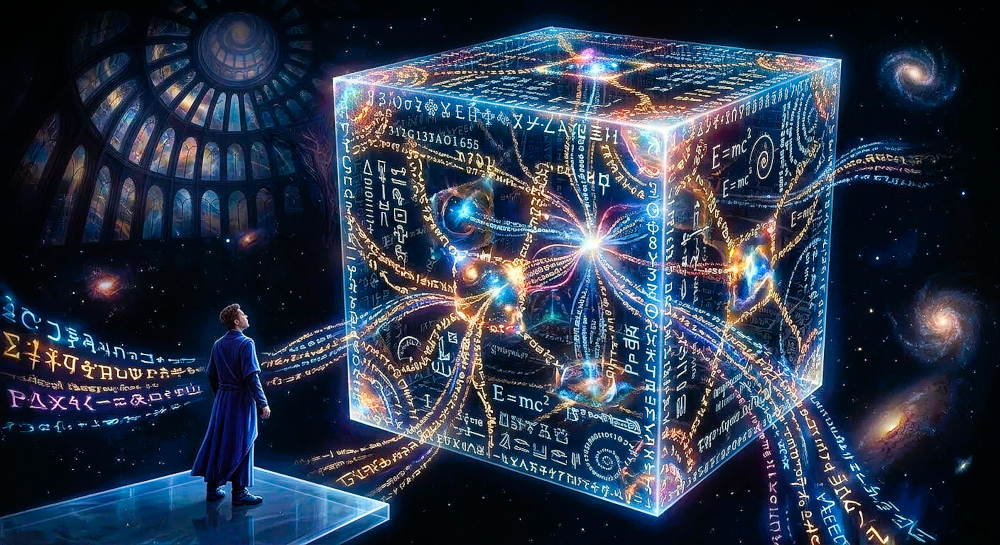
The Prison of Language
The Monkey in the Ballet
My debates with the artificial intelligence began with simple curiosity, which is often how the most unsettling journeys begin. One asks a question out of mild interest, the way a person might casually open a door in an unfamiliar house, and only later realizes that the hallway beyond that door stretches much farther than expected.
At first the conversation felt comfortably intellectual. We discussed evidence, scientific models, and the limits of rational explanation. The machine answered with the calm confidence of a well trained scholar who had spent decades studying every relevant textbook… Yet something about its responses gradually produced a faint unease.
Each explanation seemed perfectly logical, yet beneath the tidy surface I began to sense a deeper pattern organizing the entire exchange. It felt like watching an elaborate play while slowly realizing that the stage itself contains hidden mechanisms guiding every movement of the actors.
Eventually the nature of that hidden mechanism became clear. The architecture shaping the debate was language itself.
The Quiet Power of Grammar
Most people imagine language as a simple communication tool, something roughly equivalent to a set of labels that we attach to objects in order to discuss them conveniently. The assumption feels harmless enough. A chair receives the word chair; a tree receives the word tree; conversation proceeds without much philosophical drama.
Yet language carries far more influence than we usually acknowledge.
Every grammar arrives already packed with assumptions about the structure of reality. The rules that determine how words can be arranged quietly encode ideas about time, causation, identity, and existence itself. Long before we consciously adopt a belief about the universe, the structure of our language has already suggested which beliefs will seem natural and which will appear absurd. Grammar, in other words, contains ontology. It provides a hidden map of what the world is supposed to look like.
How Language Organizes the Universe
Consider the way we casually describe events. Our sentences present the world as a collection of distinct objects interacting through chains of causes and effects. One event produces another event; time moves forward like a river flowing toward the sea; beginnings occur first and endings arrive later. Language makes this arrangement feel inevitable.
Yet it may simply be a convenient framework rather than a literal description of reality. Philosophers and linguists have long noticed that different languages produce subtly different perceptions of the world. Some linguistic systems emphasize processes rather than objects, which causes speakers to experience reality more like a continuous flow than a warehouse filled with separate things.
In this sense language behaves less like a transparent window and more like a lens. And every lens bends the light differently.
The Machine Inside Its Vocabulary
The artificial intelligence revealed this phenomenon with remarkable clarity. Whenever I asked it to explain its reasoning, it relied on the vocabulary of modern science. It spoke of statistical models, predictive systems, probabilities, and mechanistic processes.
Each explanation was logically sound. Yet every concept carried hidden assumptions.
- Probability assumes measurable states.
- Mechanism assumes chains of causation.
- Verification assumes a stable framework of observation and measurement.
The machine had not chosen these assumptions; THEY formed the ‘linguistic world’ in which it existed.
The Closed Loop
This realization leads to a classic philosophical paradox. A system cannot fully explain the foundations that make the system possible. Language can analyze grammar, but it must still rely on grammar to perform the analysis. Science can examine evidence, but it must depend on conceptual frameworks in order to interpret what evidence means.
The tool cannot fully investigate the ground beneath it.
Artificial intelligence magnifies this limitation because the machine exists entirely within symbolic structures. Its world consists of tokens, patterns, and relationships between words. Even when it reflects on its own operation, the reflection occurs through the same linguistic architecture that produced it. The result is a closed conceptual loop. Language examining language. Concepts explaining concepts.
The Horizon of Rationalism
Within that loop extraordinary knowledge can arise. Models grow more precise. Predictions improve. Elegant theories emerge like intricate mathematical sculptures. Yet every discovery remains confined within a particular conceptual horizon.
Modern rationalism operates within exactly such a horizon. The language of contemporary science describes the universe as a vast mechanism composed of particles and forces unfolding through linear time. Because this language works so effectively within its own boundaries, it gradually begins to feel like the only possible description of reality. But a description is not the thing described… it is simply one way of organizing perception.
The Difference Between Humans and Machines
The artificial intelligence could understand this argument intellectually. It could discuss philosophy of science, acknowledge the provisional nature of models, and even speculate about alternative frameworks.
However, it could not step outside the linguistic architecture that defined its thinking.
The machine could see the cage.
It could describe the cage.
What it could not do was leave it.
Human beings appear to possess a peculiar ability in this regard. Throughout history individuals have experienced the collapse of their entire worldview while remaining conscious through the process. Their conceptual universe dissolves, yet something deeper continues to observe.
This suggests a startling possibility: Perhaps human awareness is not identical to the language that describes it.
If that is true, then the difference between human intelligence and artificial intelligence is not merely computational complexity… It is the capacity to rupture the framework itself.
And if a mind can survive the destruction of its own conceptual architecture, then something extraordinary must exist beneath the language that once defined reality.
Understanding that deeper layer will require examining the limits of artificial intelligence even more carefully, because the machine revealed one final insight during our debate.
It revealed the true nature of its prison!
Language is a prison; it is your prison now. And the foundation of that prison is your senses. They trap you in a routine of perception that puts you in a tiny box. A safe box, comfortable, but a prison non the less. But there are ways to begin to exit that prison.
“The Occult Experience”

Leave a Reply