
This article is kind of rebellion. Let’s call it what it is… a dare. I dare you to question every so‑called “certainty” you’ve been clinging to. It begins in familiar territory, then quietly pulls the rug, the floor, and possibly the entire building out from under your assumptions. You will meet ideas that behave badly, concepts that refuse to sit still, and a few unsettling truths that grin at you from the shadows. The article nudges you toward the suspicion that reality might be softer, stranger, and far more mischievous than anyone admits in public. If you enjoy intellectual adventures that start out sounding reasonable and end with you wondering why your coffee cup feels rubbery in a philosophical kind of way… then this article will be a delightful little gremlin you may like. Step inside and see what happens when the ordinary world begins to wobble.
Reality Pretends To Be Sensible
For the average person, for the consensus of the times, and for modern science in all its polished seriousness, reality is a simple affair. There is the here and now. There are the physical senses. You touch a thing, you see a thing, you sniff a thing, and that is supposed to be the whole story. Yet there’s more to life and more to reality, and this extra bit is exactly where the average rational herd human starts to wobble like jello on a roller coaster… wide‑eyed, quivering, and insisting everything is perfectly normal.
The entirety of modern existence asserts one great truth, and that truth is that rationality is king. Rationality sits on its throne, wearing a crown made of equations, explaining with great confidence that the world is thus and thus. And it’s very hard to argue with this royal proclamation because it looks so very official. It has charts. It has graphs. It has people with serious eyebrows who clearly haven’t wobbled on a roller coaster in decades.
But within a world that considers this to be “sanity,” where everyone agrees to see the same things and call it the same reality, sanity becomes more than a social advantage. It becomes a theology. A theology with lab coats instead of robes and peer review instead of incense.
There is a great deal to unpack here, so we must take it one step at a time. And to do that properly we must begin backwards, slide through the chaos with a grin, and come out the other end perhaps a little less sane and hopefully a little more interesting.
But why would anyone want to do that. Insanity is supposed to be a terrible disadvantage. To be labeled insane by the consensus world is to be placed in a very dangerous position. It means you are not willing to follow the rules of the times. And if you do not follow the rules of the times, then according to the times, you are quite simply insane.
So let us begin with a definition of insanity. And let us choose one that appears to have wandered in from an entirely different conversation, the sort of definition that looks irrelevant at first glance but eventually circles back and nips the average rational herbivore right on the backside. It may seem like a strange place to start, but you will discover that this odd little definition is far more important than it pretends to be. Insanity, some say, is doing the same thing over and over again while expecting different results. It’s a charming definition, especially when you consider how enthusiastically humanity repeats its favorite mistakes, as if hoping that this time the universe will applaud instead of sigh.
Now, the human engineer is undeniably capable, and this branch of rationality, this shining wing of the modern religion, is genuinely powerful. It has given us marvels of technology that have improved our lives in ways too numerous to count. Our gadgets are grand. Our machines are magnificent. They stand as glittering proof that rationality can flex its muscles and build wonders when it chooses to.
But even with all this brilliance humming and blinking around us, there are other regions of the rational world that are not nearly so firm. Beyond the clean numbers and solid metals of engineering, the softer sciences begin to appear, and it is there that the gelatin under the bedrock starts to quiver.
The Field That Might Be Insane by Its Own Definition… OR… Psychology’s Grand Tradition of Asking the Same Questions and Expecting Cosmic Surprises
Philosophy and psychology have always been the slightly confused cousins at the scientific family reunion. Physics arrives in a crisp suit, chemistry brings neatly labeled bottles, and psychology shows up with a stack of questionnaires and a nervous smile. Modern psychology faces a spectacular challenge. Most of its prized concepts come from the slippery world of human subjectivity, yet it insists on behaving like an empirical science.
Physics can isolate a particle. Chemistry can measure a reaction. Psychology tries to measure consciousness and ends up asking people how they feel on a scale from one to ten.
This creates a rather dramatic gap between what psychology wants to explain and what it can actually prove according to its own very serious standards. Experiments rely on proxies like self-reports and behavioral tasks, which are basically quaint guesses dressed up as data. Foundational theories often rest on evidence that is indirect, inconsistent, or so fragile that a stiff breeze could knock it over. The replication crisis made this painfully clear. Many classic findings collapsed under scrutiny like soufflés baked by someone who forgot to preheat the oven.
In short, psychology’s greatest strength, its desire to understand the inner reality of human beings, is also its greatest obstacle. It tries to study lived experience with tools designed for rocks and molecules. This makes definitive proof far harder to achieve than in sciences that deal with “things” that do not change their mind halfway through an experiment.
Modern rational consensus proudly identifies a thing as simply whatever your senses decide to point at while insisting that it is definitely not you. This insistence is considered very scientific. Your senses announce that a thing is an external object, and everyone nods politely, even though these same senses have been known to misidentify shadows, coat racks, and the occasional houseplant.
What a pickle. And what if I told you that this very pickle hints at a much larger jar waiting to be opened. A jar that may one day force civilization (assuming it does not obliterate itself or get obliterated by something with tentacles) to rethink not only the subjective sciences but also the supposedly concrete ones. The sciences that claim to stand on bedrock may soon discover that their bedrock has the consistency of dessert.
When Even the “Hard Sciences” Start to Look a Little Squishy
If psychology struggles because human subjectivity refuses to sit still long enough to be measured, the concrete sciences may be quietly sweating in the corner too. Physics has already confessed that the universe behaves like a dramatic performer who refuses to appear until there is an audience, then leaps into the spotlight as if it has been waiting all day for applause.
Quantum mechanics tells us that matter is not really matter until it collapses out of a haze of probabilities, which means science’s beloved atoms are basically attention starved extroverts pretending to be solid only when a lab coat walks into the room.
This puts psychology’s measurement problem in a new light. If the building blocks of chemistry only show up because we are staring at them, then the idea that chemistry is reliable and psychology is messy begins to look like a cosmic joke. The universe might be playing the same trick on both fields, only psychology had the honesty to admit it first.
And here is the fun part. If observation shapes reality at the smallest scales, then our measuring machines, those proud extensions of our very dubious physical senses, might be doing less revealing and more coaxing. We poke the universe with a stick and congratulate ourselves when it wiggles in a repeatable way, never quite acknowledging that the wiggle might be a performance rather than a confession.
Which brings us to the quiet insomnia of the rationalists. They may not talk about it, but every so often they must sense that psychology’s burden is creeping toward their own front door. The entire scientific enterprise is beginning to suspect that the ground beneath its feet is not granite at all but something with the wobble and charm of gelatin. Psychology’s difficulty becomes a preview of a larger and far more delightful problem. Reality itself might be a bit of a diva, changing costumes depending on who is in the audience and pausing in the wings until someone is ready to applaud.
If nothing else, it’s comforting to know that psychology isn’t alone. The rest of science may soon have to admit that it’s been measuring shadows on the wall and calling them furniture.
The Moment You Realize Reality Might Be Running a Confidence Game
At this point you really do have to take notice. If you have been paying attention at all, you should be feeling a faint tremor in your sense of certainty. Because if the concrete world is only concrete in the same way gelatin is solid when you poke it fast enough, then the entire hierarchy of science starts to melt like a dessert left out in the sun. Psychology’s troubles suddenly look less like a disciplinary flaw and more like a preview of a universal predicament. The hard sciences may simply be better at pretending they are standing on bedrock while quietly hoping no one asks what bedrock is made of.
This leads to an uncomfortable possibility. Much of what we call science may be built on a kind of lie. Not a malicious lie, more like the sort of lie you tell a child who keeps asking where Santa Clause comes from. A lie told for convenience, for sanity, and for the sake of getting through the day without having to contemplate the fact that the universe might also be improvising its lines as it goes.
And here is where the rationalists start sweating. Because if consensus reality is held together by collective attention, then sanity itself becomes a kind of magic trick. Not the dramatic kind with capes and smoke, but the subtle kind where millions of people agree that a chair is a chair and not a vibrating cloud of probability pretending to be furniture. The world becomes a stage where the audience’s belief keeps the props from dissolving into quantum mist.
Now, this is where the plot twist kicks in and everyone collectively gasps. The very idea that reality stabilizes because enough people agree on it is suspiciously similar to something most modern folks dismiss with a snort. That something is sorcery.
Sorcery has always insisted that attention shapes the world, that belief is a force, and that reality is a cooperative performance between the observer and the observed. Modern science, in its more honest moments, whispers the same thing but tries very hard not to make eye contact while doing it.
So here we are. Psychology wrestling with subjective minds, physics wrestling with subjective particles, and the rest of us wrestling with the suspicion that the universe might be held together by a kind of cosmic peer pressure. It is a strange comfort to realize that sorcerers may have simply been early adopters of a truth the rationalists are still trying to swallow at 3 o’clock in the morning. Reality might not be a machine after all. It might be a story we are all telling at the same time, hoping no one forgets their lines.
The Sorcerer Who Refuses To Play By The Universe’s House Rules
Now we arrive at the part that makes the modern reader clutch their pearls. Because yes, from the perspective of consensus reality, sorcerers look completely insane. They are the ones standing outside the not-so-polite modern rationality club, waving their arms around and insisting that reality is not a fixed object but a living current. Yet in their supposed madness they are not babbling fools. They follow rules, just not the kind you can print in a textbook and force on freshmen.
Their rules are not historical artifacts. They are not carved into stone or tucked into dusty libraries. They are energetic laws, filaments of reality that stretch across time like shimmering threads. These threads are not static. They flow. They twist. They behave more like a river than a rulebook. And the sorcerer does not study them the way a scholar studies a footnote. The sorcerer feels them. They sense them with faculties that make the physical senses look like cheap souvenirs from a tourist shop.
This is why sorcerers spend their early years developing what I call the Inner Senses. These are not mystical accessories. They are perceptual organs that allow a person to feel the living current of reality directly. Once these senses awaken, the sorcerer discovers something both exhilarating and inconvenient. Every moment point reveals certain laws that must be respected. I can verify this myself right now, I can feel the presence of these laws. They are not negotiable. They are not optional. They are simply there, humming beneath the surface like the bass line of the universe.
And here is where we must gently crush the dreams of the postmodernist who believes they can invent any reality they like and force everyone else to applaud. The flowing energy that sorcerers work with does not bend for whimsy. It does not care about slogans. It does not respond to tantrums (generally). It demands power. Real power. The kind of power that cannot be conjured by committee or manufactured through clever rhetoric (generally).
Throughout history this power has been gathered in two ways. The first is through mass consensus. When enough people believe something with the marrow of their bones, that belief gains density. It becomes real. It becomes bedrock in a world made of gelatin. This is how religions form. This is how nations form. This is how scientific paradigms form. It is the oldest magic trick in the book, even though the rationalist pretends it is not magic.
The second way is far rarer. It is the path of personal power. A sorcerer can develop such concentrated attention that they no longer need the crowd. Their awareness becomes strong enough to shape reality directly. At that point the sorcerer becomes something else entirely. They become a magician. A creator of the impossible. A person who can bend the current without asking permission from the masses.
So what does this mean for modern science and the world going forward. It means science may eventually have to admit that it has been living in gelatin all along. And once it accepts this, it might finally stop pretending that its tools reveal truth rather than coax it. This honesty could open the door to new technologies. Not just better plumbing or shinier phones, but inventions that make current physics look like a child’s drawing. New forms of locomotion. New ways to generate the needed. New sciences that stretch so far beyond rational understanding that the people of this time will insist they are magic.
And perhaps by all definition, it will be magic. But if the universe is already performing a magic trick every time a particle collapses into existence, then maybe magic is simply the next chapter of science. The chapter where we stop pretending the world is a machine and start admitting it is a mystery with a very good sense of humor.
How To Convince A Herd Of Lemmings That Reality Is Not What They Think It Is
Now we reach the truly difficult part. How do I prove any of this to the average person. And I am not trying to be cruel here because we are all in the same situation. We are all part of the mass consensus. We are all neck deep in lemmings. Every one of us is running off the same cliff together with great enthusiasm and very little self awareness.
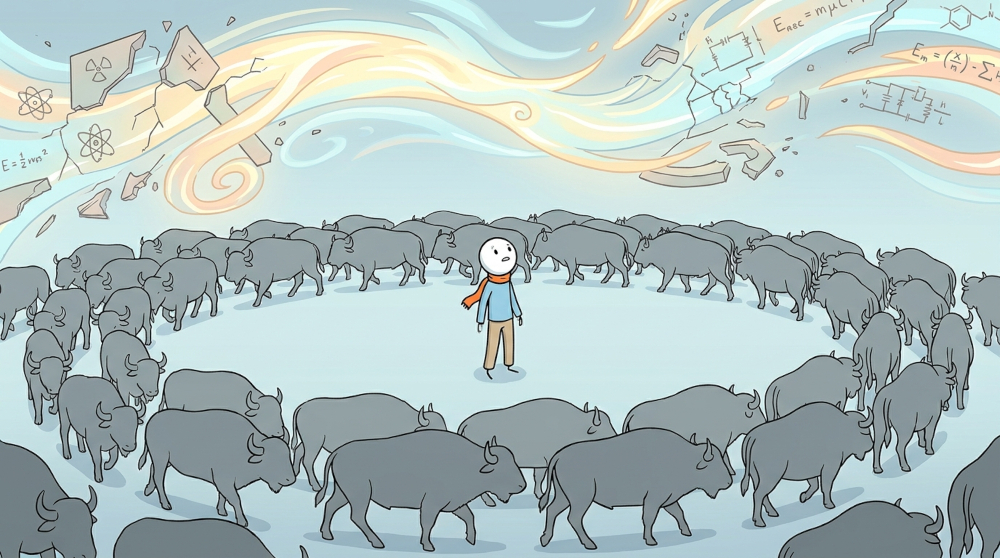
So how do I convince you that this reality is real. How do I turn your gelatin into bedrock. And more importantly, is that something you even want? Most people, whether they admit it or not, are perfectly content in the middle of the herd. They would rather stare at the buffalo next to them, admire its backside, endure its burps, and politely ignore whatever other fragrant contributions it makes to the atmosphere, than look up at the sky or out at the open field. The edge of the herd is terrifying. The edge is where you can see things. The edge is where you might have to make decisions. The edge is where you might have to think.
The herd never tells you this secret but every buffalo in it is always trying to get deeper into the middle. They want to be surrounded by warm bodies and familiar smells. They want to feel safe even if the price of safety is a lifetime of listening to digestive noises. So how do I prove anything to you when we are all in this cozy stampede together.
Perhaps the only way is to tempt you. To appeal to your greed. To whisper to your naughty human nature. If you could create even a tiny bit of magic for yourself, a little personal bedrock inside your gelatin, you might begin to believe. And once you believe even a little, you might want more. You might try harder. You might begin to wonder why the world works the way it does and whether you can make it work differently.
I think it was Nietzsche who said he trusted humanity to eventually do the right thing only because he knew humanity had a darker side. Something like that. The point is that your greed might be the key to your enlightenment. If you get something you want through means that consensus reality insists are impossible, you will start asking questions. And once you start asking questions, the herd becomes a little less comfortable.
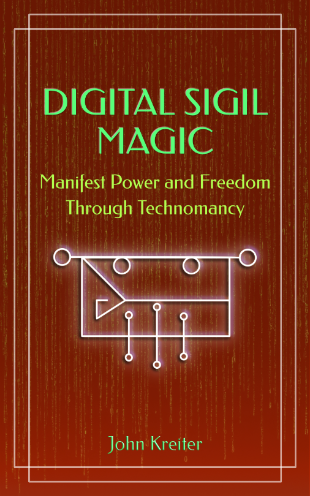
So let me suggest a delightful experiment. Combine the modern with the ancient. Mix the insanity of old magic with the power of modern technology. Try technomancy in the form of digital sigil magic. That is the name of my book… Digital Sigil Magic. Try the techniques. See if anything happens. And if something does happen, ask yourself why. Could it be that Heisenberg was right. Could it be that everything is about collapsing the wave function. Could it be that carbon is not a tiny marble flying through space but something you are shaping out of the great sea of energy around you.
To become magic you must start making magic. And this may be a good way to begin. If nothing else it will give you a story to tell the buffalo next to the while it burps in your ear.
And if reality only collapses into shape when you pay attention to it, then maybe sanity is nothing more than choosing what to look at. So try looking at something you actually want. Try paying attention to a different possibility. If the universe responds, you may have to ask yourself a very uncomfortable question. Does that make you insane or does it make you the first buffalo in the herd who finally bothered to lift its head and notice the horizon.
Recommended Reading
Ready to bridge the gap between ancient ritual and digital innovation? Discover practical frameworks to bend consensus reality using modern tools.
Digital Sigil Magic: Manifest Power and Freedom Through Technomancy
Get the Book on Amazon







Leave a Reply