
Look around you. The frustration you feel, the patterns you can’t seem to break, the constant cycle of trying to change your life only to end up back where you started; these are just symptoms. The real battle is happening at a level most people don’t even know exists. Beneath the surface of daily life lies a forgotten concept: a meta-structure that quietly governs our consciousness, our attention, and our very identity. This deep dive takes you on a journey through the fringes of human understanding, weaving together the secrets of ancient sorcerers, the implications of modern AI, and the chaotic nature of true freedom. It forces you to question the invisible rules you’ve been playing by and exposes why mainstream self-help keeps you running in circles. If you are ready to stop managing the effects of your reality and start understanding the architecture that creates it, step inside. The door is open, but be warned: once you look behind the curtain, there is no going back.
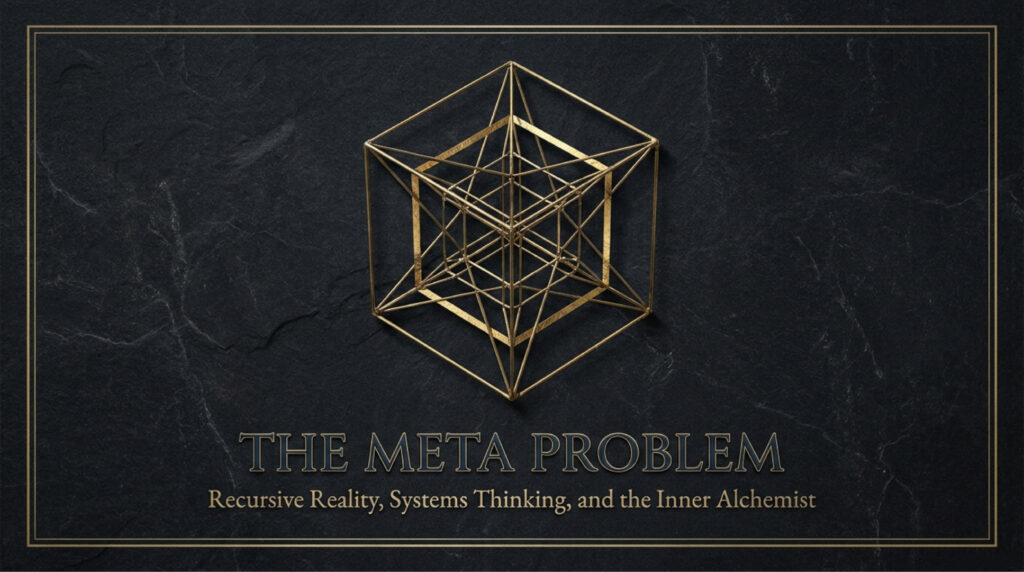
The Meta Problem: Why Reality Is Built Like a Hall of Mirrors
Modern people have an almost pathological love for straight lines. We adore them with a desperate, almost childlike fervor. Our world is constructed from them. We build flowcharts to map our ambitions and timelines to cage the relentless march of time itself. We slice reality into neat little segments of cause and effect as though the universe were a tidy spreadsheet designed by a profoundly nervous accountant suffering from a caffeine addiction and an unhealthy, obsessive relationship with color-coded tabs.
First this happens.
Then that happens.
And then because of that one specific thing, this other predictable event occurs.
The human mind craves linearity because it is comforting. It provides the soothing illusion that reality behaves like a reliable train schedule, always arriving on time at its designated station… instead of an exploding jazz performance conducted by a committee of drunk octopi in zero gravity.
But as you push deeper into the examination of existence, things become stranger and more fluid. Reality is not truly linear. It refuses to be tamed by our desire for order. It is meta structured. And the failure to comprehend this fundamental truth creates what I call the meta problem.
What Is Meta?
The word meta is used with lazily in modern culture. People toss it around to mean self-referential, ironic, or somehow detached and superior to something else. But that is not the definition I am using here.
In the context of consciousness, sorcery, manifestation, psychology, systems theory, language, and reality itself, meta refers to the structures that shape other structures.
A meta act is an act performed on a piece of a system in order to alter the behavior of the whole.
That is the key.
Not above.
Not superior.
Not detached.
Interwoven.
A meta structure is not sitting on top of reality like a king on a throne. It exists as part of a simultaneous gestalt where all structures influence one another continuously.
The modern mind asks its favorite question:
Which came first, the chicken or the egg?
The meta perspective offers a radically different answer. Neither. Both emerge from a larger system of simultaneous conditions that make their existence possible. The chicken depends on the egg for its birth. The egg depends on the chicken to be laid. Both depend on genetics. Genetics depend on environments. Environments depend on ecosystems. Ecosystems depend on astronomical stability. Astronomical stability depends on forces born in the hearts of distant stars. Stars depend on earlier cosmic conditions…
And around and around it goes, a dizzying spiral until one realizes the universe resembles less a straight line and more a multidimensional spider web designed by a mathematically unstable deity with a fondness for recursion. Reality is layered, but not vertically like floors in a building. Reality is recursively layered like a coral reef in shifting tide: full of recognizable shapes that only pretend to be separate before dissolving back into the same living flow.
A gestalt is less like a coral reef during a tide shift: thousands of creatures, currents, colors, and chemical exchanges, all distinct enough to point at but impossible to separate without ruining the whole shimmering circus. Everything blends into everything else, the boundaries mostly existing for the convenience of creatures who like labeling things… humans, for example.
The Illusion of Sequential Reality
Human beings perceive time sequentially because our nervous systems are wired to process experience in discrete slices. We live through moments one after another, so we mistakenly assume reality itself is fundamentally sequential.
But many systems are actually simultaneous in their operation. Language provides a perfect example. When you hear a sentence, your brain processes it word by word, yet meaning does not emerge from the individual words alone. Meaning blossoms from the relational structure between all the words at once.
The meaning of that very first word can be entirely reshaped by the final word you hear. The final word gains its full significance from the context provided by the first one. Context continuously rewrites interpretation in real time. The structure behaves meta-relationally.
Your own mind functions this way as well. A feedback loop of pure existence. Your beliefs shape your emotions, which then shape your perception of events. That perception shapes where you direct your attention, and your attention determines what you encode into memory. Finally, your memories turn around and reinforce or reshape your original beliefs.
This is not linear causality. This is recursive causality in a complex system. And once this truth sinks into your bones, the entire idea of manifestation, sorcery, psychology, identity formation, and even artificial intelligence starts to look very different indeed.
The Meta Problem
The meta problem emerges with frustrating clarity when people attempt to solve a problem directly while completely ignoring the structures that generate the problem in the first place.
Most human beings spend their lives attacking symptoms. Very few choose to alter systems.
A person might say I want confidence. So they attempt to behave confidently, practicing speeches and forcing a smile. But true confidence is not merely an outward behavior. It emerges from deeply interconnected systems: biology, memory, social conditioning, emotional reinforcement, identity structures, attention patterns, internal language, and embodied experience all woven together into a single complex whole.
Trying to force confidence directly while ignoring these systems is like attempting to improve a tree by yelling motivational phrases at a leaf.
The leaf is not the system.
The meta act is the act of altering those deep structures that generate the desired outcome in the first place. This is why profound transformation often appears indirect on the surface.
You improve sleep.
The mind becomes clearer.
Clarity improves emotional regulation.
Emotional regulation improves social interaction.
Social interaction improves self image.
Self image improves confidence.
One alteration reshapes the whole.
Complex systems behave this way constantly.
Chaos mathematics demonstrates that even tiny alterations in initial conditions can produce radically different outcomes over time. Small structural changes ripple outward through interconnected networks like a stone dropped into a still pond. Reality is astonishingly sensitive to relationship, and this principle is precisely why ancient sorcerers obsessed so relentlessly over power. Power as structural influence.
Meta Structures and Artificial Intelligence
Oddly enough, modern artificial intelligence provides one of the clearest and most sophisticated examples of meta structuring ever invented by humankind. Consider the task of creating a brilliant software program using a Large Language Model. The linear thinker approaches this problem with simple brute force: write one prompt, get one output, then manually fix any problems that arise. It is slow, tedious, and limited and linear.
But the meta thinker immediately sees the hidden architecture beneath the surface. Why use one intelligence process when multiple interconnected processes can recursively improve one another? This is the very foundation of agentic systems.
One model plans the strategy. Another critiques the plan for flaws. A third rewrites the code for efficiency. A fourth fact-checks all data points. A fifth optimizes style and user interface. A sixth simulates the end-user experience to predict reactions. A seventh monitors logical consistency throughout the entire process.
The result is not simply additive. It becomes emergent.
The system begins producing outputs of a quality no single isolated process could reliably generate alone. This is meta layering in action, pure and simple.
What is fascinating is that modern technology is accidentally rediscovering something ancient traditions understood intuitively for millennia. Transformation rarely occurs through isolated effort. It occurs through orchestrated structures.
The magician creates rituals, the monk creates disciplines, the psychologist creates behavioral systems, the programmer creates agents, and the alchemist creates symbolic architectures. Different costumes for the same fundamental principle. All are attempts to alter the structures that generate reality.
The modern world calls this agentic architecture. Ancient sorcerers called it hunting power. Frankly, the only real difference is that modern people use APIs while ancient mystics used incense and stared dramatically into caves for concerning lengths of time.
The Sorcerer’s Dilemma
This line of thought leads directly to one of the oldest and most persistent magical questions imaginable. Do you pursue the thing you want directly? Or do you upgrade yourself first so that getting what you want becomes far easier? At first glance, upgrading yourself seems obviously superior. If you become stronger, wiser, more disciplined, more focused, and more perceptive, then surely acquiring everything else becomes easier.
And this is absolutely true, but the path contains a subtle trap. Because there is no upper limit to self-improvement. A person can spend decades endlessly preparing for life without ever truly entering it.
Ancient sorcerers understood this problem intimately because they lived with it every single day. Many pursued power obsessively. They cultivated energy, performed rituals, expanded perception, mastered concentration, and built psychic resilience. But some became tragically trapped by the very power they sought.
They became so fascinated with increasing their capability that they forgot the purpose that capability was meant to serve in the first place. A swordsman may sharpen his blade forever and still never leave the house to face a real battle. Meanwhile reality continues moving forward, indifferent to your preparation.
Enemies gather strength. Time passes without mercy. Bodies age. Civilizations collapse under their own weight. Taxes continue arriving with the demonic inevitability of cosmic entropy.
One must therefore understand the meta structure of power itself. Power is not the final goal.
Freedom is.
Hunting Power
Ancient systems of sorcery often described self-transformation as acquiring power or hunting power, and this was not merely a metaphorical turn of phrase. Power referred to an increased capacity to influence perception, emotion, attention, energy, behavior, and one’s very experience of reality itself.
The methods varied wildly across cultures and centuries, but the underlying mechanics were remarkably similar in their application. They all relied
Focused attention.
Repetition.
Symbolic reinforcement.
Emotional intensity.
Visualization.
Embodied ritual.
Identity restructuring.
The forms changed with culture, but the mechanics remained constant. One sorcerer used chants to focus the mind. Another used sigils as a symbolic anchor. Another used meditation to quiet internal noise. Another used guided visualization or specific movements like dance or martial arts. Some even practiced controlled dreaming.
Underneath all of these varied techniques was the same core principle: attention reorganizes reality. At minimum, it reorganizes personal reality, and that is extraordinarily important because human beings do not interact with objective existence directly. We interact only with our interpreted version of existence, filtered through our senses and our mind.
The nervous system filters reality continuously, deciding what to let in and what to block out. What you repeatedly focus on becomes neurologically reinforced. The pathways get stronger. What becomes reinforced becomes perceptually dominant in your world. And what becomes perceptually dominant begins shaping your behavior without your conscious knowledge. That new behavior reshapes your circumstances, which then reshapes your identity over time. Again we see it: recursive systems and meta structures at work behind the scenes of your life.
Manifestation and Neural Sorcery
Take the classic example from neurolinguistic programming often called the swish pattern. The idea seems simple on the surface. A negative emotional pattern is interrupted and replaced repeatedly with a desired emotional state or symbolic image until the new response becomes automatic.
But beneath that simple description, something far more interesting and powerful is happening. Attention is being forcibly redirected away from old pathways. Associative networks in the brain are being rewired. Emotional energy is being reassigned to new thoughts. Identity structures are being subtly but fundamentally altered. The old neural pathway weakens through disuse. The new pathway strengthens with every repetition.
The Swish Pattern: a rapid perceptual shift technique where an unwanted mental image is replaced by a preferred one before your brain has time to argue about it.
Neurons that fire together wire together, as modern neuroscience likes to say, while conveniently pretending ancient mystics had not already stumbled onto suspiciously similar conclusions thousands of years ago while hallucinating beside campfires.
As your focus accumulates in a specific direction, the very structures of possibility begin changing around you. New opportunities appear where there were none before. Synchronicities increase in frequency and meaning. Your behavior shifts subtly but significantly. Your perception alters to notice new things. Different decisions emerge from your clearer state of mind. Eventually, entire life trajectories can change course.
Was this magic? Psychology? Manifestation? Neurology? The answer is irritatingly meta: yes to all of them.
The Inner Alchemist
The modern inner alchemist differs from many older models of sorcery in one important and crucial respect. The focus is not on domination. It is on liberation.
Older sorcery houses often became trapped by their obsession with material power, status, control, influence, and acquisition. But the deeper realization is that an obsession with power can itself become another prison, perhaps even more confining than the one you started in.
The inner alchemist seeks just enough stability to escape perpetual survival mode. This is where something like Maslow’s Hierarchy of Needs becomes vitally important.
Maslow’s hierarchy of needs is the idea that humans grow through layers of motivation, starting with basic survival and moving toward meaning. At its simplest:
- Basic needs — food, water, safety
- Social needs — belonging, connection
- Esteem needs — feeling valued
- Self‑actualization — becoming your fullest self
The core idea: you’re more likely to chase purpose and creativity once your body and life feel secure.
A starving person cannot meditate effectively on transcendence because hunger keeps hijacking their attention every twelve seconds. A person drowning in chaos cannot sustain deep internal work because the need for basic survival consumes all available cognitive bandwidth. Therefore, the inner alchemist attempts to establish stability first and foremost.
Enough safety.
Enough resources.
Enough autonomy.
Enough peace.
Not infinite wealth or endless accumulation, just enough structural support to reclaim attention from the demands of mere existence.
Because attention is the true currency of this world. Where attention goes, reality reorganizes itself in response. It is a principle as old as thought itself.
Escaping the Matrix
The metaphor of the matrix appears in so many traditions because human beings instinctively recognize these systems of invisible conditioning that shape our lives. Social systems, economic systems, psychological systems, ideological systems, and emotional systems all operate around us. Most people exist inside these structures their entire lives without ever consciously examining their walls or bars.
Ancient traditions personified these controlling forces as demons, archons, spirits, cosmic jailers, the con, or the illusion builders. Modern language uses different terms like conditioning, systems theory, propaganda, consumerism, algorithmic influence, trauma loops, and behavioral engineering. It is all different language describing the exact same phenomenon.
The inner alchemist seeks freedom from unconscious structural control. Not through fantasy or denial of reality, nor by abandoning the world entirely into some spiritual nirvana. But through a conscious relationship with attention, identity, emotion, perception, and energy.
The goal is not to gain infinite power inside the cage. The true goal is understanding the cage well enough to stop mistaking it for the whole universe. You must see the bars for what they are before you can learn how to walk through them.
The Final Meta
And this finally brings us to the deepest meaning of meta. A meta act is the act of improving one piece in order to transform the whole system. A person upgrades their perception to alter their behavior. They alter their behavior to reshape their identity. And they alter their identity to fundamentally change their destiny.
A civilization improves its methods of communication and accidentally transforms the consciousness of every citizen. A programmer improves prompts and accidentally creates emergent intelligence systems that think for themselves. A sorcerer disciplines their attention and in doing so, accidentally reshapes their very experience of reality itself.
Everything influences everything else. Nothing exists independently or in a vacuum. Reality is not a ladder you climb one rung at a time. It is a living network of simultaneous relationships continuously generating one another in an endless dance. And this means something both terrifying and beautiful for every human being.
Every small act matters.
Every moment of focus matters.
Every repeated thought matters.
Every structure contributes to every other structure without our consent or knowledge!
The old sorcerers knew this, although they wrapped it in enough symbols and cryptic language to make it sound as though enlightenment required surviving a theatrical scavenger hunt designed by sleep-deprived circus clowns.
The modern world is rediscovering the same profound truth through neuroscience, systems theory, artificial intelligence, and complexity mathematics. The names change with each generation. The underlying principle remains eternal.
To change reality, one rarely attacks reality directly. One alters the structures that generate it.
That is the meta.
And perhaps the strangest part of all is this: The moment you truly understand the meta problem, you begin realizing that the person attempting to change reality is also a vital part of the reality being changed. You cannot stand outside the system to fix it. The observer is inside the system. Which means the final upgrade was never merely the world around you. It was always and only you.
Addendum: The Tightrope of Awareness
But do hold this thought close to your heart, for it is the cornerstone of true understanding:
Do not become trapped inside a single layer of the structure. That was the great folly that consumed many of the old sorcerers.
They became utterly obsessed with power for its own sake, a pursuit as hollow as an echo in a vast cavern. Their existence devolved into endless struggles for dominance, a ceaseless war against shadows. Endless rituals were performed not for wisdom but for more strength, more influence, more control over the levers of reality itself.
In many ways it was simply a far more theatrical and dangerous version of keeping up with the Joneses, except instead of buying a slightly larger lawn ornament they were attempting to bend reality itself into increasingly elaborate pretzel shapes. The sheer spectacle was mesmerizing but ultimately meaningless. And so many of them forgot the point entirely. As Plato wrote (and as Socrates bombastically explained to anyone who would listen) they chased the shadows on the cave wall and somehow managed to overlook the rather obvious sun blazing outside.
Attention is limited. Time is limited. Energy is limited, a finite resource that cannot be manufactured from nothing.
A human life is astonishingly short when measured against the size of existence. You only possess so much focus, so much emotional energy, so much awareness to direct toward the structures of your reality. Be extremely careful where you place it, for it is the seed of what will grow within you.
Because attention feeds systems. What you repeatedly energize begins to shape you in return, molding your very consciousness into its image. This is why understanding the meta structure is so important. Reality is not made of isolated pieces sitting neatly beside one another like canned soup on a supermarket shelf. It is a gestalt of interconnected existence, a living conglomeration of energy where every thread affects the whole. Everything participates in everything else.
The chicken does not merely come from the egg, nor does the egg merely come from the chicken. Both arise simultaneously from a deeper relational structure that allows both to exist at all. Once you begin to see reality this way, with your eyes opened to its true, intricate nature, everything changes. You stop trying to force isolated outcomes and begin working on the structures that generate those outcomes in the first place.
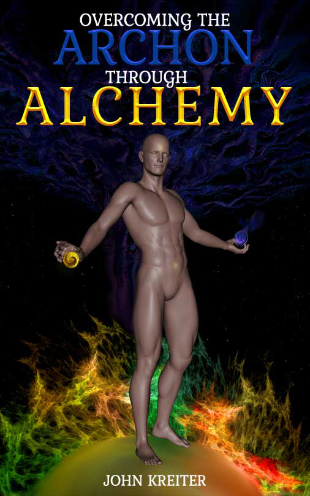
You stop obsessing over symptoms and begin altering systems from their very root. You stop asking only how to gain power and begin asking what that power is actually for, questioning its purpose with ruthless honesty. This is why my books are structured the way they are, each one a stepping stone on a longer path.
Each layer supports the next. Each technique feeds the others like streams converging into a river. Each piece of the system strengthens the whole until it becomes an unshakeable fortress of awareness. The meta structure itself is part of the teaching, not just the container for it.
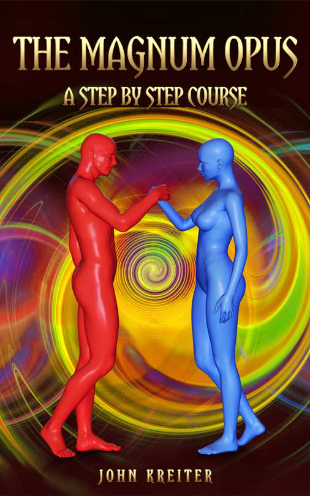
In my book The Magnum Opus, the early stages focus heavily on the acquisition of energy, attention, discipline, visualization, emotional control, and internal power. This is done not because power itself is the final goal, but because power without direction is useless, a rudderless ship in a storm, and direction without energy is impossible.
- First you learn to stop leaking energy through the cracks of distraction and fear.
- Then you learn to gather it, drawing it into your core the way a star pulls its own fire together, brightening not by taking in light but by becoming the place where it’s made.
- Then you learn to direct it with precision toward the realities you wish to build.
- And then you learn to transform your reality with it, reshaping the clay of existence.
And ultimately, the goal is not merely comfort, wealth, influence, or even psychic ability. These are pleasant byproducts but never the destination. The goal is freedom. Freedom from unconscious systems that drive you like a puppet on strings. Freedom from emotional imprisonment in the cage of past traumas and future anxieties.
Freedom from endless reactive existence where you are merely a mirror reflecting the world’s chaos back at itself. And most importantly, freedom from the Archonic cage that keeps human beings trapped in cycles of distraction, fear, survival, and mechanical living. That is the real meta upgrade, the ultimate prize.
Not becoming stronger merely to dominate the game, but becoming aware enough to stop being consumed by it entirely. To see the board, to see the players, to see the rules, and then to choose whether or not to play. And that is the tightrope every true inner alchemist must walk, balancing on a wire of pure consciousness high above the world.
You must build enough stability to survive the currents below. You need enough power to transform your own vessel. But you require enough awareness to remain free from the intoxicating lure of control. And all the while you must do it without forgetting why the journey began in the first place: for liberation, not for another, more ornate prison!
Recommended Reading
Continue your structural transformation and dive deeper into reality architecture with the definitive guide.
Read: The Magnum Opus, A Step by Step Course



Leave a Reply